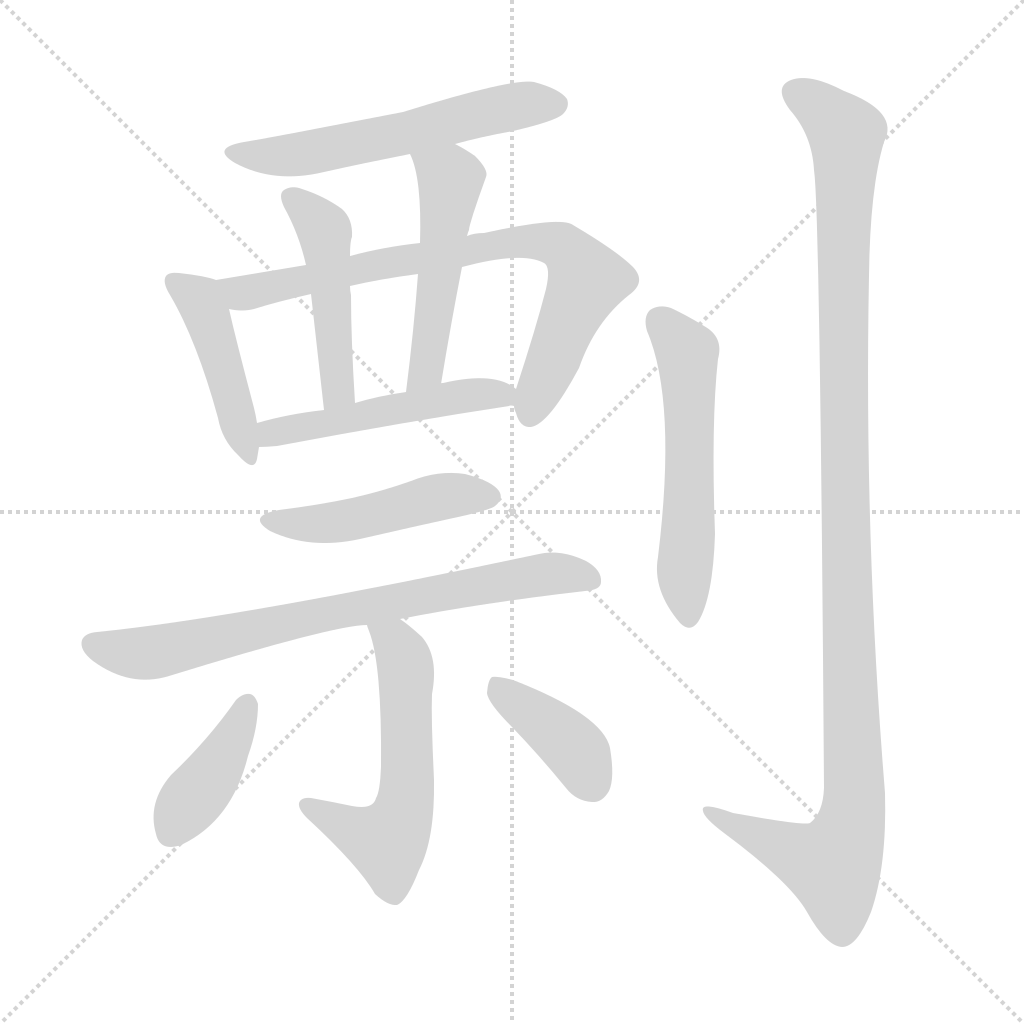
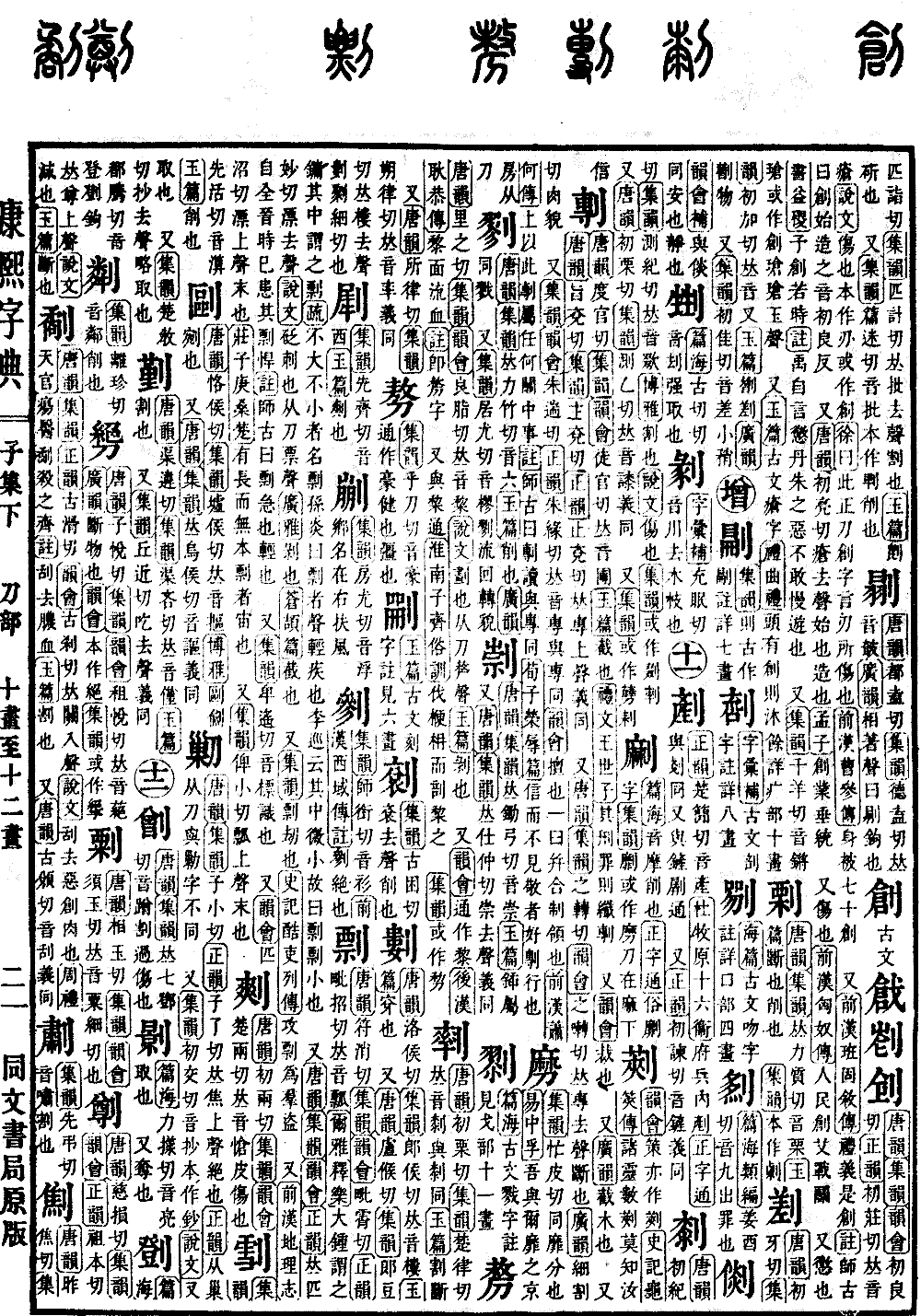
Zi Collection, Page Position: Lower
Radical: Knife (dāo)
piāo; Kangxi Stroke Count: 13; Page 143, Entry 33
Pronunciation fú xiāo qiè (from Tang Yun); pí xiāo qiè (from Jiyun and Yunhui); pí zhāo qiè (from Zhengyun), pronounced the same as "piáo".
"Great bells are called yōng, and medium-sized bells are called piāo." — Er Ya, Explaining Music
Annotation: Bells that are neither large nor small are called piāo. Sun Yan says: piāo refers to a quick and rapid sound. Li Xun says: it is medium and slightly small, hence called piāo. Piāo means small.
Also, pí miào qiè (from Tang Yun, Jiyun, Yunhui, Zhengyun), pronounced the same as the departing tone of "piāo".
"To prick and treat illness with a stone needle." The character's form combines "knife" and the sound "piāo". — Shuowen
Means to peel. — Guang Ya
Means to cut off. — Cang Jie Pian
Also, jié lüè (from Jiyun), meaning to plunder.
"Attacking and plundering, they became a band of robbers." — Shi Ji, Biographies of Cruel Officials
Also, "Since the time of the complete Jin state, there has been anxiety about the fierce and impetuous people there." — Qian Han, Treatise on Geography
Annotation: Shigu says: piāo refers to being hasty and rash.
Also, yáo qiè (from Jiyun), pronounced the same as "biāo", meaning to discern.
Also, pǐ zhǎo qiè (from Yunhui), pronounced the same as the entering tone of "piāo", meaning the end.
"That which has length but no beginning or end is called zhòu." — Zhuangzi, Geng Sang Chu
Also, bǐ xiǎo qiè (from Jiyun), pronounced the same as the rising tone of "piáo", meaning the end.