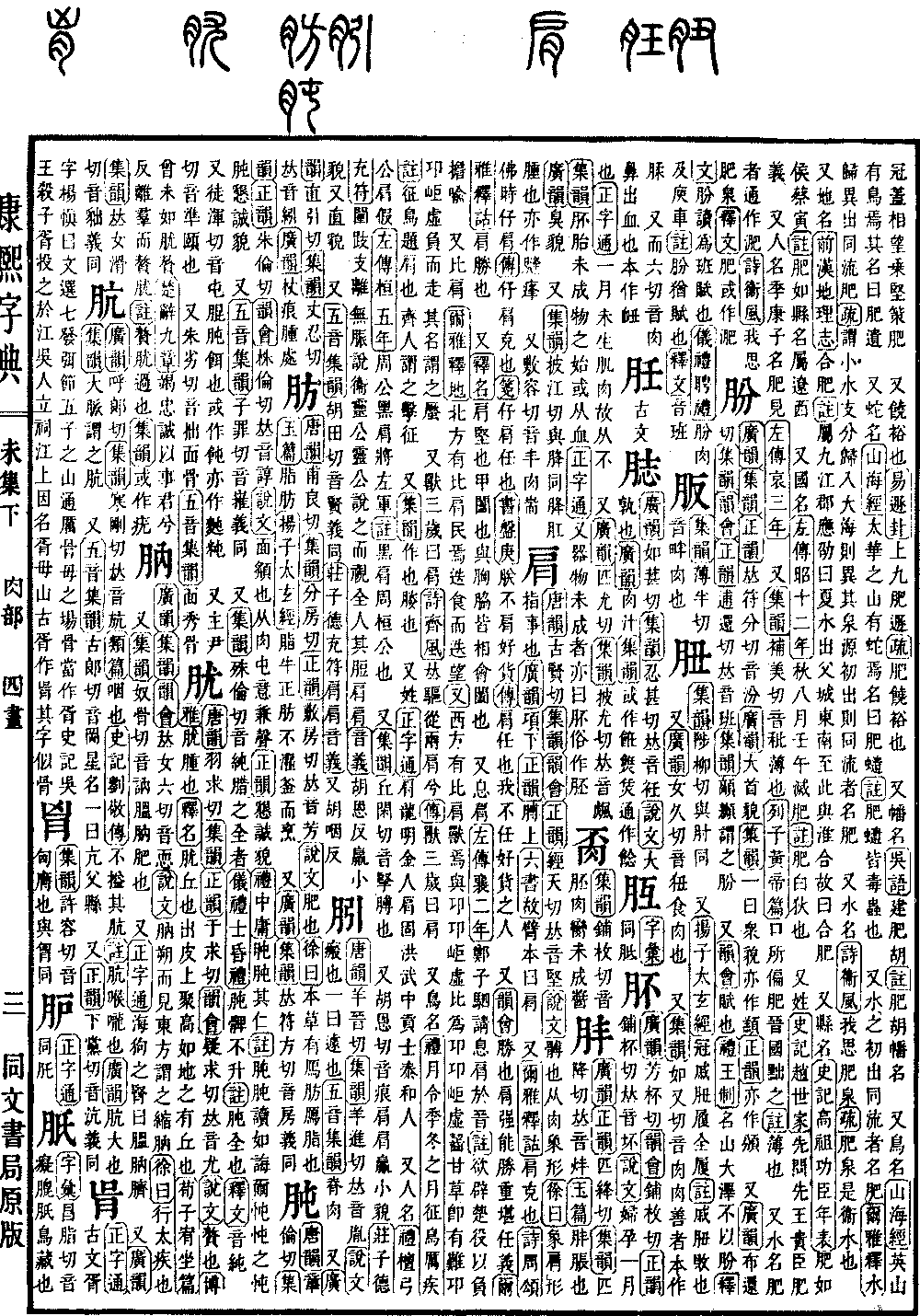
Wei Collection, Lower Volume
Radical: Meat (ròu)
Kangxi Strokes: 10
Page 975, Entry 10
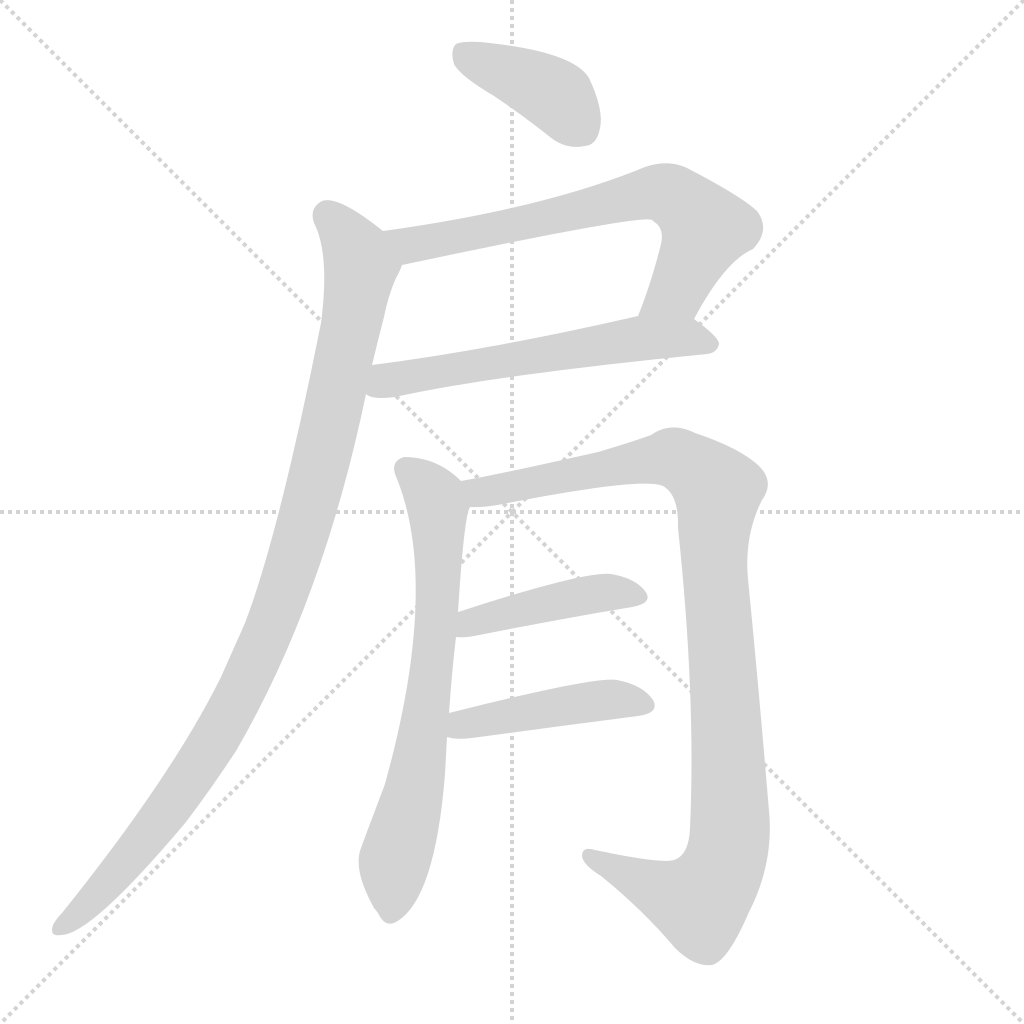
Pronounced jian.
According to the Explaining Graphs and Analyzing Characters (Shuowen Jiezi), it is the shoulder blade. Derived from the radical for meat, it is a pictographic character. Xu states that it resembles the shape of a shoulder and is a character that indicates a concept.
According to the Broad Rhymes (Guangyun), it is the area below the neck.
According to the Correct Rhymes (Zhengyun), it is above the upper arm.
According to the Six Categories of Characters (Liushu Gu), the base of the arm is called the shoulder.
According to the Approaches to Glosses in the Erya (Erya Shigu), shoulder means to be capable.
In the Book of Odes (Shijing), in the Zhou Eulogies, it says: "Bear these responsibilities." The commentary notes that to bear a responsibility means to be capable. The sub-commentary notes that this refers to a task or burden.
In the Book of Documents (Shangshu), in the Announcement of Pan Geng, it says: "I do not entrust these duties to those who love wealth." The commentary states that shoulder means to bear a responsibility; it means I do not entrust duties to those who are fond of wealth.
It also means to overcome or prevail. The shoulder is strong and able to bear weight, hence the meaning of being capable of a task. The Approaches to Glosses in the Erya states that shoulder means to overcome.
According to the Explanation of Names (Shiming), shoulder means firm, as it acts as a lid or closure; it is where the chest and ribs meet and close together.
It also refers to resting the shoulder. In the Zuo Tradition (Zuo Zhuan), in the second year of Duke Xiang, it is noted that Zisi of Zheng requested to rest his shoulder in the state of Jin. The note explains this metaphorically as wishing to avoid forced labor imposed by the state of Chu, using the burden on the shoulder as a comparison.
It also refers to shoulder-to-shoulder. The Approaches to Geography in the Erya states that in the north there are the shoulder-to-shoulder people, who take turns eating and taking turns keeping watch. Furthermore, in the west, there are shoulder-to-shoulder beasts; they are paired with the qiongqiong juxu (a mythical creature). When the qiongqiong juxu nibbles sweet grass, if there is danger, the beast carries it and runs away, and it is known as the jue (a type of magical beast).
A three-year-old beast is called a jian. In the Book of Odes (Shijing), in the Odes of Qi, it says: "Driving and following the two three-year-old beasts." The commentary notes that a three-year-old animal is called jian.
It is also a type of bird. In the Book of Rites (Liji), in the Monthly Ordinances for the last month of winter, it mentions the fierce predatory birds. The note explains that these predatory birds are known as tijiian, which the people of Qi call jizheng.
Also pronounced jian (level tone).
It also means to arise or to accompany.
It is also a surname. According to the Guide to Correct Characters (Zhengzitong), Jian Longming was a person of the Jin dynasty. Jian Gu was a tribute student from Taihe during the Hongwu period.
It is also used in names. In the Book of Rites (Liji), in the Tan Gong chapter, there is Gongjian Jia. In the Zuo Tradition (Zuo Zhuan), in the fifth year of Duke Huan, it mentions Zhou Gong Hejian leading the left army. The note explains that Hejian was Duke Huan of Zhou.
Also pronounced qian. Refers to the upper arm.
Also pronounced hen. Jianjian describes a thin, small appearance. In the Zhuangzi (Zhuangzi), in the chapter on the Perfection of Virtue, it describes a person who is deformed and lacking limbs, yet he persuaded Duke Ling of Wei. Duke Ling was pleased with him, and when he looked at a whole person, he thought their necks looked thin and small. The sound annotation for this indicates a pronunciation similar to hen. It also means straight in appearance.
Also pronounced xian. The meaning is the same.