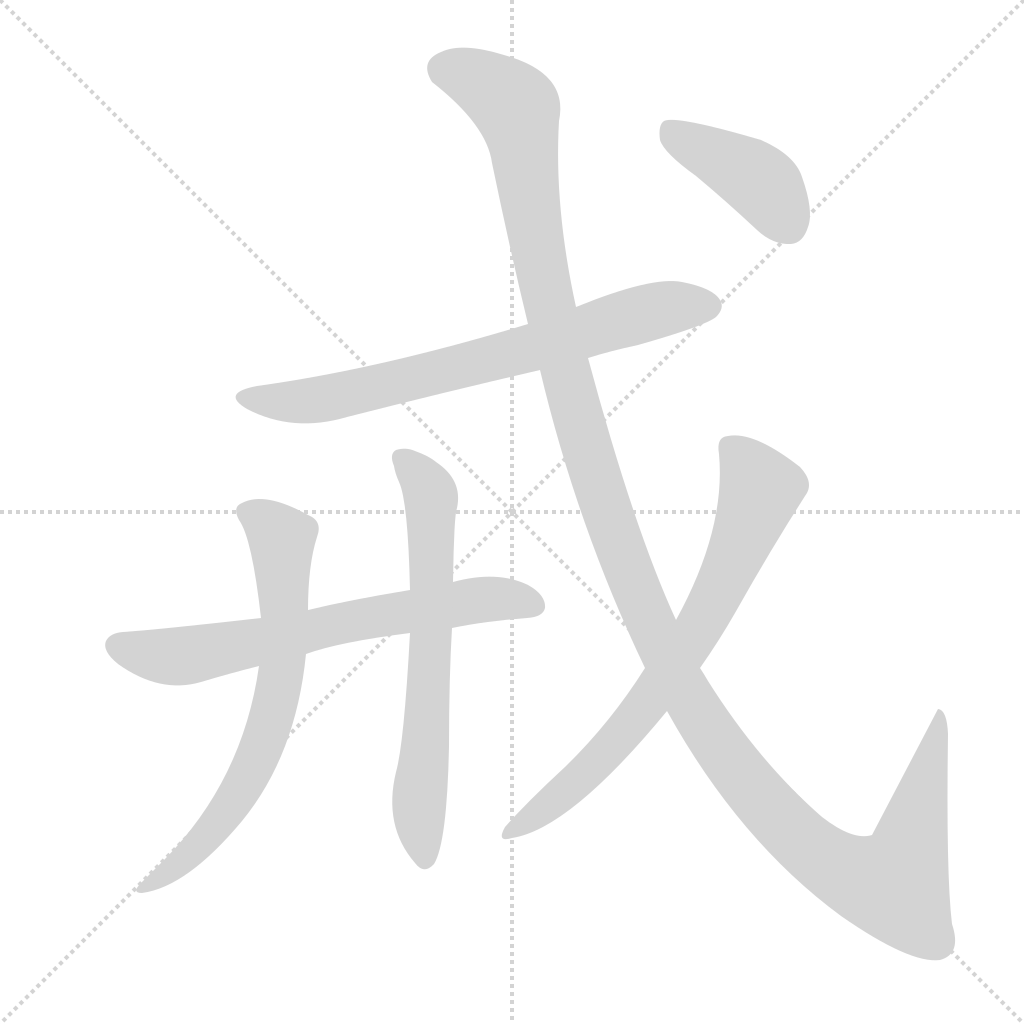
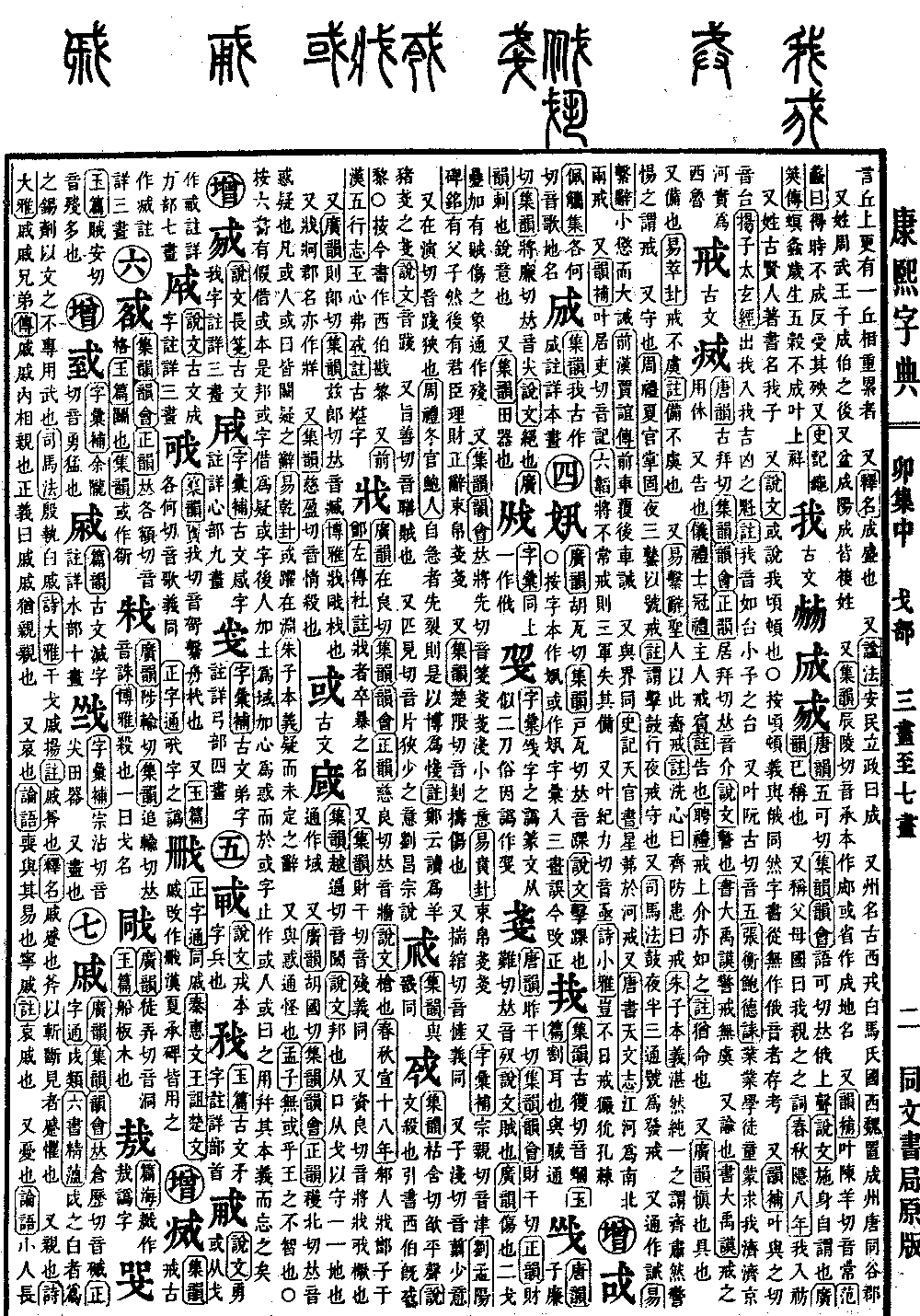
Mao Collection, Middle Volume. Radical: Halberd (gē). Kangxi strokes: 7. Page 412, Entry 05. Ancient script.
Pronounced jiè.
Shuowen Jiezi (Shuowen): To alert.
Book of Documents (Shujing): Alert and be without worry.
Also means to instruct. Book of Documents (Shujing): Instruct them with excellence.
Also means to inform. Book of Rites (Yili): The host informs the guest. Note: This means to inform. Book of Rites (Yili): Informing the chief attendant is the same. Note: This means to command.
Also, from Guangyun: To be cautious, to be equipped.
Also means to prepare. Book of Changes (Yijing): Prepare for the unexpected. Note: To prepare against the unexpected.
Also, Book of Changes (Yijing): The sage uses this to purify and be cautious. Note: To cleanse the heart is called purification (zhai), to prevent misfortune is called caution (jie). Zhu Xi's Commentary (Benyi): To be clear and purely focused is called purification, to be solemn and vigilant is called caution.
Also means to guard. Rites of Zhou (Zhouli): At night, sound the three drums to issue a defensive warning. Note: This refers to beating drums during the night to signal the guard.
Also, Sima Fa: The drums beat three times at midnight, which is called the morning warning.
Also commonly written as the variant form (jiè). Book of Changes (Yijing): A small punishment leads to a great warning. History of the Former Han (Qianhan): If the leading cart overturns, the following carts take warning.
Also synonymous with boundary. Records of the Grand Historian (Shiji): The star faded at the river boundary.
Also, Book of Tang (Tangshu): The Yangtze and the Yellow River serve as the northern and southern boundaries.
Also, from Yunbu: Rhymes with ji (rising tone). Six Secret Teachings (Liutao): If the general is not always vigilant, the three armies lose their readiness.
Also rhymes with ji (rising tone). Book of Odes (Shijing): Why do we not alert ourselves daily, the Xianyun are very urgent.
Textual research: In Book of Changes (Yijing), the text originally read purification (zhai) and caution (jie). The original text was corrected from zhai to qi. In Sima Fa, the text originally read issue warning (fa jie). The original text was corrected from fa jie to morning warning (chen jie).