Zi Collection, Middle Volume
Radical: Person (rén)
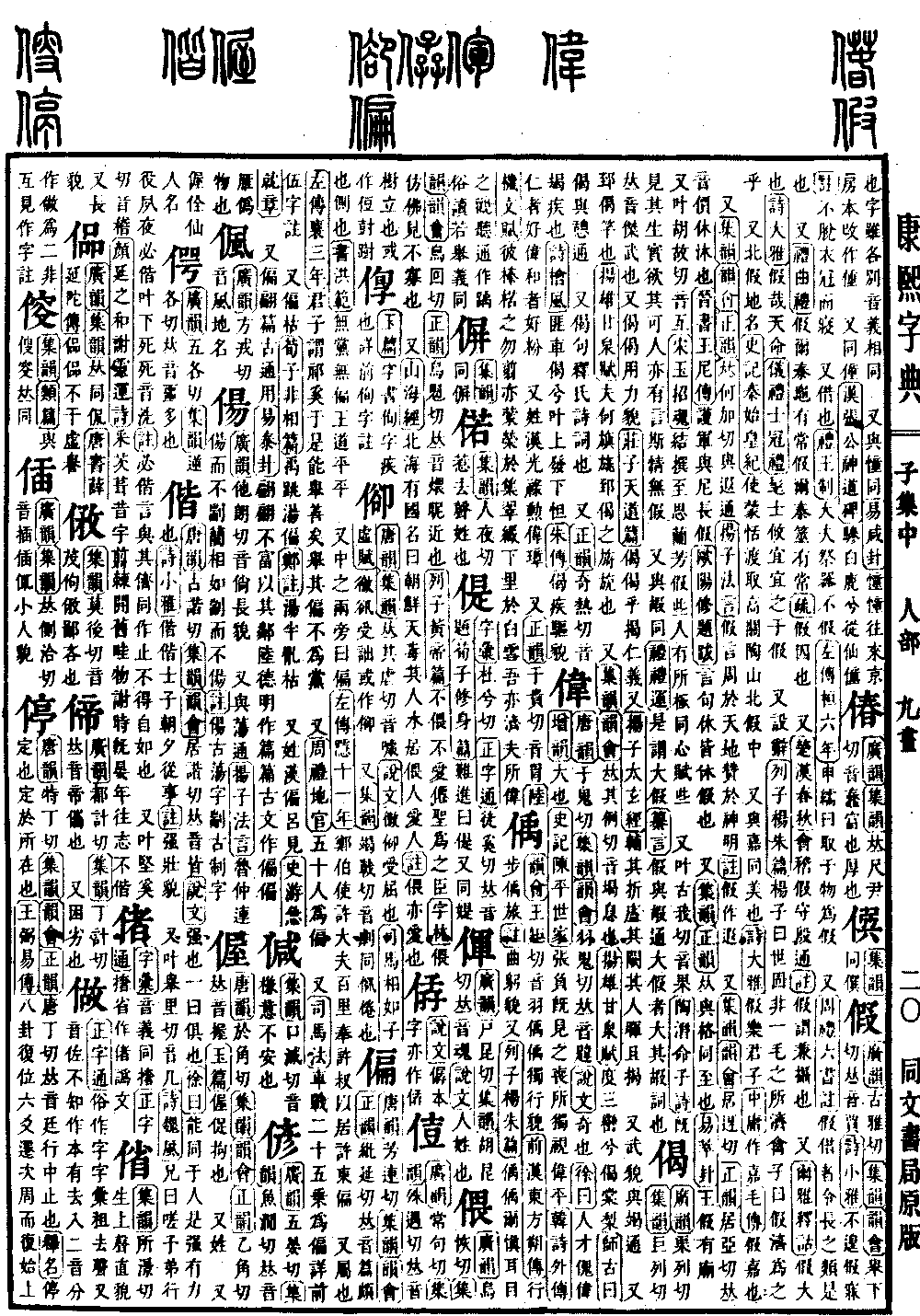
Page 110, Entry 03
Pronounced jia (falling tone).
Book of Odes (Shijing), Lesser Odes: Do not have leisure to sleep without undressing.
Commentary: To sleep without removing clothes or hat.
Also means to borrow.
Book of Rites (Liji), Royal Regulations: An official shall not borrow sacrificial vessels.
Zuo Tradition (Zuozhuan), Sixth Year of Duke Huan: Shen Ru states that taking items for use from others is called borrowing.
Rites of Zhou (Zhouli), Notes on the Six Writings: Phono-semantic borrowing refers to characters like ling (magistrate) or zhang (chief).
Also, Book of Rites (Liji), Songs of the Rites: There is an established rule for borrowing this great tortoise shell; there is an established rule for borrowing these great stalks of yarrow.
Sub-commentary: To borrow means to rely upon.
Also, Chu-Han Spring and Autumn (Chu Han Chunqiu): Yin Tong was the acting administrator of Kuaiji.
Commentary: Acting refers to holding a position on an interim or concurrent basis.
Also, Literary Expositor (Erya), Explaining Ancient Words: To be great.
Book of Odes (Shijing), Greater Odes: Great is the mandate of Heaven.
Ceremonial Rites (Yili), Capping Ritual for Scholars: A talented scholar is fit for his role, and becomes even more fit in times of greatness.
Also, a particle introducing a hypothesis.
Master Lie (Liezi), Yang Zhu Section: Master Yang said, if the world were saved by a single hair, would you do it? Qinzi replied, if it could be saved, would you do it?
Also, Beijia, a place name.
Records of the Grand Historian (Shiji), Annals of Qin Shi Huang: Sent Meng Tian to cross the river and seize the regions of Gaoque, Taoshan, and Beijia.
Also, identical to the character jia (beautiful). It means beautiful.
Book of Odes (Shijing), Greater Odes: A beautiful and happy gentleman.
Doctrine of the Mean (Zhongyong): Written as jia.
Mao Commentary: Jia means jia (beautiful).
Also pronounced xia (rising tone).
Commonly used interchangeably with the character xia (distant/far).
Yangzi, Model Sayings (Fayan): If one's words could reach the heavens and earth, they would assist the spirits.
Commentary: Jia functions as xia.
Also pronounced jia (falling tone).
Means to take leave or vacation.
History of Jin (Jinshu), Biography of Wang Ni: The Protector of the Army granted Wang Ni a long leave.
Ouyang Xiu, Colophons: Mentions the ten-day rest, which refers to taking leave.
Also, identical to the character ge (to arrive). Means to arrive.
Book of Changes (Yijing), Gathering Hexagram: The king arrives at the ancestral temple.
Also, rhymes with the sound hu (falling tone).
Song Yu, Summoning the Soul: With refined thoughts and exhausted efforts, the fragrance of orchids is deposited here. Everyone has an ultimate aspiration, and with one heart they compose poems to express their feelings.
Also, rhymes with the sound guo (falling tone).
Tao Qian, Poem on Naming My Son: Since I have seen his birth, I truly hope he becomes talented. People also speak this way, and this true emotion is not false.
Also, identical to the character gu (blessing).
Book of Rites (Liji), Evolution of Rites: This is what is called a great blessing.
Zuan Yan: Jia is interchangeable with gu. A great blessing refers to expanding upon words of benediction.