Zi Collection, Middle Volume
Radical: Person (rén)
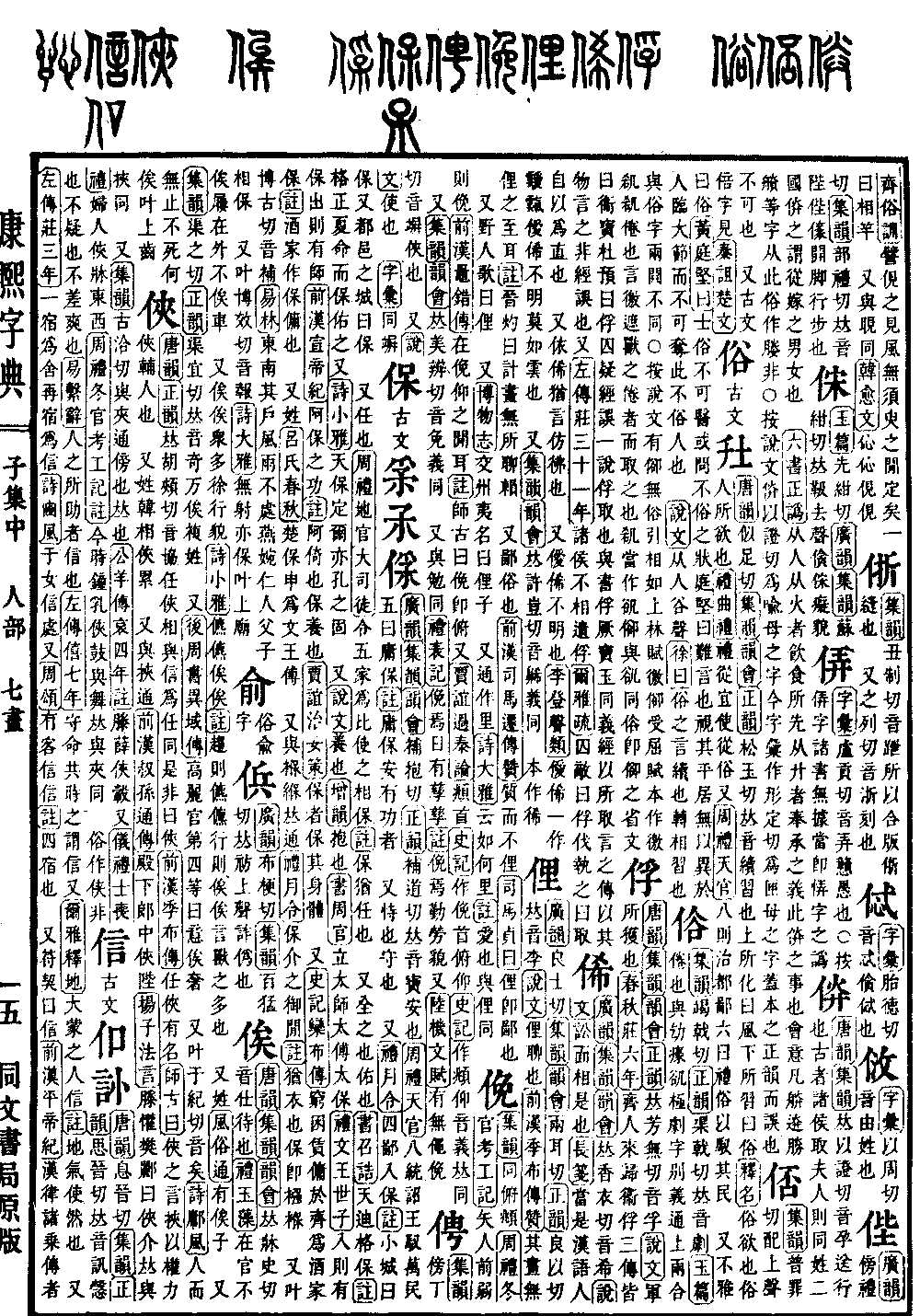
xiá; Kangxi Stroke Count: 9; Page 105
According to the Tang Rhymes (Tangyun) and Correct Rhymes (Zhengyun), the pronunciation follows the initial of hú and the final of jiá, sounding like xié. Chivalry. Mutual trust is defined as rèn, and possessing identical views on right and wrong is defined as xiá. He was famous for his chivalry — Book of Han (Hanshu), Biography of Ji Bu. Yan Shigu says: xiá means to support, referring to the use of power to help others. It is also used as a surname, such as Xia Lei, the Prime Minister of the State of Han. Furthermore, it is interchangeable with the character xié. Palace attendants stood on both sides of the throne steps — Book of Han, Biography of Shusun Tong. Yangzi's Exemplary Sayings (Fayan) uses the term xiájiè to describe figures such as Teng, Huan, Fan, and Li as being chivalrous and upright. Same as xié. According to the Collected Rhymes (Jiyun), it also has a pronunciation following the initial of gǔ and the final of qià, making it interchangeable with the character jiā, meaning the sides or both sides. The states of Teng and Xue were on either side of the wheel hub — Gongyang Commentary (Gongyangzhuan), Annotation for the Fourth Year of Duke Ai. The women stood on the east and west sides of the bed — Book of Etiquette and Ceremonial (Yili), Rites of Mourning for an Officer. In modern times, the bell bosses are located on both sides of the gǔ and wǔ sections — Rites of Zhou (Zhouli), Record of Trades, Annotation. Same as jiā. The common written form is incorrect.