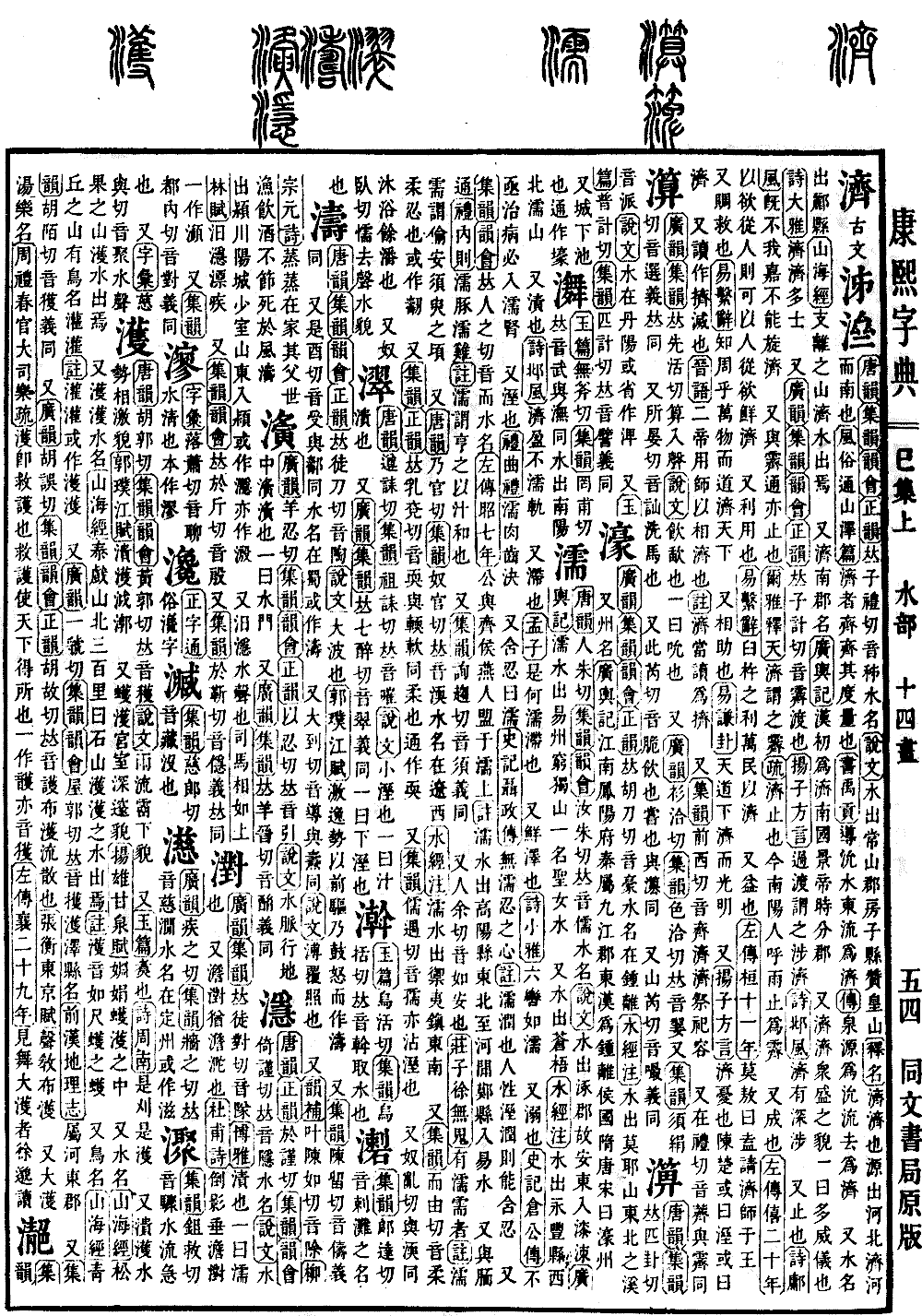
Si Collection, Upper Volume
Radical: Water (shuǐ)
Entry: Ji
Kangxi Strokes: 18
Page 656, Entry 01
Ancient form: Ji
Tang Dynasty Rhymes (Tangyun), Collection of Rhymes (Jiyun), Dictionary of Rhymes (Yunhui), Correct Rhymes (Zhengyun): Pronounced zi (rising tone).
Name of a river.
Shuowen Jiezi: The river originates from Zhanhuang Mountain in Fangzi County, Changshan Prefecture.
Explanation of Names (Shiming): Ji means to settle; the source originates in the north of the Yellow River, crosses the river, and flows south.
Customs and Traditions, Chapter on Mountains and Marshes: Ji means to align, to standardize measures.
Book of Documents (Shujing): Guide the Yan River, which flows east to become the Ji River.
Commentary: The spring source is called Yan, and as it flows away, it becomes the Ji.
Also the name of a river, originating in Li County.
Classic of Mountains and Seas (Shanhaijing): The Ji River originates from Zhili Mountain.
Also Jinan, the name of a prefecture.
Comprehensive Geography (Guangyuji): At the beginning of the Han Dynasty, it was the Jinan Kingdom; during the reign of Emperor Jing, it was divided into a prefecture.
Also jiji, the appearance of a numerous and flourishing crowd. One definition is having many dignified manners.
Book of Odes (Shijing): Dignified are the many gentlemen.
Guangyun, Jiyun, Yunhui, Zhengyun: Pronounced ji (falling tone).
To cross a river.
Yangzi: Dialect: To cross a passage is called sheji.
Book of Odes (Shijing): To cross where it is deep, one must wade.
Also to stop.
Book of Odes (Shijing): Since you do not favor me, I cannot turn back and stop.
Also used interchangeably with ji (to clear up after rain). It also means to stop.
Erya, Explanation of Heaven: Ji is called ji (to clear).
Commentary: Ji means to stop. Nowadays, people in Nanyang call the stopping of rain ji (to clear).
Also to succeed.
Zuo Tradition (Zuozhuan): To follow one's own desires at the expense of others rarely leads to success.
Also to make use of.
Book of Changes (Yijing): The benefit of the mortar and pestle allows all people to succeed.
Also to benefit.
Zuo Tradition (Zuozhuan): Mo'ao said: Why not request supplementary troops from the King?
Also to provide relief.
Book of Changes (Yijing): Wisdom encompasses all things, and the Way provides relief to the world.
Also to assist.
Book of Changes (Yijing): The Way of Heaven descends to assist, and it is bright.
Also Yangzi: Dialect: Ji means worry. In the regions of Chen and Chu, it is sometimes called shi, or sometimes called ji.
Also read as ji (to crush), meaning to destroy.
Discourses of the States (Jinyu): The two emperors used troops to crush one another.
Commentary: Ji should be read as ji (to crush).
Jiyun: Pronounced qi.
Jiji, the appearance of sacrificial rites.
Also pronounced ji (rising tone).
Used interchangeably with ji (to clear up after rain).