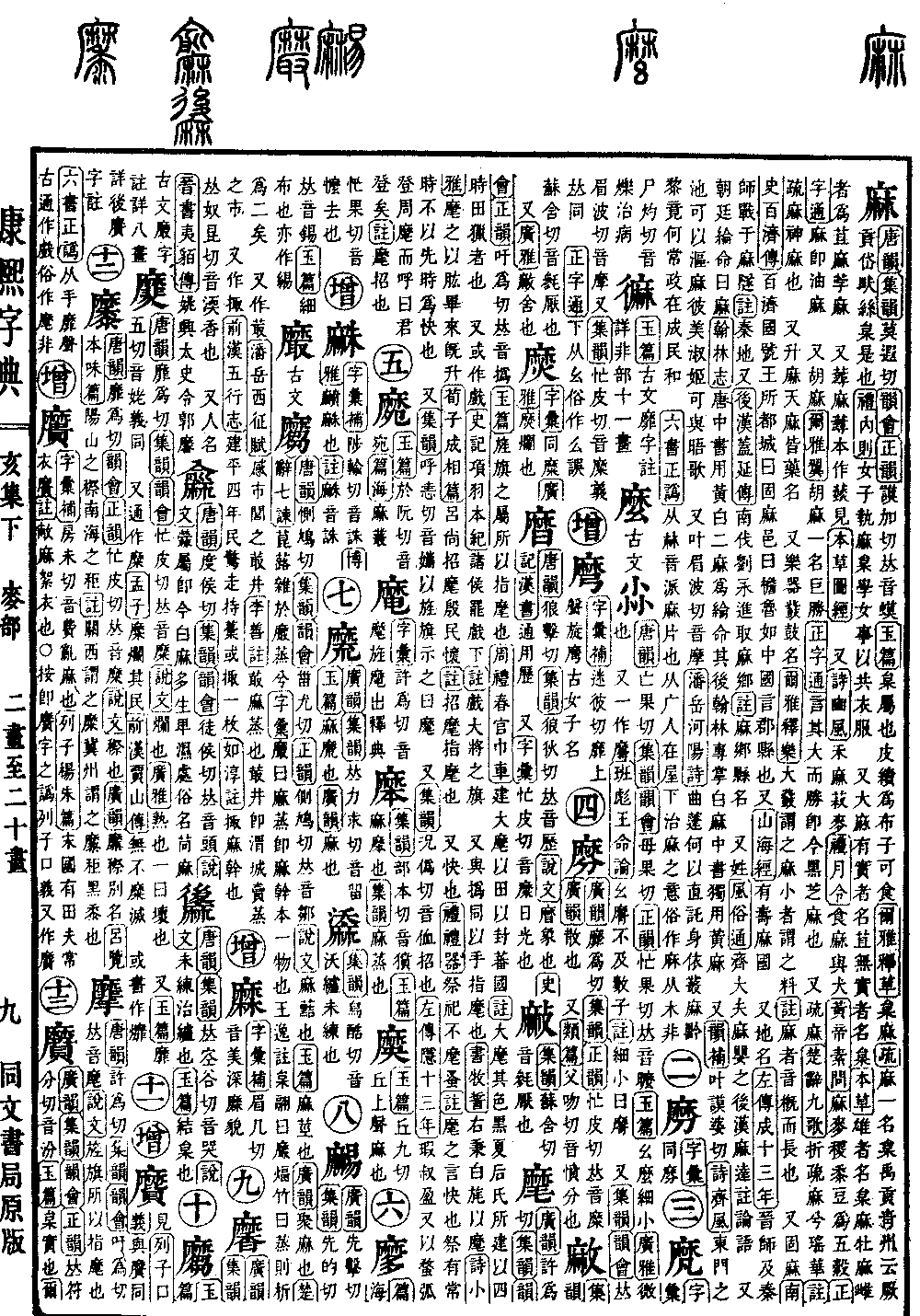
Hai Collection, Lower Volume
Radical: Hemp (má)
Kangxi Strokes: 15
Page 1515, Entry 13
Pronounced hui.
Yu Pian (Jade Chapters): A type of banner or standard, used for command.
Zhou Rites (Zhouli), Spring Officials, Carriage Keeper: Erect the great standard (da hui) to conduct a hunt and to delineate the feudal states. Commentary: The great standard, its color is black, established by the Xia Dynasty, used during the seasonal hunts.
Also written as a variant form (xi). Records of the Grand Historian (Shiji), Annals of Xiang Yu: The feudal lords withdrew from beneath the standard (xi). Commentary: Xi, the banner of a great general.
Also identical to the character meaning to gesture with the hand. Book of Documents (Shangshu), Oath at Mu: Holding a white yak tail in the right hand to signal command. Book of Odes (Shijing): Signal them with the arm, all have come and boarded the carriage. Xunzi, Chengxiang Chapter: Lu Shang signaled for the people of Yin to submit. Commentary: Zhao hui, meaning to direct or command.
Also means fast. Book of Rites (Liji), Vessels of Rites: The rites of sacrifice are not valued for being fast. Commentary: Hui means fast. Sacrifices have fixed times; one should not consider finishing early as being fast.
Also pronounced hui (falling tone). To use a banner to signal is called hui.
Also pronounced hui (falling tone). Meaning to beckon. Zuo Commentary (Zuo Zhuan), 13th Year of Duke Yin: Xia Shuying again carried the Mao Hu flag, climbed the wall, waved the flag to all sides, and shouted: The lord has ascended the wall. Commentary: Hui, meaning to beckon.
Textual Research: In Collection of Rhymes (Jiyun), the phonetic notation kuang wei results in the sound xu. Note: The Collection of Rhymes does not contain the character xu under the phonetic kuang wei, so it cannot be pronounced as xu. I have corrected xu to hui.