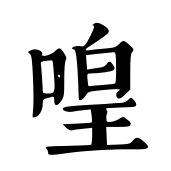
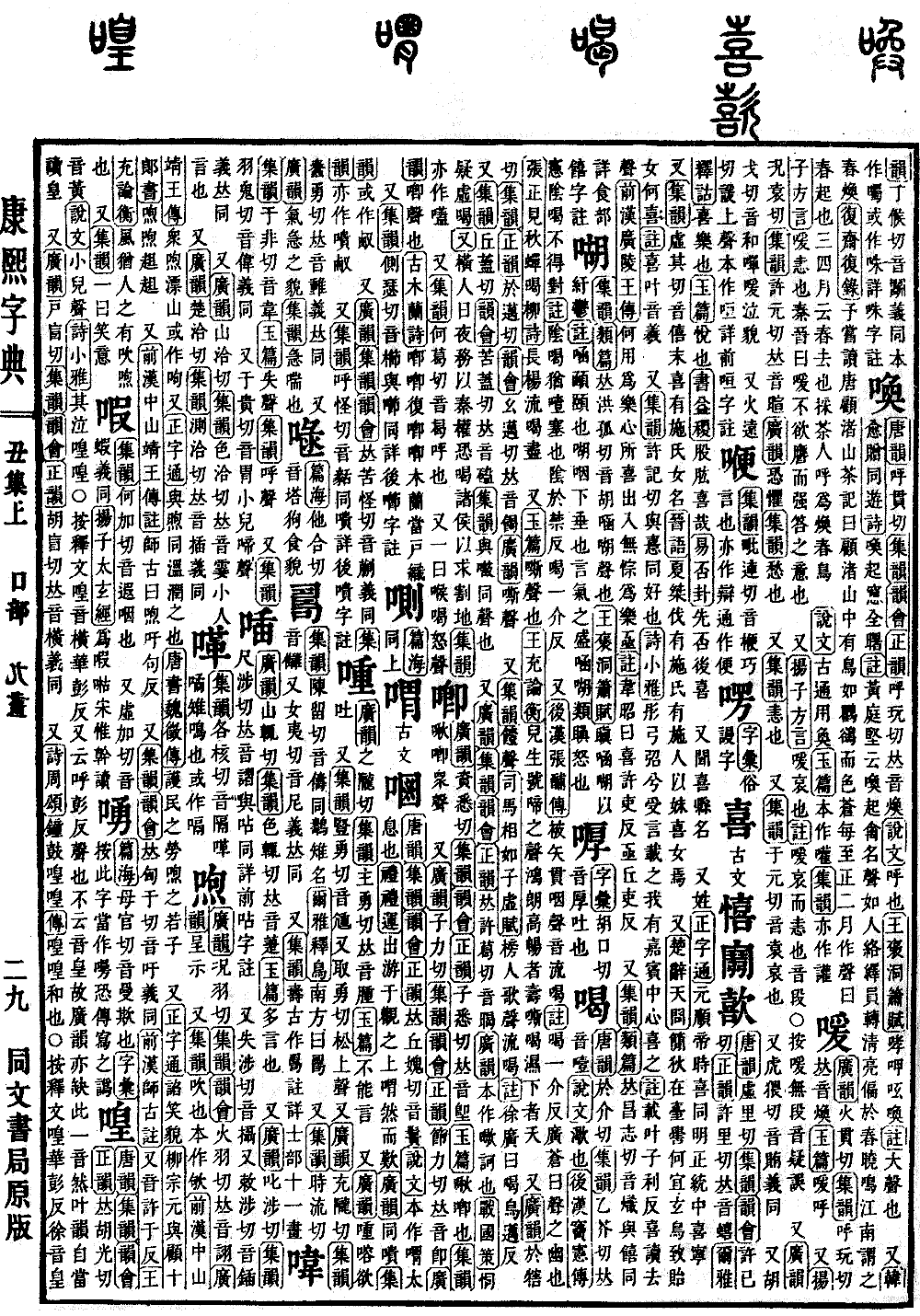
Chou Collection, Upper Volume
Radical: Mouth (kǒu)
Kangxi stroke count: 12
Page 199, Entry 25
Tang Rhymes (Tangyun), Collection Rhymes (Jiyun), Rhyme Meetings (Yunhui), and Orthodox Rhymes (Zhengyun) record the pronunciation as huang.
According to the Explaining Graphs and Analyzing Characters (Shuowen), it refers to the sound of a small child.
Book of Odes (Shijing), Lesser Odes of the Kingdom (Xiaoya): Their crying is huanghuang. According to the Explanation of Text (Shiwen), huang is pronounced heng, or by combining hua and peng. It also states it can be pronounced hu and peng, representing a sound. It does not state it is pronounced huang; therefore, the Expanded Rhymes (Guangyun) also lacks this pronunciation. However, when used for rhyme harmony, it should be read as huang.
Also, according to the Expanded Rhymes (Guangyun), it is pronounced hu and mang. According to the Collection Rhymes (Jiyun), Rhyme Meetings (Yunhui), and Orthodox Rhymes (Zhengyun), it is pronounced hu and mang, with the sound heng. The meaning is the same.
Also, Book of Odes (Shijing), Zhou Hymns (Zhousong): The bells and drums are huanghuang. The Commentary states: huanghuang means harmonious. According to the Explanation of Text (Shiwen), huang is pronounced by combining hua and peng. Xu reads it as huang, and another reading is hong. All three pronunciations are acceptable.
Also, according to the Collection Rhymes (Jiyun), it means clamorous or angry.
Also, Book of Odes (Shijing), Zhou Hymns (Zhousong): Huanghuang is their sound. According to the Explanation of Text (Shiwen), huang is pronounced by combining hua and mang. Another reading is heng, and another is huang. All three pronunciations are acceptable.
Also, according to the Expanded Rhymes (Guangyun), it is pronounced hu and heng. According to the Collection Rhymes (Jiyun), it is pronounced hu and heng, with the sound huang. The Expanded Rhymes (Guangyun) states it means the sound of many voices. The Collection Rhymes (Jiyun) states it means clamorous.
Also, the General Elegance (Tongya) cites the term yin huang, which refers to the shouts of lictors clearing the way. Under the Liang dynasty regulations, the Grand Minister of Works and the Censor-in-Chief were each provided with ten attendants in ceremonial dress. Those wearing martial caps and crimson sleeves would all shout upon entering the palace hall. This is called yin huang until reaching the steps; one person holding the ceremonial bag does not shout.
Also, according to the Collection Rhymes (Jiyun), it is pronounced hu and huang, with the sound huang. Huangxia refers to a multitude.