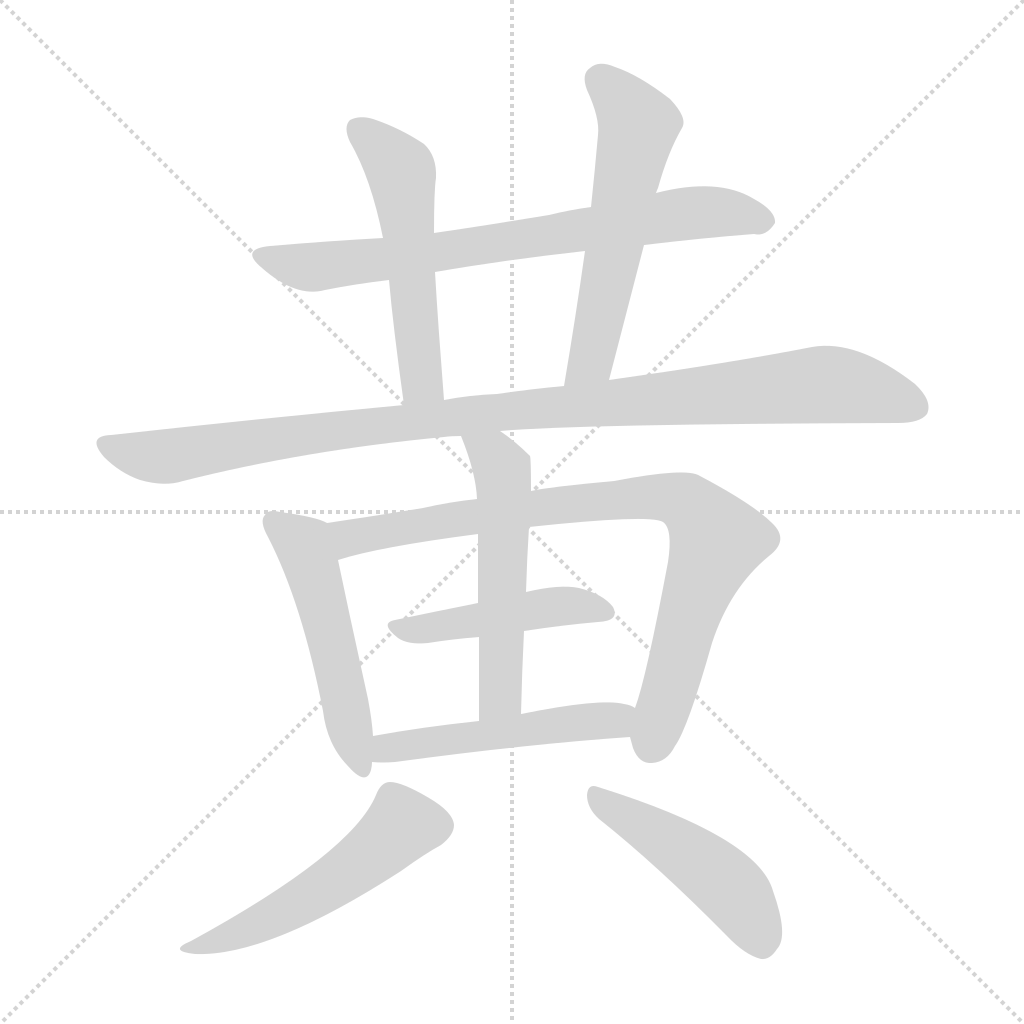
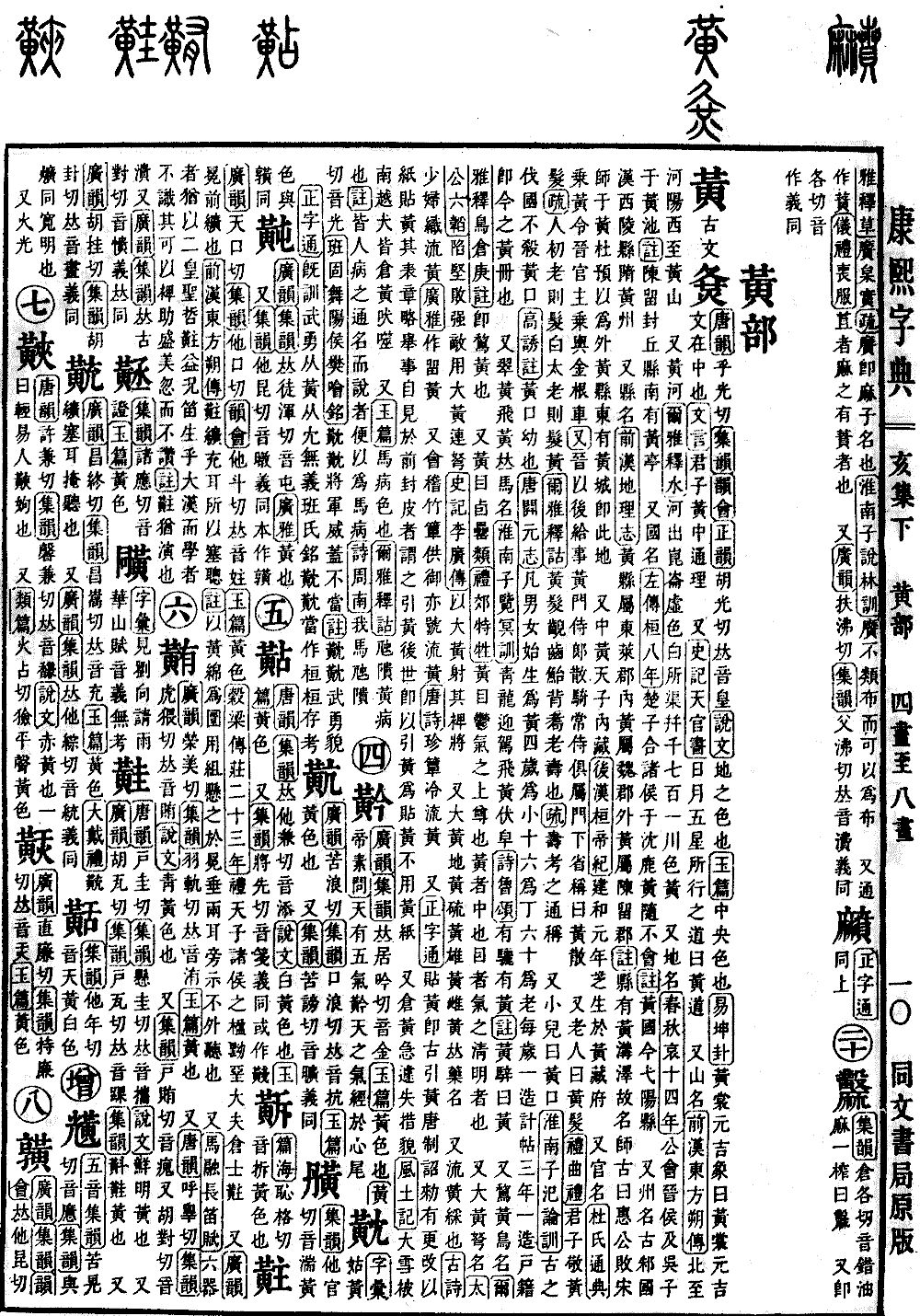
Hai Collection, Lower Volume, Radical: Yellow (huáng), Kangxi Strokes: 12, Page 1516, Entry 04
Ancient text. Pronounced huáng. According to Tangyun, pronounced huáng. According to Jiyun, Yunhui, and Zhengyun, pronounced huáng. According to Shuowen, it is the color of the earth. According to Yupian, it is the color of the center. According to Book of Changes (Yijing), Kun Hexagram: A yellow lower garment brings great fortune. Commentary states: A yellow lower garment brings great fortune because of the color of the center. Wenyan commentary states: The superior man possesses yellow at the center and understands the underlying principles. Also, according to Records of the Grand Historian (Shiji), Celestial Offices Treatise, the orbital path of the sun, moon, and five planets is called the Yellow Path (ecliptic). Also a mountain name. According to Book of Han (Hanshu), Biography of Dongfang Shuo: Reached Chiyang in the north, and Yellow Mountain in the west. Also the Yellow River. According to Erya, Explanations of Water: The Yellow River originates at Kunlun Peaks, its color is white, it merges with one thousand seven hundred tributaries, and the entire river becomes yellow in color. Also a place name. According to Spring and Autumn Annals (Chunqiu), fourteenth year of Duke Ai: The Duke met with the Marquis of Jin and the Viscount of Wu at Huangchi. Commentary: South of Fengqiu County in Chenliu, there is Yellow Pavilion (Huangting). Also a state name. According to Zuo Tradition (Zuozhuan), eighth year of Duke Huan: The Viscount of Chu gathered the feudal lords at Shenlu, but the states of Huang and Sui did not attend. Commentary: The State of Huang is present-day Yiyang County. Also a prefecture name. Ancient State of Zhu, Xiling County during the Han Dynasty, Yellow Prefecture during the Sui Dynasty. Also a county name. According to Book of Han (Hanshu), Treatise on Geography: Huang County belonged to Donglai Commandery, Neihuang belonged to Wei Commandery, and Waihuang belonged to Liu Commandery. Commentary: There is a Yellow Ditch Marsh in the county, hence the name. Shigu states: Duke Hui defeated the Song army at the land of Huang; Du Yu believed that since there is a Yellow City east of Waihuang County, this is the place. Also Central Yellow, the Emperor’s inner treasury. According to Book of Later Han (Houhanshu), Annals of Emperor Huan: In the first year of Jianhe, spirit mushrooms grew in the Yellow Storehouse (Huangcang). Also an official title. According to Du's Comprehensive Statutes (Tongdian), the Director of the Yellow Chariot was a Jin Dynasty official in charge of the Emperor's Golden Root Chariot. Also: From the Jin Dynasty onwards, the Attendant Gentleman of the Yellow Gate and the Regular Cavalier Attendant were part of the Secretariat, collectively known as the Yellows and Regulars (Huangsan). Also, the elderly are called yellow-haired. According to Book of Rites (Liji), Qu Li: The superior man performs the bow of respect to the yellow-haired elderly. Commentary: When a person first grows old, their hair turns white; when they are very old, it turns yellow. According to Erya, Explanations of Words: Yellow-haired, toothless, mottled-backed, and ancient are all terms for longevity. Commentary: General terms for long-lived elders. Also, young children are called yellow-mouths. According to Huainanzi, Discussion on Principles: In ancient times, when punishing another state, they did not kill yellow-mouthed children. Gao You's commentary: Yellow-mouth refers to the very young. According to Tang Kaiyuan Statutes: Those newly born are called yellow, at four years old they are called small, at sixteen they are called adults, and at sixty they are called old. A census account was created every year, and a household register was created every three years; these are what are now called the Yellow Registers. Also Cuihuang and Feihuang are names of horses. According to Huainanzi, Surveying the Obscure: The green dragon pulls the chariot forward, and the Feihuang horse lies by the trough. According to Book of Odes (Shijing), Eulogies of Lu: There are black horses and yellow horses. Commentary: Red-yellow horses are called yellow. Also Lihuang is a bird name. According to Erya, Explanations of Birds, Commentary on Canggeng: It is the Lihuang. Also Huangmu is a type of sacrificial wine vessel such as the You or Lei. According to Book of Rites (Liji), Jiao Te Sheng: The Huangmu is the most honorable vessel for holding aromatic millet wine. Yellow is the color of the center. The eye symbolizes the clarity of the spirit. Also Dahuang is the name of a crossbow. According to Taigong, Six Secret Teachings: To capture a fortified position and defeat a powerful enemy, use the Great Yellow repeating crossbow. According to Book of Han (Hanshu), Biography of Li Guang: Used the Great Yellow crossbow to shoot the enemy's vice-commander. Also Dahuang, Dihuang, sulfur, realgar, and orpiment are names of medicines. Also Liuhuang is a type of colored silk. Ancient poetry: The young woman weaves Liuhuang silk. Guangya states it is written as Liuhuang. Also, bamboo mats offered as tribute from Kuaiji are called Liuhuang. Tang poetry: Precious bamboo mats as cool as Liuhuang. Also, according to Zhengzitong, Tiehuang (pasted yellow) is the ancient Yinhuang (lead yellow). In the Tang Dynasty system, when imperial edicts had revisions, yellow paper was pasted over them. Summaries of memorials that listed key points and were written on the front cover were called Yinhuang. Later generations treated Yinhuang as Tiehuang, and stopped using yellow paper. Also Canghuang describes the appearance of being hurried, panicked, and at a loss. According to Fengtuji: Great snow covered Nanyue, and the dogs were all barking and biting in a panicked state. Also, according to Yupian, the color of a horse's illness. According to Erya, Explanations of Words: Huitui refers to yellow sickness. Commentary: These are general terms for human illness, though some interpreters believe they refer to horse illness. According to Book of Odes (Shijing), Zhou Nan: My horses are exhausted and ill.