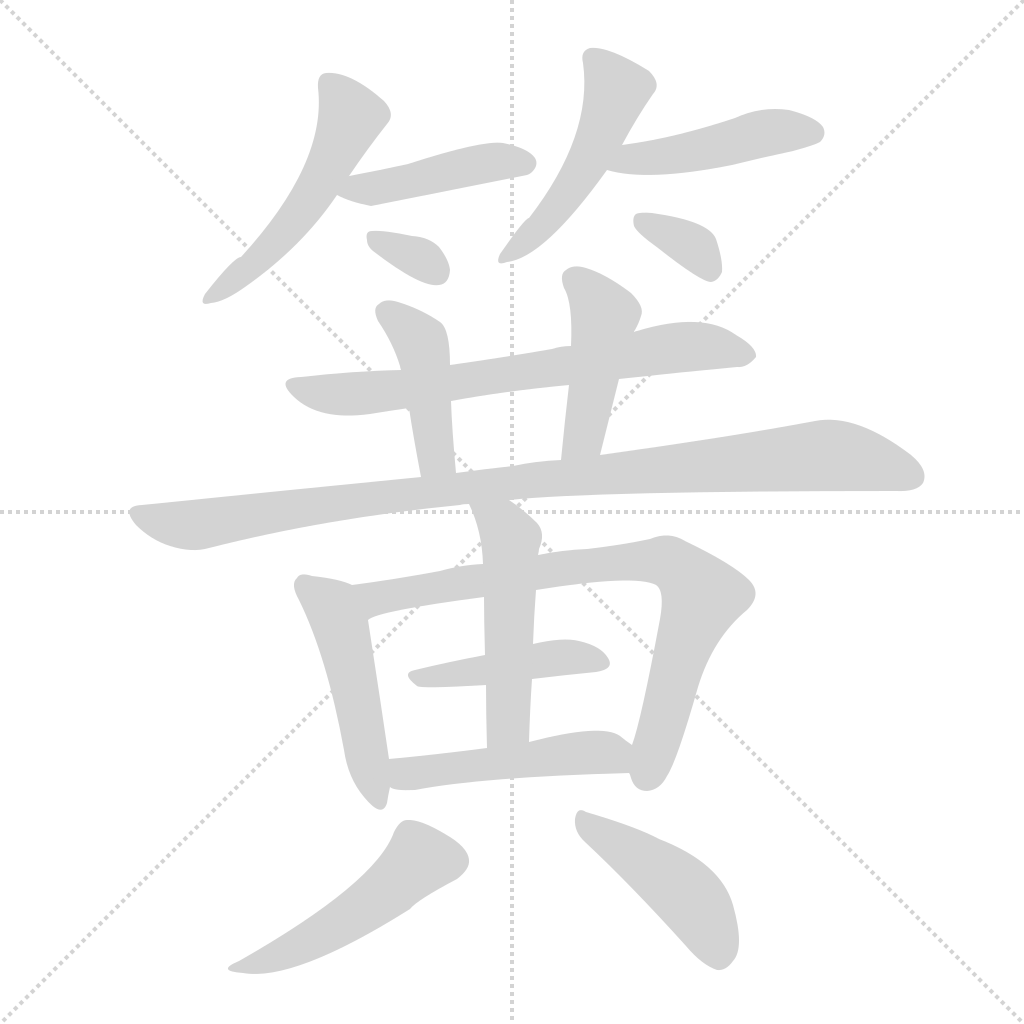
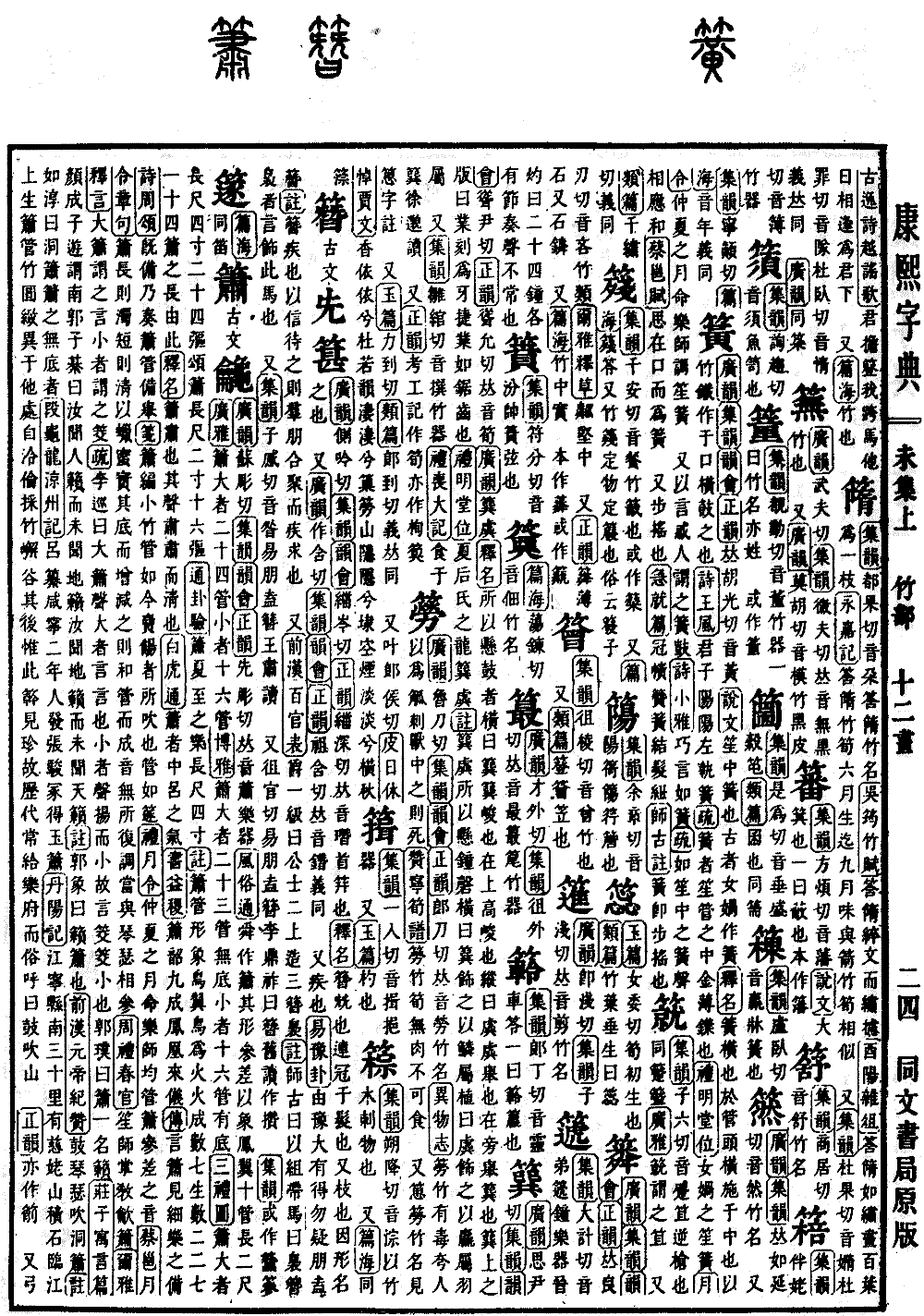
Wei Collection, Upper Volume
Radical: Bamboo (zhú)
Kangxi Strokes: 18
Page 900, Entry 11
Guangyun, Jiyun, Yunhui, and Zhengyun dictionaries state the pronunciation is huang.
Shuowen Jiezi states it is the reed inside a sheng (a reed pipe wind instrument). In ancient times, Nuwa created the reed.
Shiming states: A reed is horizontal. It is placed horizontally inside the head of the pipe. It is made of bamboo or metal and placed at the mouthpiece, played by blowing across it.
Book of Odes (Shijing), Odes of Wang: The noble man is happy and at ease, holding a reed in his left hand.
Commentary: The reed is the thin metal strip inside the pipe of the sheng.
Book of Rites (Liji), Mingtang Wei: The sheng and reed of Nuwa.
Yueling: In the month of mid-summer, command the music master to tune the yu and sheng pipes and the reeds.
Also, using words to confuse people is called huanggu (to incite with flowery speech).
Book of Odes (Shijing), Minor Odes of the Kingdom: Clever words are like reeds.
Commentary: Like the reeds in a sheng, where the sounds harmonize with one another.
Cai Yong's Rhapsody: Thoughts are in the mouth and become the reed.
Also, a buyao (a type of dangling hair ornament).
Jijiupian: Crown, turban, hairpin, reed, and knotting of the hair.
Shigu Commentary: The reed is the same as the buyao.
Verification: In the Book of Rites (Liji), Yueling, it says: In the month of mid-summer, command the music master to tune the sheng and reeds. Following the original text, the characters for yu and the character for zhi have been added before the sheng and reed respectively.