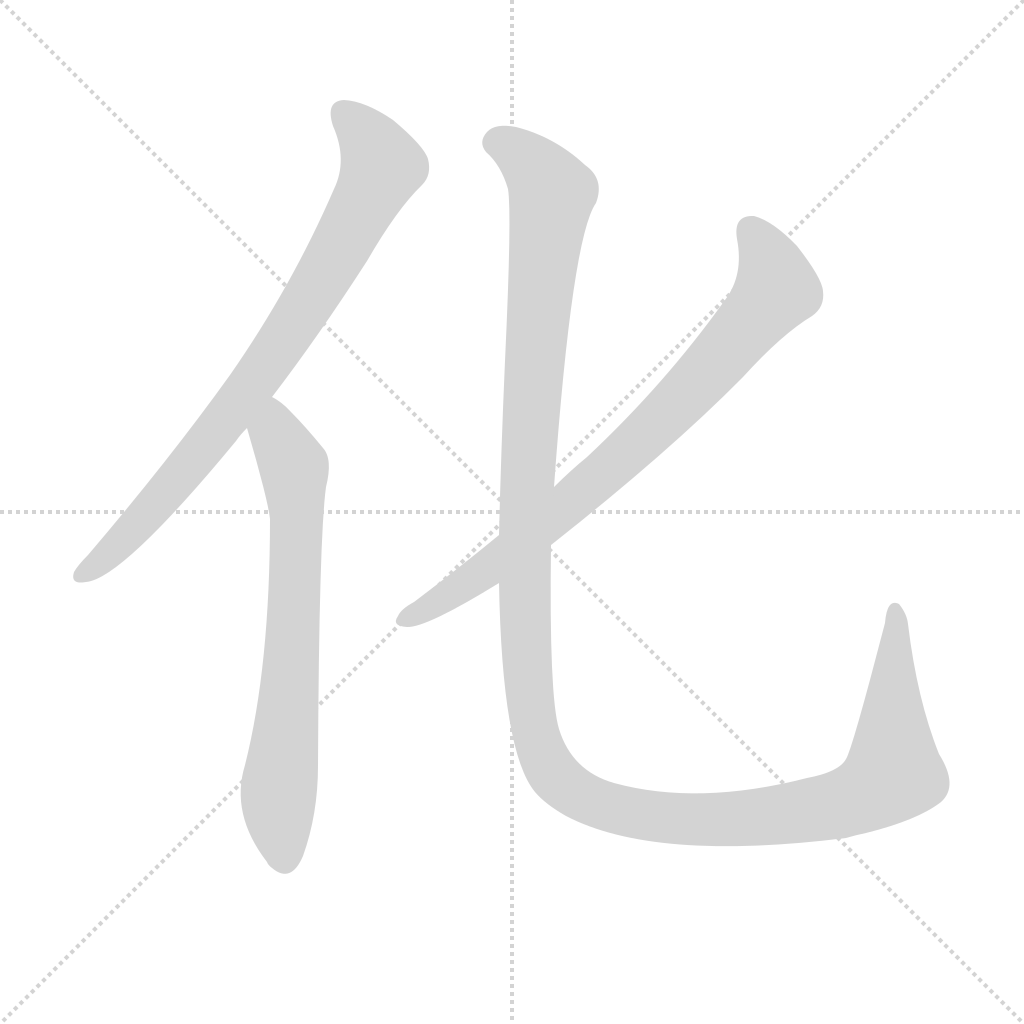
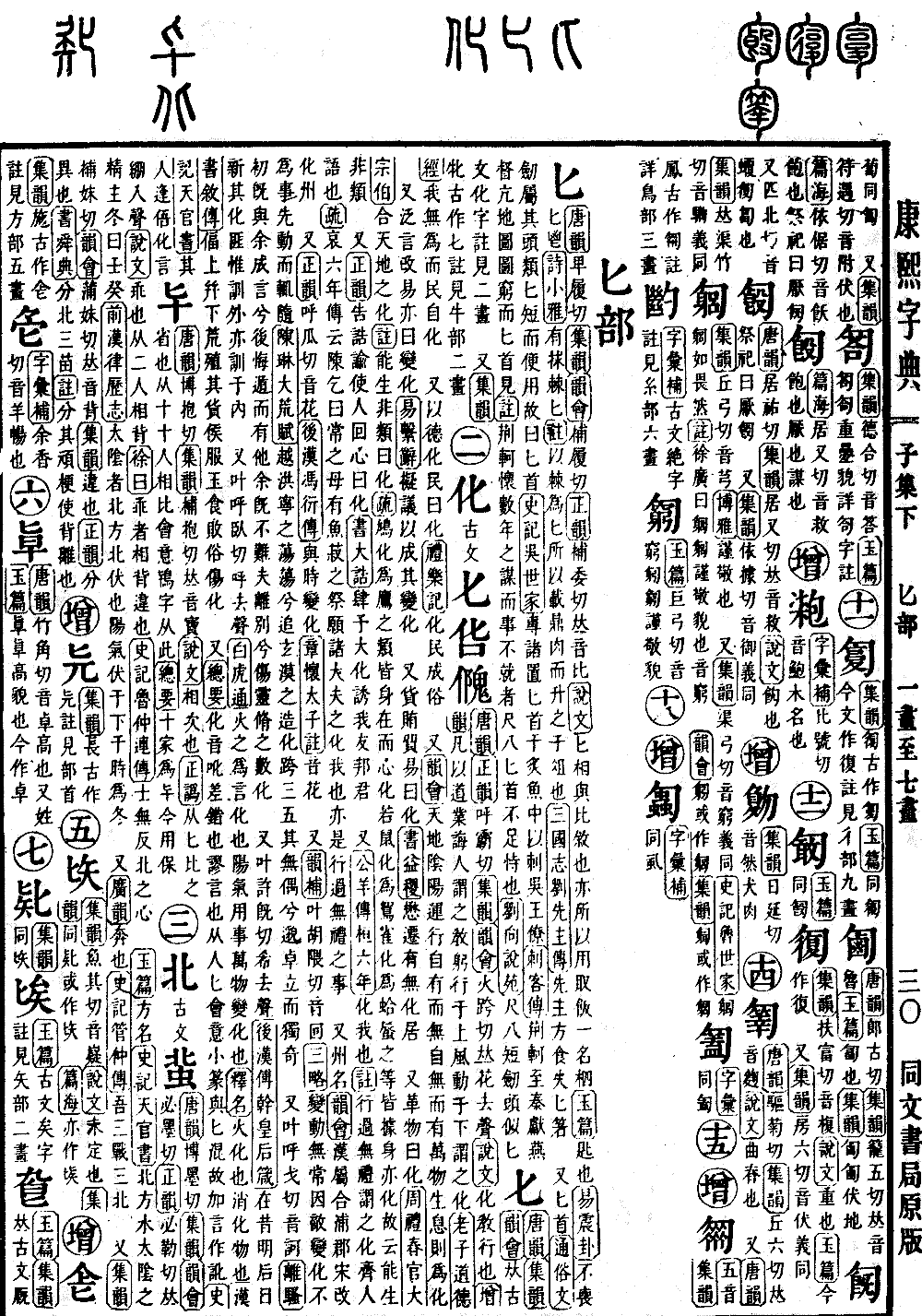
Zi Collection, Page Position: Lower. Radical: Ladle (bi). Character: Hua. Kangxi stroke count: 4. Page: page 152, number 20. Ancient form character. According to the Tang Rimes (Tangyun) and Correct Rimes (Zhengyun), the pronunciation is a combination of the initials h- and -ua, pronounced as hua in the departing tone. According to the Collected Rimes (Jiyun) and Rhyme Assembly (Yunhui), the pronunciation is a combination of h- and -ua, also sounding like hua in the departing tone. Explaining Graphs and Analyzing Characters (Shuowen) states that hua means the implementation of teaching. The Augmented Rimes (Zengyun) states that instructing others in the way and professional practice is called teaching; when those in superior positions practice it personally and those below are moved as if by the wind, it is called transformation (hua). The Classic of the Way and Its Power (Daodejing) states that I take no action and the people transform themselves. Furthermore, transforming the people through virtue is called hua. The Record of Music (Yueji) in the Book of Rites (Liji) states to transform the people and establish customs. The Rhyme Assembly states that the movement of the Yin and Yang of Heaven and Earth, moving from existence to nothingness and from nothingness to existence, and the birth and growth of the myriad things is called transformation. It also generally refers to changing or altering, also called change and transformation (bianhua). The Classic of Changes (Yijing) states to deliberate and discuss to achieve its changes and transformations. Furthermore, the trade and exchange of goods is called hua. The Book of Documents (Shangshu) states to encourage the exchange of what one has for what one lacks and the circulation of goods. Furthermore, the metamorphosis of physical things is called hua. The Rites of Zhou (Zhouli) states to harmonize the transformations of Heaven and Earth. The commentary states that the ability to give birth to a different species is called hua. The sub-commentary states this refers to things like a cuckoo transforming into a hawk, where the body remains but the heart transforms. If a quail transforms into a clam or a sparrow transforms into a large oyster, these are cases where the body also transforms, hence it is said to give birth to a different species. The Correct Rimes states that proclamations and instructions that cause people to change their hearts are called hua. The Book of Documents states that thus I spread great transformation to induce the lords of my friendly states. The Gongyang Commentary (Gongyang Zhuan) uses hua to mean treating one with impropriety. The commentary states that acting without propriety is called hua in the dialect of the people of the Qi state. The sub-commentary notes a similar usage where a request regarding a sacrifice is considered an act lacking propriety. It is also the name of a prefecture. The Rhyme Assembly states it belonged to the Hapu Commandery during the Han Dynasty and was renamed Huazhou during the Song Dynasty. It is also pronounced like hua in the level tone according to the Correct Rimes. The Biography of Feng Yan in the Book of the Later Han (Hou Hanshu) mentions changing with the times, where the commentary by Prince Zhanghuai notes the pronunciation is hua. It is also used as a rhyming character pronounced like hui according to the Rhyme Supplement (Yunbu). The Three Strategies (Sanlue) states that changes and movements are inconstant, transforming according to the enemy; do not act beforehand, but move and follow them. The Rhapsody on the Great Wilderness (Dahuang Fu) also uses it as a rhyme. It is also used as a rhyming character pronounced like he. The Lament for Parting (Lisao) states that at first you gave me your word, but later you regretted it and changed your mind; I do not find parting difficult, but I am grieved by the frequent changes of the sovereign. It is also used as a rhyming character pronounced like xi in the departing tone. The Admonitions for the Empress (Huanghou Zhen) in the Book of the Later Han states that in the past the brilliant sovereigns daily renewed their transformation; not only did they instruct those outside the court, but also those within. It is also used as a rhyming character pronounced like hu in the departing tone. The Comprehensive Discussions in the White Tiger Hall (Baihu Tong) states that fire is synonymous with transformation; when the Yang energy is in effect, the myriad things change and transform. The Explanation of Names (Shiming) states that fire is transformation, as it consumes and transforms things. The History of the Han (Hanshu) states that they pressured those above and merged with those below, wildly accumulating their goods; wearing noble clothes and eating fine food, they ruined customs and harmed transformation. The Essence of Rimes (Zhongyao) states that hua is also pronounced like e, meaning an error or a mistaken word. It is a compound ideogram from the characters for person and ladle. Because the small seal script form was easily confused with the character for ladle, the radical for speech was added to form the character for error (e). The Records of the Grand Historian (Shiji) mentions people encountering and speaking mistaken words (hua yan).