Wu Collection, Upper Volume
Radical: Field (tián)
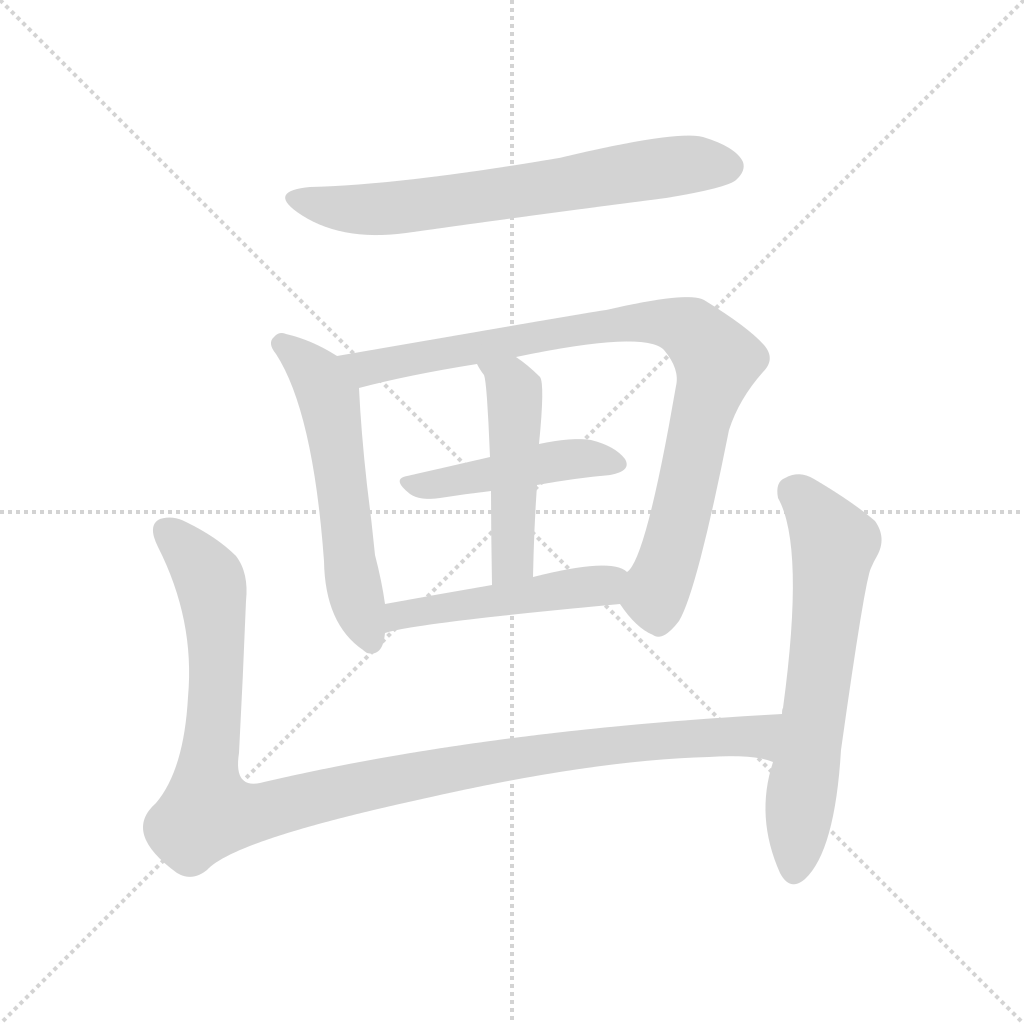
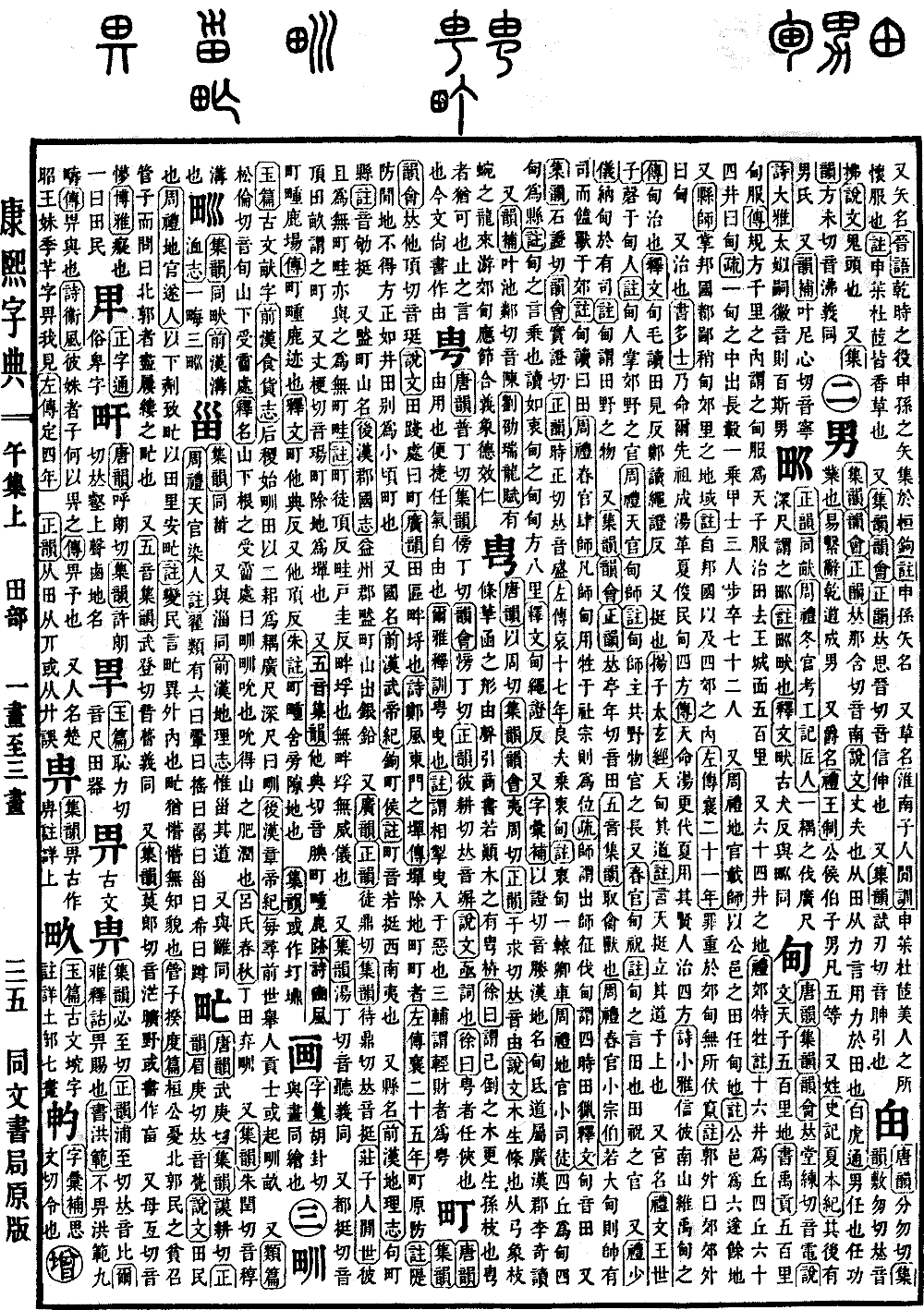
画; Kangxi Strokes: 12; Page 759, Entry 08
Compendium of Characters (Zihui): Pronounced hua. The same as the character for drawing. It means to depict. This is the ancient form of the character for drawing.
Tang Rhyme (Tangyun), Collection of Rhymes (Jiyun), Dictionary of Rhymes (Yunhui), and Standard Rhymes (Zhengyun): Pronounced hua (entering tone). It refers to the lines of a divination diagram. It also means to divide or to mark a boundary.
Zuo Commentary (Zuozhuan), Year 4 of Duke Xiang: Vast are the tracks of Yu, divided into the Nine Provinces. Note: This means to divide.
Book of Rites (Liji), Tan Gong: Duke Ai sent a messenger to offer condolences to Kui Shang. Meeting him on the road, he stepped aside, drew a palace on the ground, and received the condolences there. Note: This means drawing a palace on the ground as a representation.
It also means strategies or plans.
Zou Yang, Petition to the King of Wu: Therefore, I wish for the King to examine the plans and that is all.
Records of the Grand Historian (Shiji), House of King Yan of Jing: Tian Sheng of Qi traveled and lacked funds, so he used a plan to influence the Marquis of Yingling, Ze. Note: Fu Qian says he used a plan to seek his favor.
It also means to stop or to limit.
Analects (Lunyu): Now you define limits.
It also refers to the name of a hill.
Erya (Erya), Explaining Earth: If the road passes to its right and circles it, it is called a painted hill. Note: This means it is marked out by the road.
Explaining Names (Shiming): A path passing to its right is called a painted hill. The people of the hill value the right side; whenever they gesture, they use the right hand.
It also refers to a place name.
Records of the Grand Historian (Shiji), Biography of Tian Dan: When the state of Yan first entered Qi, they heard of Wang Zhu, a virtuous man from the town of Hua. Note: The Correct Meaning says the Comprehensive Geography states that Jili City is thirty li northwest of Linzi, which was the town of Ji during the Spring and Autumn period. It also says it was Hua town, where Zhu lived, named after the Hua River.
It also appears in the Guangyun (Guangyun), Collection of Rhymes (Jiyun), Dictionary of Rhymes (Yunhui), and Standard Rhymes (Zhengyun): Pronounced hua.
Erya (Erya), Explaining Words: To paint is to form an image. Note: To paint is to create an image.
Explaining Names (Shiming): To paint is to hang. It means to hang the images of things using five colors. It is commonly written in a variant form.
Rites of Zhou (Zhouli), Offices of Heaven, Controller of Silk: For all sacrifices, provide items made of embroidered and painted silk. Commentary: All sacrificial robes consist of painted coats and embroidered skirts.
Ceremonial Rites (Yili), Archery Rituals in the Countryside: The great officer spreads the target, painted with tigers and leopards. The scholar spreads the target, painted with deer and swine.
It also refers to an official title.
History of the Later Han (Hou Hanshu), Treatise on Official Titles: There is one chief of the Painting Room, with a salary of four hundred piculs, wearing a yellow ribbon.
It also appears in the Rhyme Supplements (Yunbu), rhymes with hui:
Qin Langya Stone Inscription: The regional governors divide their duties, and the various administrations follow the guidelines. Their actions are always appropriate, and nothing is not as planned. Pronounced yi.