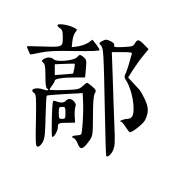
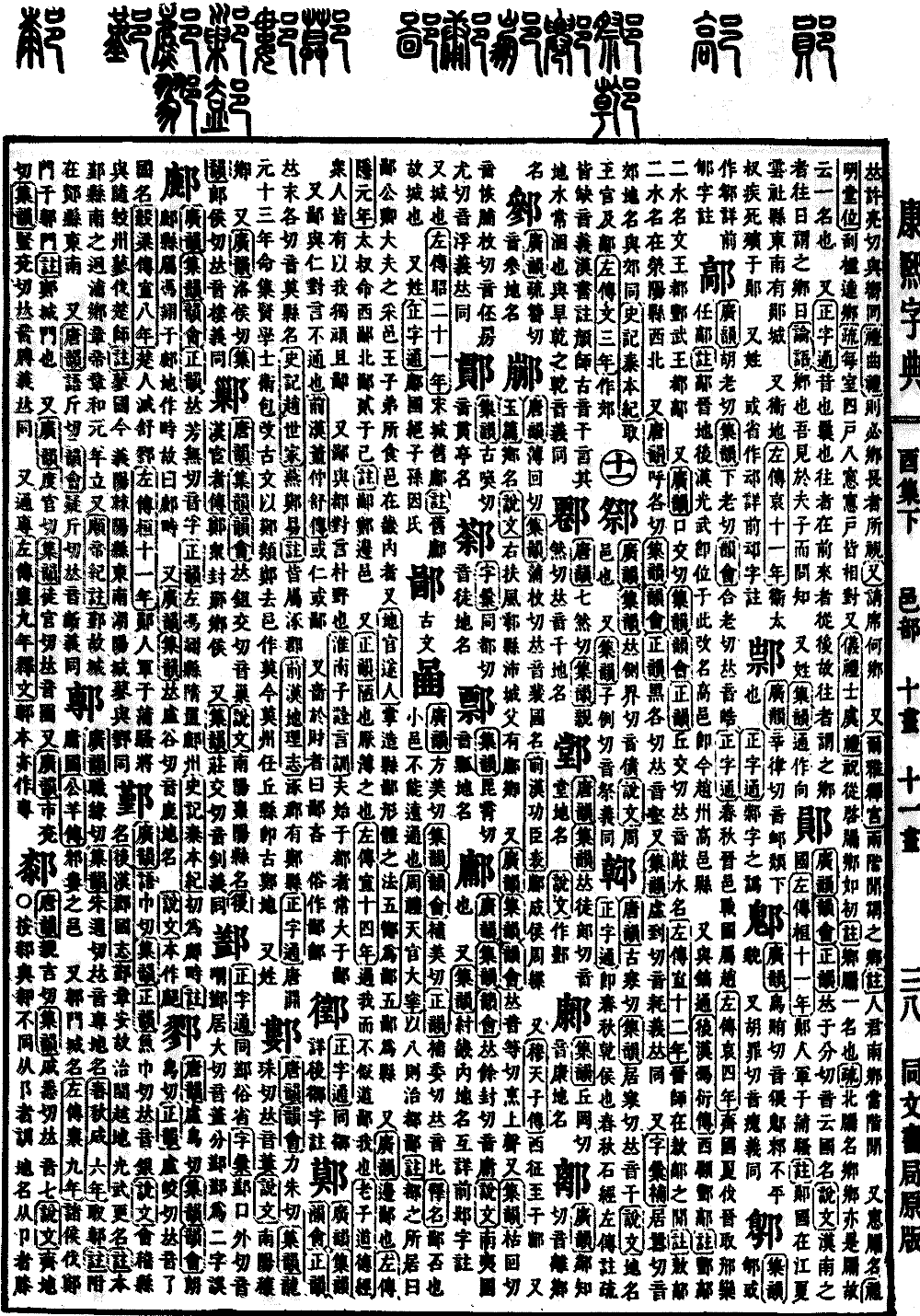
You Collection, Lower Volume Radical: City (yì) Gao; Kangxi stroke count: 17; Page: 1276, entry 05
Guangyun (Guangyun) gives the pronunciation hu lao qie; Jiyun (Jiyun) gives xia lao qie; Yunhui (Yunhui) gives he lao qie, pronounced hao. Zhengzitong (Zhengzitong) states: A city-state of Jin during the Spring and Autumn period, later belonging to Zhao during the Warring States period. Zuo Tradition (Zuozhuan), Duke Ai, Year 4: Qi's Xia attacked Jin and captured Xing, Ren, Luan, and Gao. Note: Gao was a place in Jin. Later, Emperor Guangwu of Han ascended the throne here, and its name was changed to Gaoyi, which is the present-day Gaoyi County in Zhaozhou. Also interchangeable with gao (镐). Book of the Later Han (Houhanshu), Biography of Feng Yan: Looking west to Feng and Gao. Note: Feng and Gao are names of two rivers. King Wen of Zhou established his capital at Feng, and King Wu of Zhou established his capital at Gao.
Also, Guangyun gives the pronunciation kou jiao qie; Jiyun, Yunhui, and Zhengjing (Zhengyun) give qiu jiao qie, pronounced qiao. Name of a river. Zuo Tradition, Duke Xuan, Year 12: The Jin army was between Ao and Gao. Note: Ao and Gao are names of two rivers, located northwest of Xingyang County.
Also, Tangyun (Tangyun) gives the pronunciation hu ge qie; Jiyun, Yunhui, and Zhengjing give hei ge qie, pronounced he.
Also, Jiyun gives the pronunciation xu dao qie, pronounced hao. The meaning is the same.
Also, Zihui Bu (Zihui Bu) gives the pronunciation ju xiao qie, pronounced jiao. Name of a place. It is the same as jiao (郊). Records of the Grand Historian (Shiji), Annals of Qin: Captured Wangguan and Gao. Zuo Tradition, Duke Wen, Year 3: Written as jiao (郊).
Emendation: In Zuo Tradition, Duke Ai, Year 4, Qi's Xia attacked Jin and captured Xing, Luan, Ren, and Gao. The original text has "Luan Ren", which should be corrected to "Ren Luan".