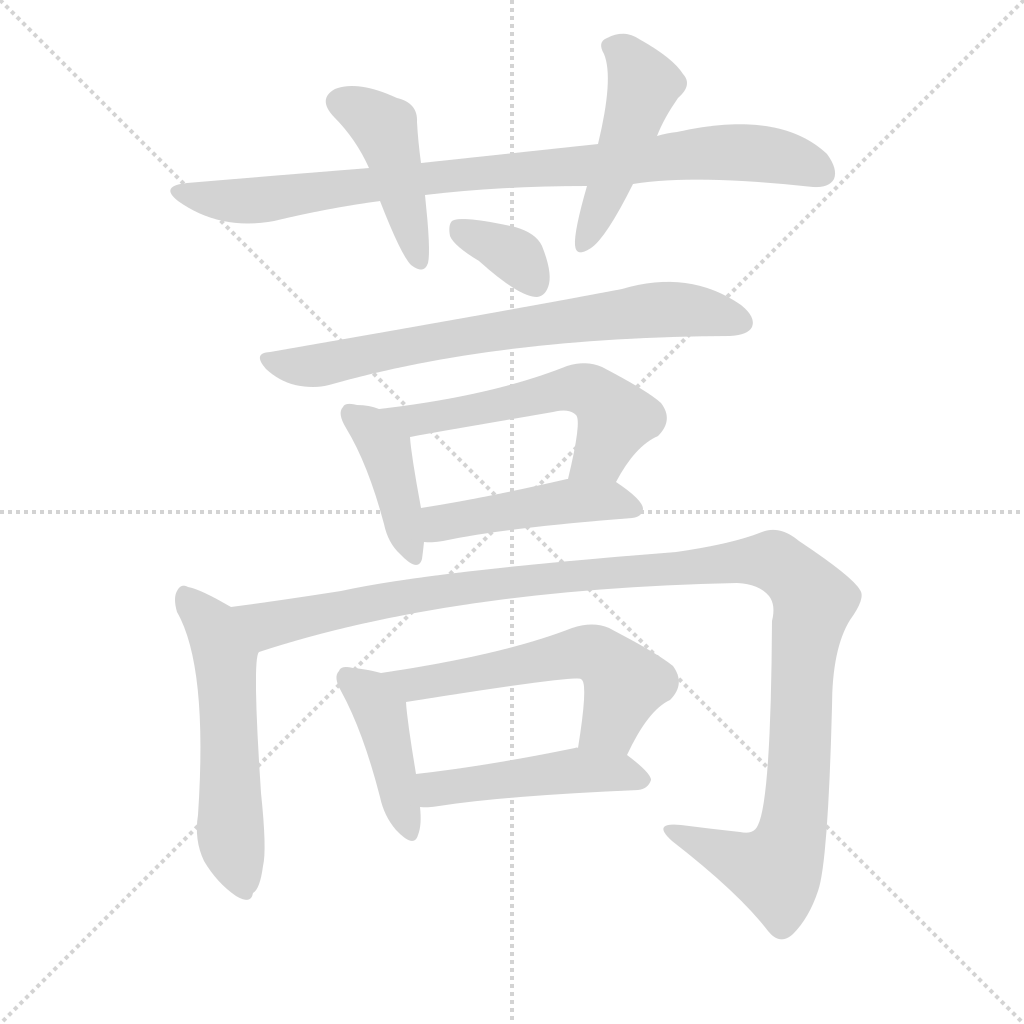
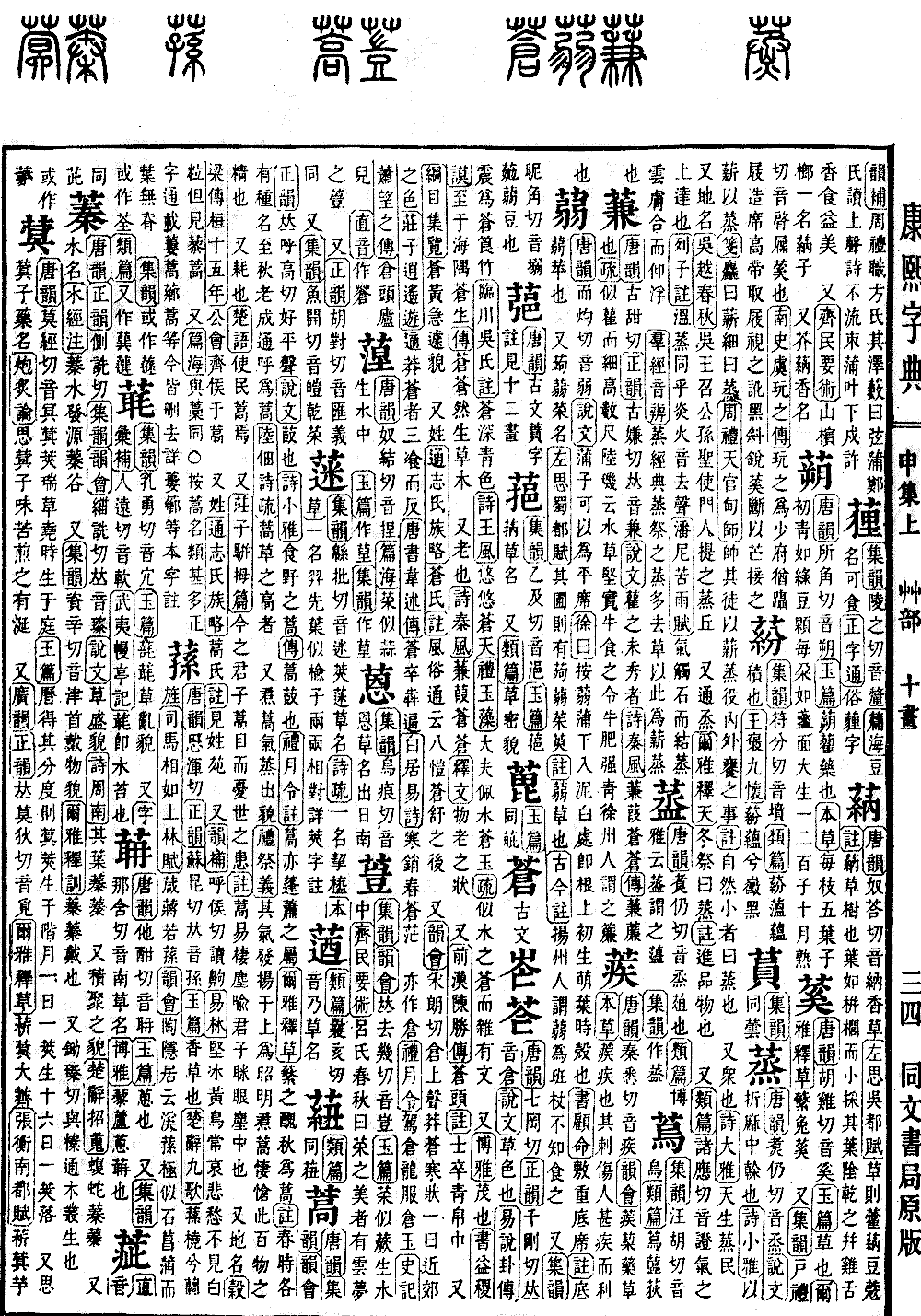
Shen Collection, Upper Volume
Radical: Grass (cǎo)
Kangxi Strokes: 16
Page 1050, Entry 25
Tangyun, Jiyun, Yunhui, and Zhengyun lexicons all state the pronunciation is hao (level tone).
Shuowen Jiezi states it is a type of plant.
Book of Odes (Shijing), Lesser Odes: Refers to eating the artemisia plant from the fields.
Commentary states that hao is the same as the qian plant.
Book of Rites (Liji), Monthly Ordinances (Yueling) commentary states that the hao plant belongs to the same category as the wormwood and mugwort.
Erya, Explanation of Plants: For the fan plant, in autumn it is called hao.
Commentary states that during spring the plants have various specific names, but in autumn when they have matured, they are collectively referred to as hao.
Lu Dian, Poetry Commentary: Hao is a type of tall-growing plant.
Also, it refers to the rising of aromatic vapors.
Book of Rites (Liji), Meaning of Sacrifices (Jiyi): The fragrance dissipates into the air, becoming a manifestation of brightness, steam, coldness, and sorrow, which is the essence of all things.
Also used interchangeably with hao (to deplete/waste).
Discourses of the States (Guoyu), Discourses of Chu: Causing the people to be depleted.
Also, Zhuangzi, Webbed Toes chapter: The gentlemen of the present day squint their eyes in worry over the troubles of the world.
Commentary: Hao grass easily accumulates dust, used as a metaphor for the eyes of the gentleman being obscured by the dust of the world.
Also, a place name.
Guliang Zhuan, 15th Year of Duke Huan: The Duke met with the Marquis of Qi at the location of Hao.
Also, a surname.
Comprehensive Treatise (Tongzhi), Clans and Tribes Summary: The Hao surname.
Commentary: Found in the Garden of Surnames (Xingyuan).
Also, Yunhui lexicon: Pronounced hou (level tone), with the sound of hou.
I Ching Forest (Yilin): The yellow bird on the solid ice, often mourning in grief. It does not see white rice, but only sees quinoa and hao plants.
Also, Pianhai lexicon: The same as the character gao.
Note: There are many types of hao plants. The Standard Dictionary (Zhengzitong) lists the lou-hao and xiang-hao, which have been omitted here. Detailed information can be found in the entries for the original characters lou and xiang.