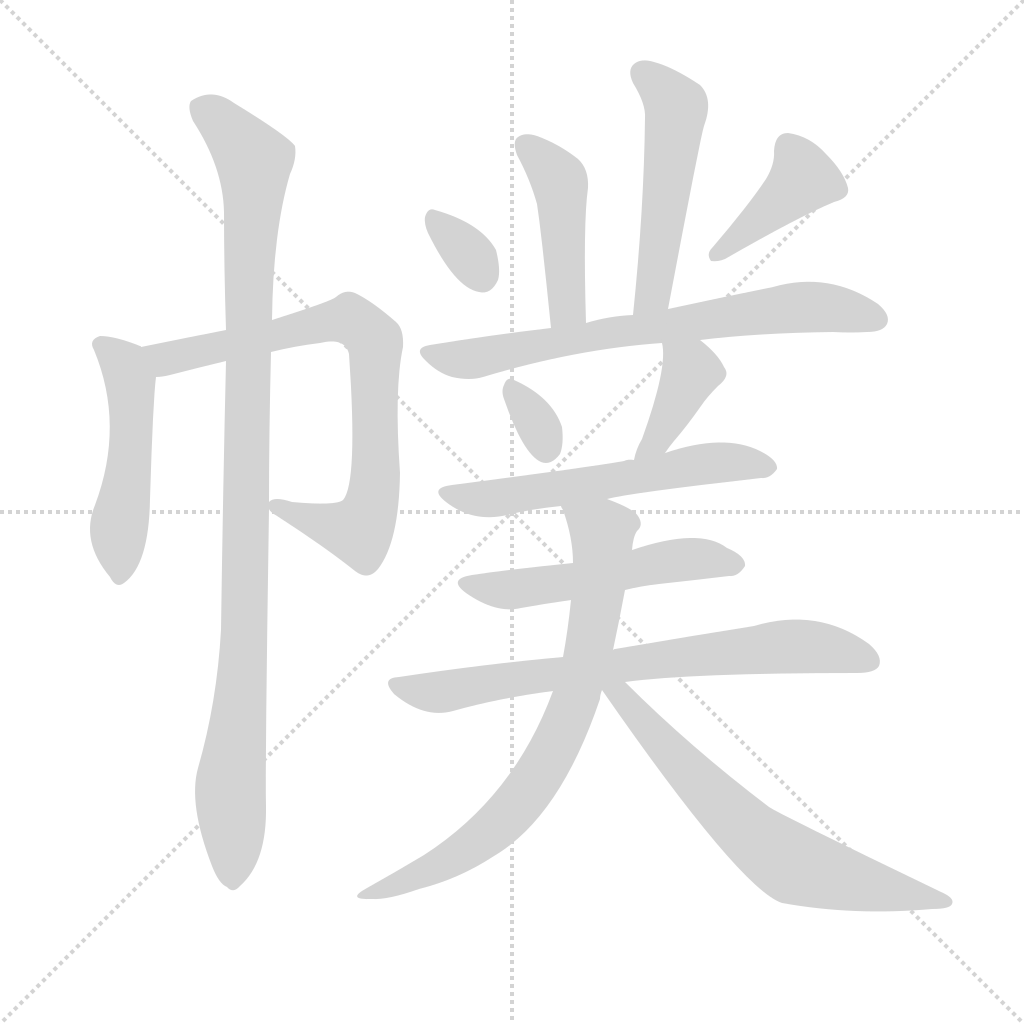
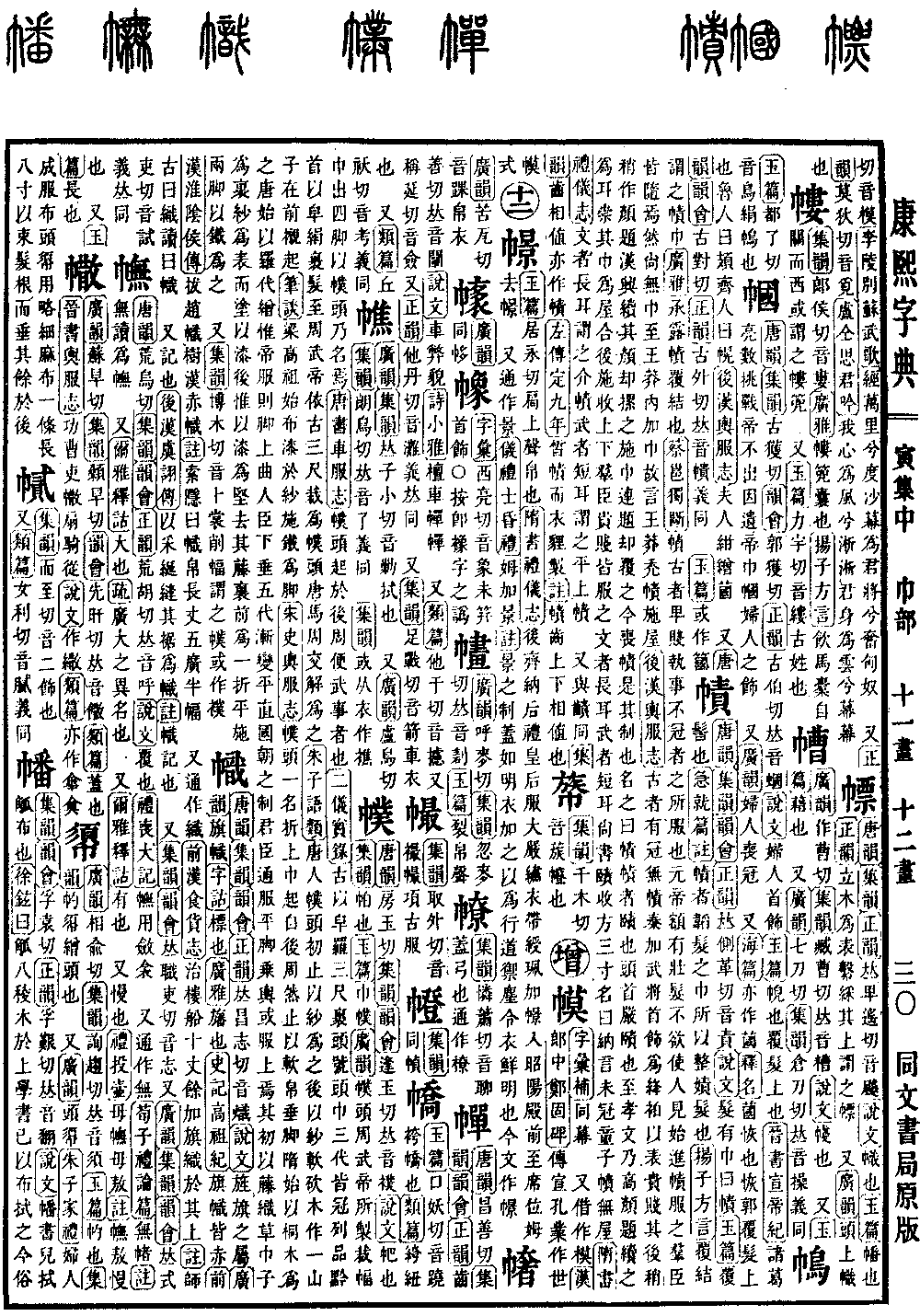
Yin Collection, Middle Volume
Radical: Turban (jīn)
Kangxi Strokes: 18
Page 336, Entry 20
Pronounced fú.
Shuowen Jiezi (Explanation of Simple and Compound Characters) defines it as a headscarf.
Jiyun (Compilation of Rhymes) defines it as a kerchief.
Yupian (Jade Chapters) defines it as a type of headscarf.
Guangyun (Expanded Rhymes) records: The futou (a type of headgear) was created by Emperor Wu of Northern Zhou. He cut a square piece of cloth and fashioned it with four corners to wrap the head, hence the name.
Book of Tang (Tangshu), Treatise on Carriages and Clothing, records: The futou originated in the Northern Zhou dynasty and was designed to facilitate military activities.
Eryi Shilu (Records of Heaven and Earth) records: In ancient times, a three-foot black silk cloth was used to wrap the head, known as a headscarf; people of the Xia, Shang, and Zhou dynasties all wore caps. Officials and commoners used black silk to wrap their hair. By the time of Emperor Wu of Northern Zhou, he followed the ancient three-foot specification to cut the cloth into a futou, which was then crossed and tied by Ma Zhou of the Tang dynasty.
Zhuzi Yulei (Classified Conversations of Master Zhu) records: The futou of the Tang dynasty was originally made only of gauze. Later, because the gauze was too soft, people carved wood into a mountain-shaped lining, placed it in the front, and used it to prop up the headgear.
Bitan (Brush Talks) records: Emperor Wu of Liang began to apply lacquer to the gauze and installed an iron framework.
History of Song (Songshi), Treatise on Carriages and Clothing, records: The futou, also called zheshangjin (upward-folded headscarf), originated in the Northern Zhou dynasty, but at that time it only used soft silk with dangling ribbons. The Sui dynasty began using paulownia wood to make the framework, and the Tang dynasty began using fine silk (luo) instead of ordinary silk cloth. Only the Emperor’s futou had ribbons that curved upward, while those of his subjects had ribbons that hung downward; during the Five Dynasties period, they gradually became flat and straight. The system of our current dynasty (Song) is that both the ruler and his subjects use futou with flat, straight ribbons, although the Emperor sometimes wears those with upward-curving ribbons. Originally, a straw lining woven from rattan was used, covered with gauze and coated with lacquer. Later, they used only lacquer to reinforce it, eliminating the rattan lining; it had a crease in the front and two flat, straight ribbons extending outward, made of iron.
Pronounced bǔ. This refers to the act of cutting a portion of fabric from the hem of a garment, which is called fu. Sometimes also written in a variant form (fú).