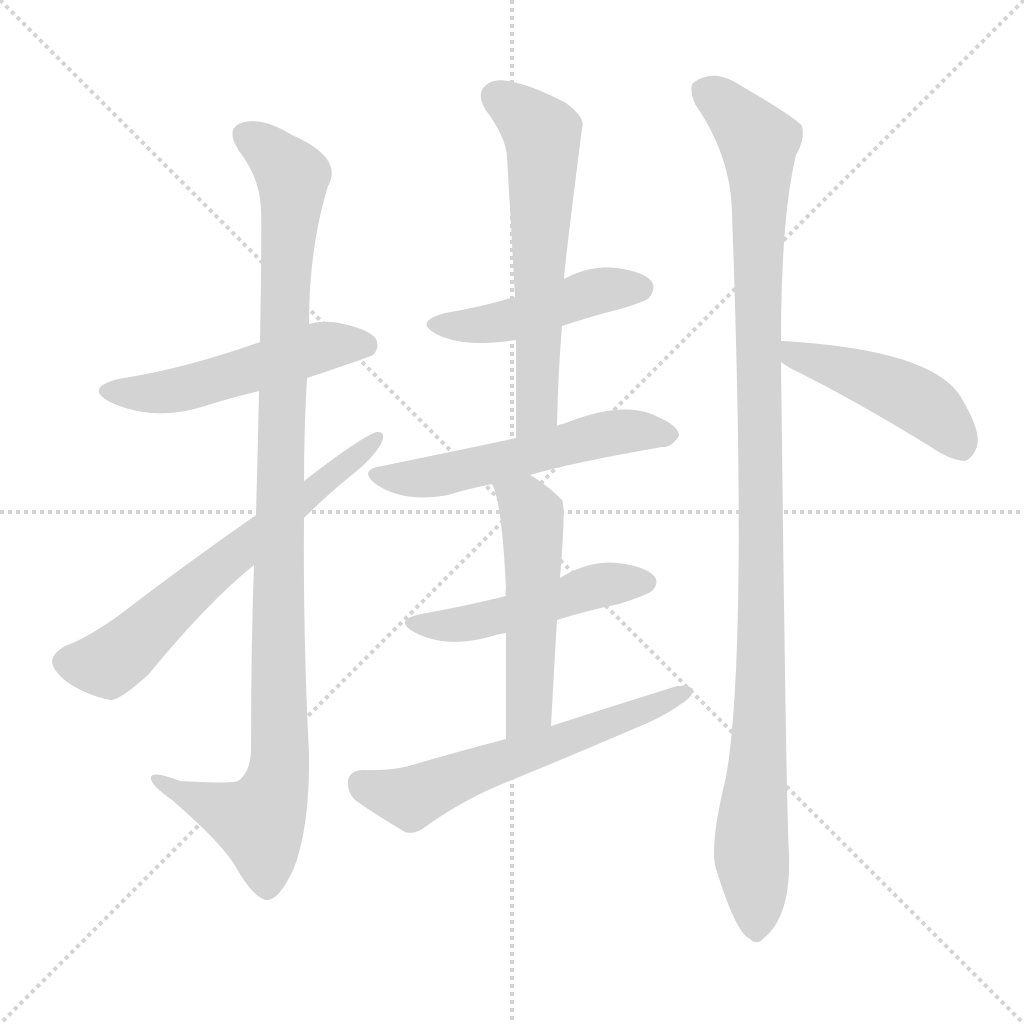
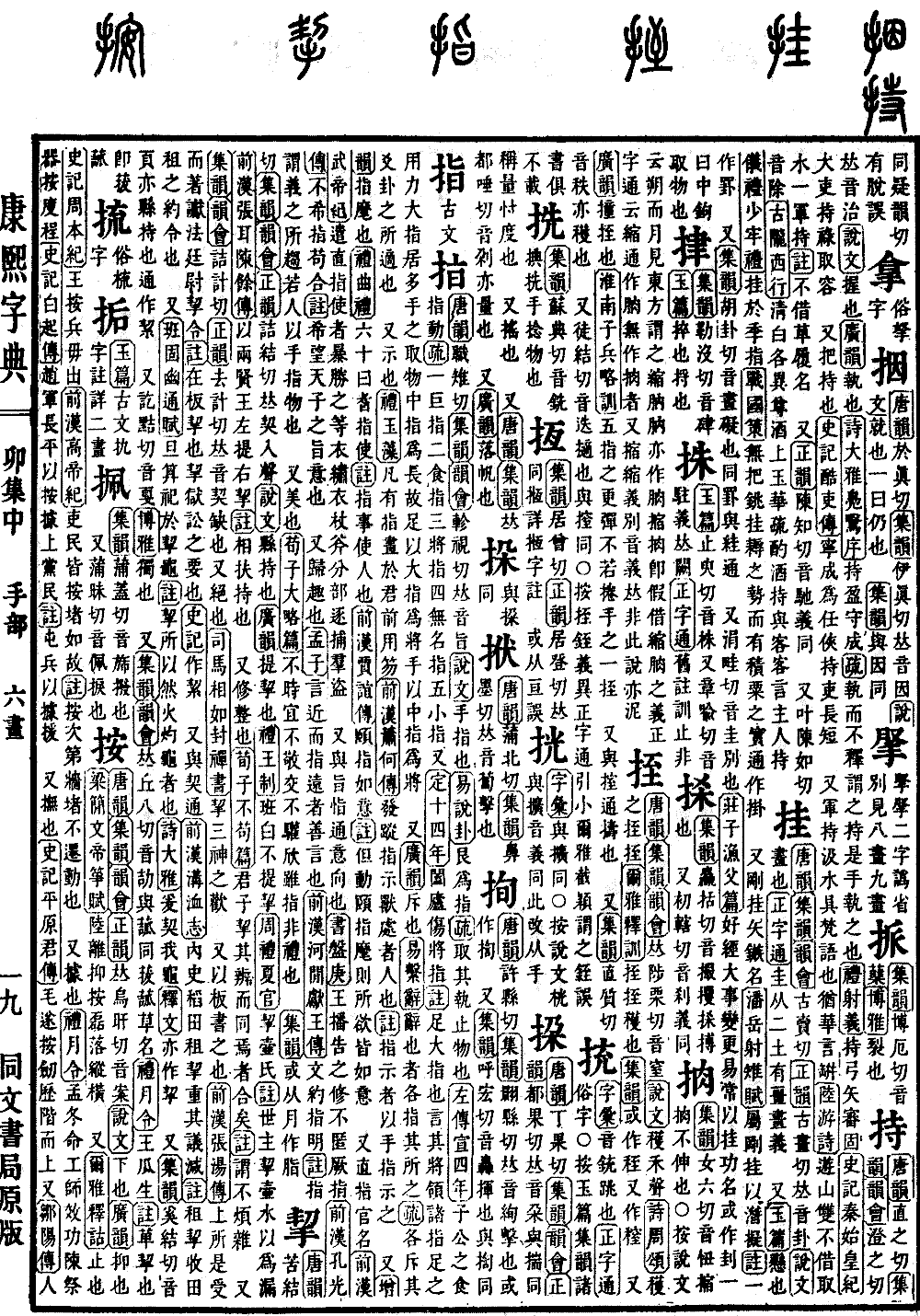
Mao Collection, Middle Volume. Radical: Hand (shǒu). Kangxi strokes: 12. Page 429, Entry 01.
Pronounced gua.
Meaning to separate or divide. Also refers to the action of tucking yarrow stalks between the fingers during divination. The Book of Changes (Yijing), in the Commentary on the Appended Phrases (Xici), records: "Set aside one to represent the three." The commentary explains that placing something aside without using it is called gua. It further records: "After two sets of calculations, then perform the gua." The commentary explains that joining and placing things together is called gua. Zhu Xi, in his Fundamental Meaning (Benyi), explains that gua refers to suspending the stalks between the fingers of the left hand.
Also, in the Zheng Yun (Standard Rhymes), it is recorded as being identical to the character gua. The sub-commentary to the Qian hexagram in the Book of Changes (Yijing) cites the Yijing Weishu (Apocrypha of the Book of Changes) stating: A hexagram is a gua. This means to hang up images to display them to people.
Also, the Jiyun (Collected Rhymes), Yunhui (Collection of Rhymes), and Zhengyun (Standard Rhymes) record the pronunciation as guai. The meaning is the same. Lu Deming, in his commentary to the Book of Changes (Yijing) titled Classic Explanation (Jingdian Shiwen), notes these two pronunciations.