Wei Collection, Middle Volume
Radical: Ear (ěr)
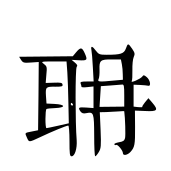
耼
Kangxi strokes: 10
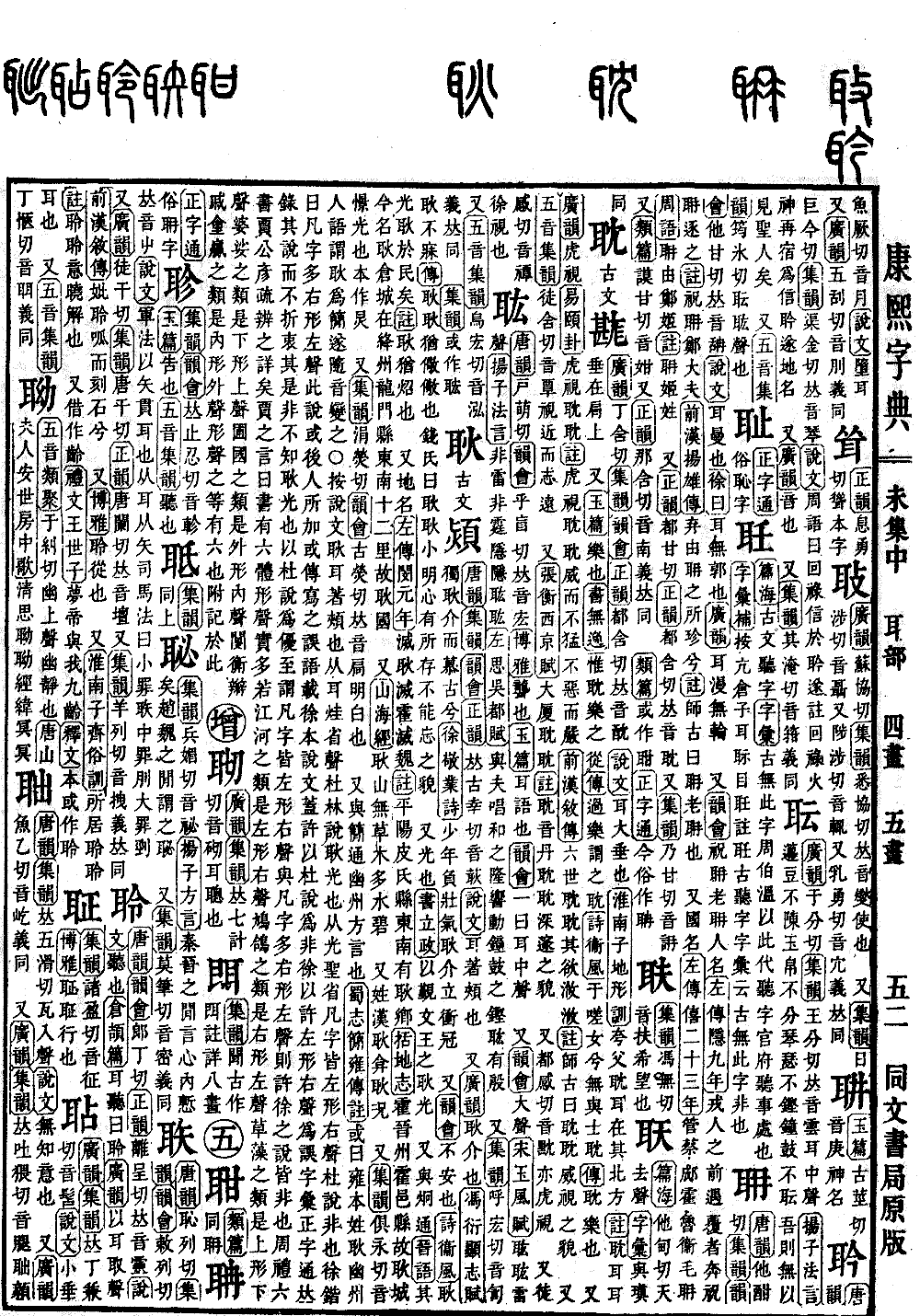
Page 966, Entry 08
Pronounced tan.
According to the Explanation of Scripts and Signs (Shuowen Jiezi), it refers to a floppy ear. Xu states it refers to an ear without a rim. According to the Broad Rhymes (Guangyun), it means an ear that is slack and lacks a helix.
Also, according to the Collection of Rhymes (Yunhui), Zhu Dan and Lao Dan are personal names. In the Zuo Tradition (Zuo Zhuan), in the ninth year of Duke Yin, it is recorded that the Rong people fled when they encountered an ambush, and Zhu Dan pursued them. The commentary notes that Zhu Dan was a high official of the Zheng state. In the History of the Former Han (Qianhan Shu), in the biography of Yang Xiong, it is written, abandoning that which was cherished by You Dan. The commentary by Shigu says that Dan refers to Lao Dan.
It is also the name of a state. In the Zuo Tradition, in the twenty-third year of Duke Xi, Guan, Cai, Cheng, Huo, Lu, Wei, Mao, and Dan are mentioned. In the Discourses of the Zhou (Zhou Yu), it is stated that Dan originated from the Ji clan of Zheng. The commentary notes that Dan had the surname Ji.
Also pronounced dan.
Also pronounced dan.
Also pronounced man.
Also pronounced nan.
The meanings are the same.
In the Classified Anthology (Leipian), it is sometimes written as a variant form. According to the Guide to Standard Characters (Zhengzitong), it is currently written as a common variant form.