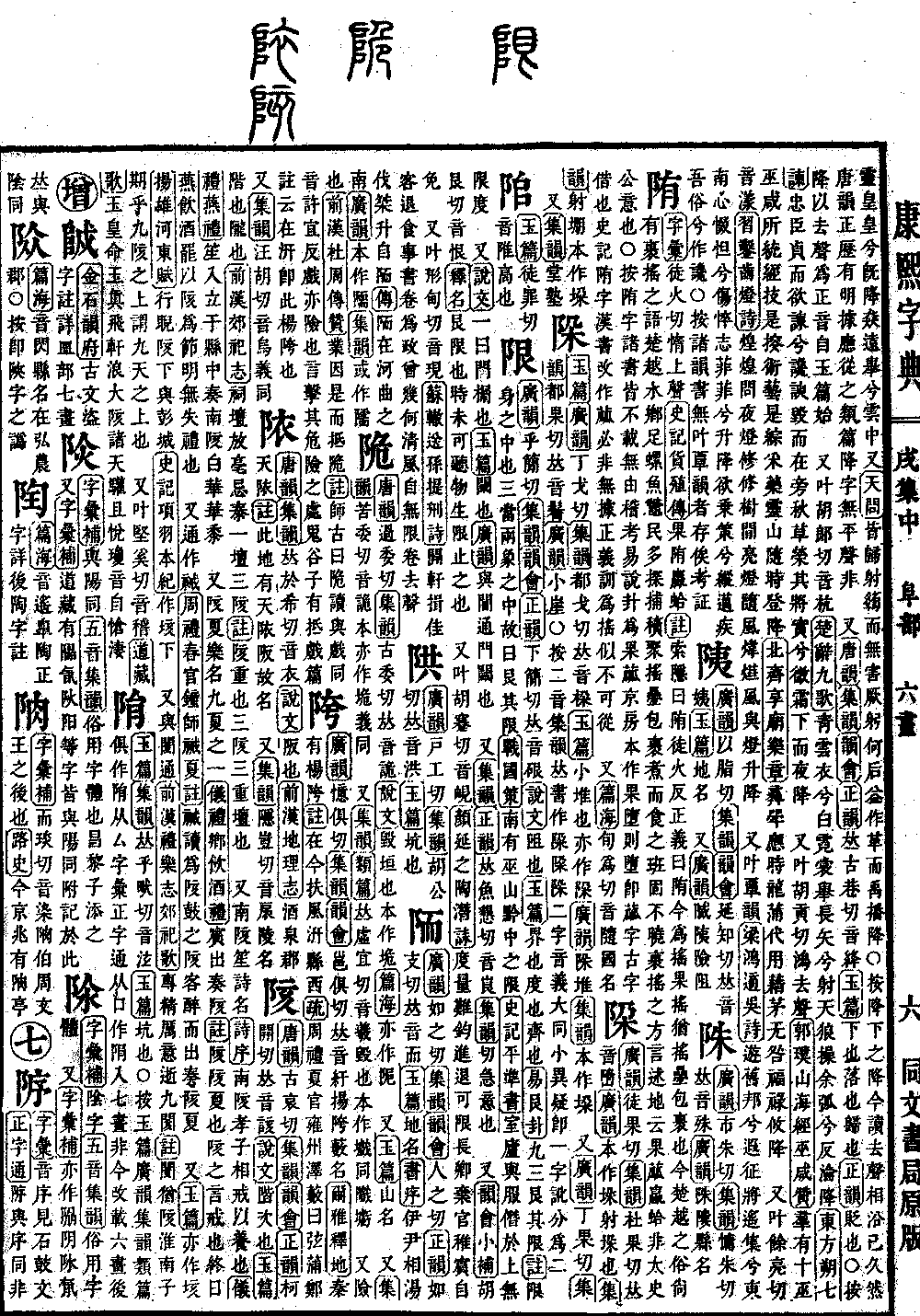
Xu Collection, Middle Volume
Radical: Mound (fù)
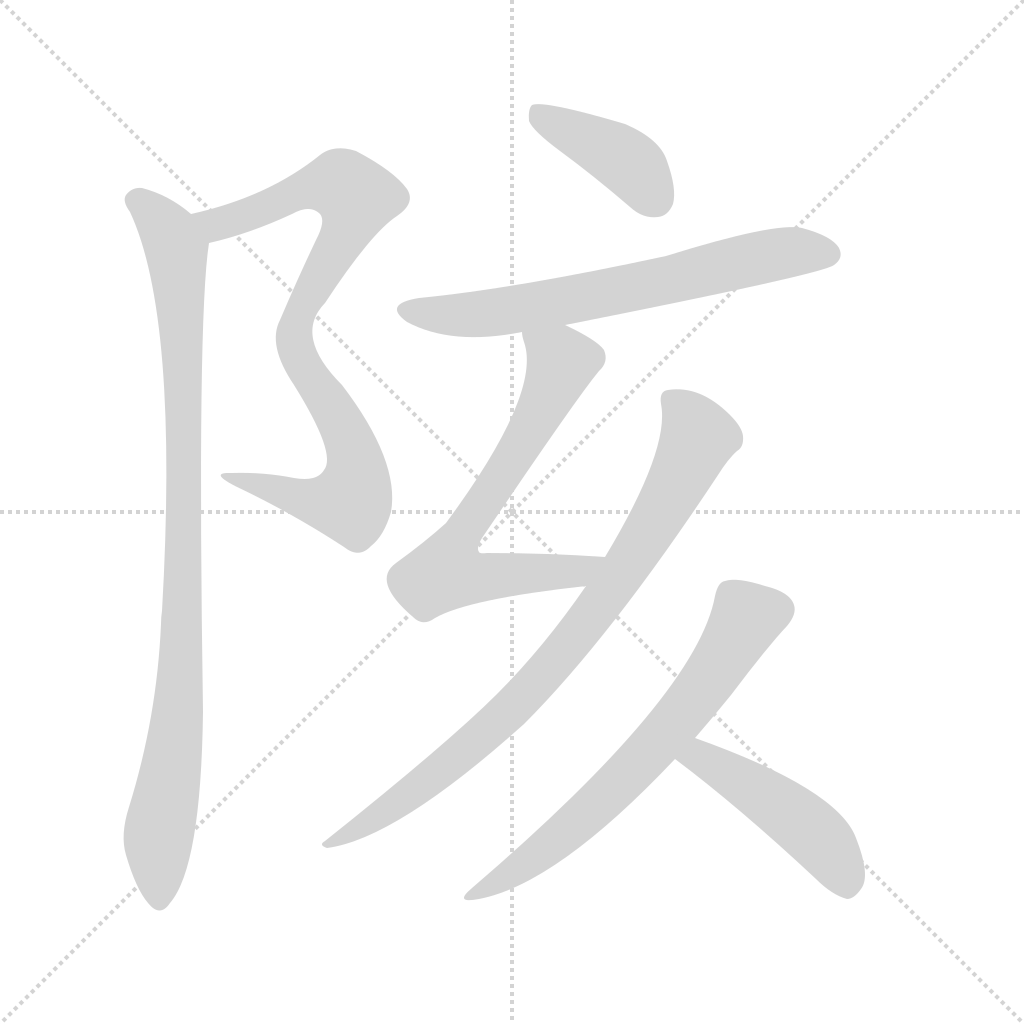
Entry: gai
Kangxi Strokes: 14
Page 1350, Number 13
According to the Tang Rhyme (Tangyun), the pronunciation is formed by the initial gu and the final ai. In the Collected Rhymes (Jiyun), Rhyme Assembly (Yunhui), and Standard Rhymes (Zhengyun), it is formed by the initial ke and the final kai. It is pronounced as gai.
In the Explaining the Meaning of Characters (Shuowen Jiezi), it is defined as steps or levels. In the Jade Chapters (Yupian), it is defined as steps or a terrace. In the History of the Former Han Dynasty (Qian Hanshu), Treatise on Sacrifices (Jiaosi Zhi), it mentions that sacrificial altars followed the style of Bo Ji's Tai altar, with one altar having three gai. The commentary explains that gai means layers, so three gai refers to a three-layered altar.
Also, South Gai (Nangai) is the name of a mouth-organ poem. The Preface to the Book of Odes (Shijing) states that South Gai describes filial sons reminding one another of the duty to support their parents. In the Etiquette and Ceremonies (Yili), Banqueting Rites (Yanli), it says that the mouth-organ players enter and stand among the hanging instruments, playing South Gai, White Blossoms, and Millet in Bloom.
Also, Gaixia is the name of a musical piece, which is one of the Nine Xia melodies. In the Etiquette and Ceremonies, District Symposium Rites (Xiangyin Jiuli), when the guests depart, the Gai is played. The commentary explains that Gai refers to Gaixia. The word gai signifies a warning or admonition. After drinking and banqueting all day, the gai is used as a rhythmic signal to end the wine service, ensuring that no breaches of etiquette occur.
Also used interchangeably with a variant form pronounced gai. In the Rites of Zhou (Zhouli), Offices of Spring, Master of Bells, a commentary on the term gaixia notes that the variant character should be read as gai, as in the gai-drum. When guests leave in a state of intoxication, the Gaixia is played.
Also, according to the Jade Chapters, it is sometimes written in a variant form pronounced gai. In Yang Xiong's Rhapsody on Hedong (Hedong Fu), it describes traveling and looking down upon Gaixia and Pengcheng. In the Records of the Grand Historian (Shiji), Basic Annals of Xiang Yu, it is written as the location Gaixia.
Also interchangeable with a character pronounced he. In the History of the Former Han Dynasty, Treatise on Ritual and Music, Hymns for the State Sacrifices, the text describes passing through the Nine He with focused spirit and vigorous intent. The commentary states that he is used in the same sense as gai. In the Master of Huainan (Huainanzi), the phrase meeting above the Nine Gai refers to being above the Nine Heavens.
Also used as a rhyming word pronounced ji. In the Songs of the Daoist Canon (Daozang), it is written that the Jade Emperor commands the Jade Perfected Ones, their flying carriages roaming the Great Gai. The various heavens are joyful and pleased, while the jade-like sounds are naturally sorrowful.