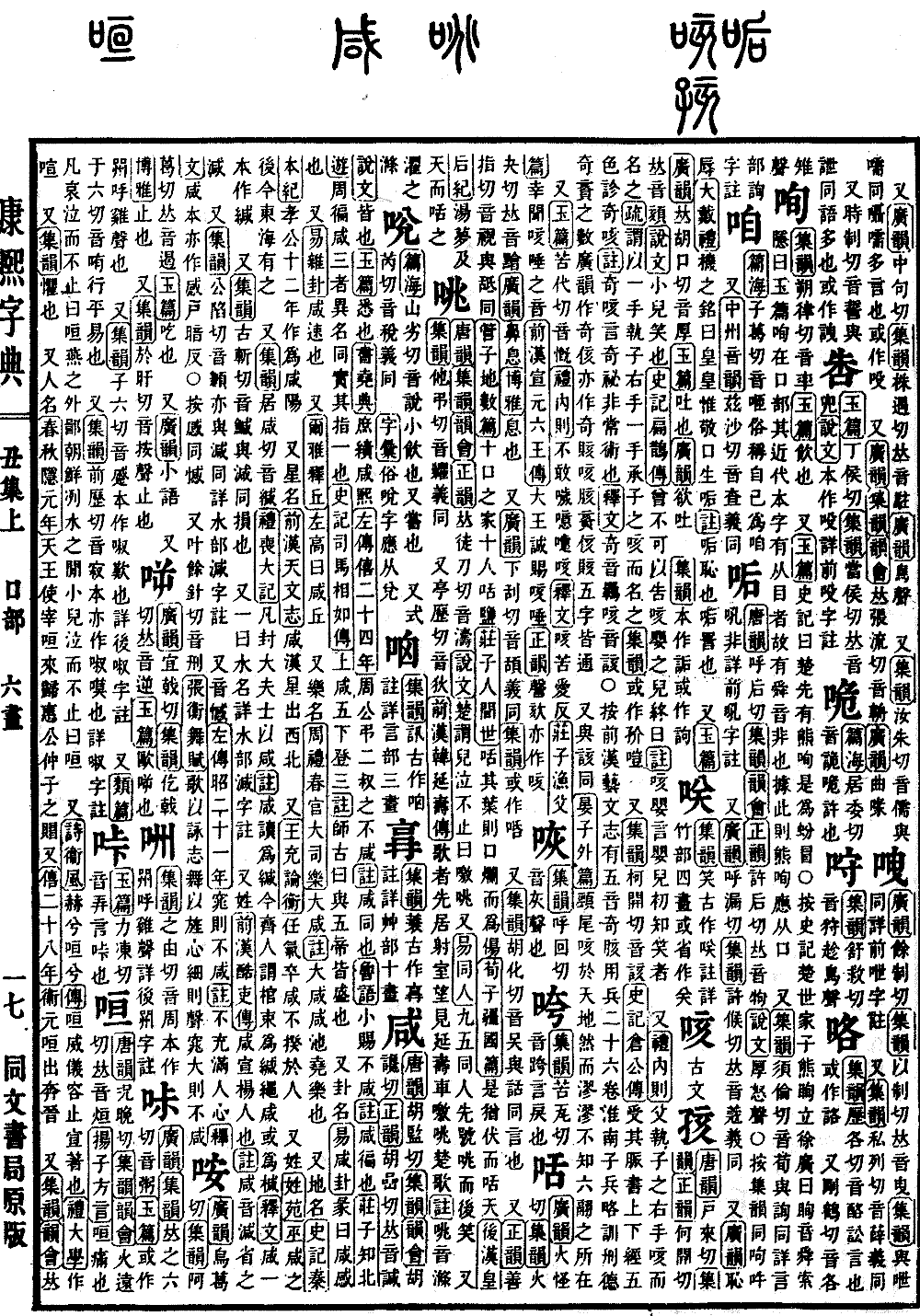
Chou Collection, Upper Volume
Radical: Mouth (kǒu)
Character: 咳
Kangxi stroke count: 9
Page 187, Entry 10
Ancient form of the character for child (hái).
Tang Dynasty Rhyme Dictionary (Tangyun): Pronounced hāi (level tone).
Collection of Rhymes (Jiyun) and Correct Rhymes (Zhengyun): Pronounced hāi (level tone), sounds like kē.
Explanatory Notes on Characters and Phrases (Shuowen): The laughter of a young child.
Records of the Grand Historian (Shiji), Biography of Bian Que: Cannot even be told to a child who has just begun to laugh (kai).
Commentary: Kai-ying refers to an infant who has just learned to laugh.
Also, Book of Rites (Liji), Inner Chapters: The father grasps the child's right hand, laughs (hai), and names him.
Sub-commentary: It means to hold the child's right hand with one hand, and support the child's laughter (hai) with the other while naming him.
Collection of Rhymes (Jiyun): Sometimes written as a variant form.
Also, Collection of Rhymes (Jiyun): Pronounced gāi (level tone).
Records of the Grand Historian (Shiji), Biography of Cang Gong: Received their pulse texts, upper and lower classics, and the five-color diagnostic technique of miraculous (qi) laughter (hai).
Commentary: Qi-hai refers to miraculous and secret techniques that are extraordinary.
Collected Explanations: Qi is pronounced jī (level tone), and hai is pronounced gāi (level tone).
According to the History of the Former Han (Qianhan), in the Treatise on Arts and Literature, there are twenty-six volumes of Five Tones and Miraculous (qi) Techniques (gāi) for Military Use. In the Huainanzi, section on Military Strategies, it mentions the numbers of virtue, the miraculous (qi), and the exhaustive (gāi). In the Extensive Rhyme Dictionary (Guangyun), it is written as qi (miraculous) and gai (extraordinary). The five characters hai, gai, gai, gai, and gai are all interchangeable.
Also, same as gai (exhaustive).
Yanzi, Outer Chapters: The neck and tail cover (gai) the heaven and earth, yet they are vast and do not know where the six feathers are.
Also, Jade Chapter (Yupian): Pronounced kǎi (departing tone).
Book of Rites (Liji), Inner Chapters: One does not dare to vomit, belch, sneeze, or cough (hai).
Explanation of Text: Hai, pronounced kǎi (departing tone).
Zhuangzi, Fisherman Chapter: Fortunate to hear the sounds of coughing (hai) and spitting.
History of the Former Han (Qianhan), Biographies of the Six Kings of the Xuan and Yuan Reigns: The great king is willing to bestow coughs (hai) and spittle.
Correct Rhymes (Zhengyun): Qing-kai (coughing), also written as hai.
Textual Research: In Records of the Grand Historian (Shiji), Biography of Bian Que, it originally included the words the whole day. Note: The words the whole day belong to the following sentence; Bian Que looked up to the sky and sighed, so they should not be connected to the previous sentence. They have been removed.
In Records of the Grand Historian (Shiji), Biography of Cang Gong, the original text reads miraculous (qi) and laughter (hai) technique. Note: The three characters are read together, and the word technique cannot be omitted. The word technique has been added after laughter (hai).
In Explanation of Text, it is noted that qi is pronounced jī, and hai is pronounced gāi. Note: This has been corrected to match the Collected Explanations in the original book.