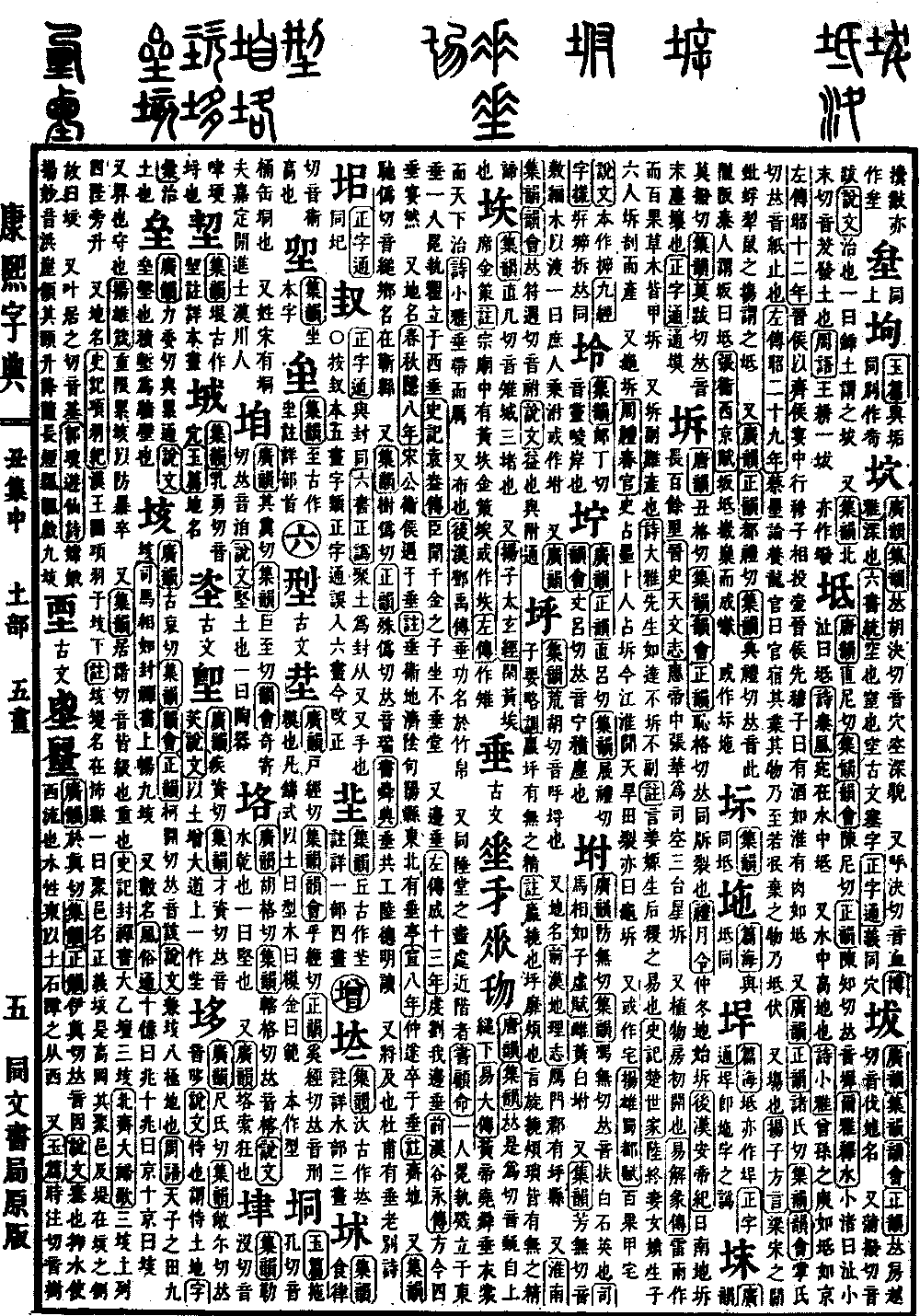
Chou Collection, Middle Volume
Radical: Earth (tǔ)
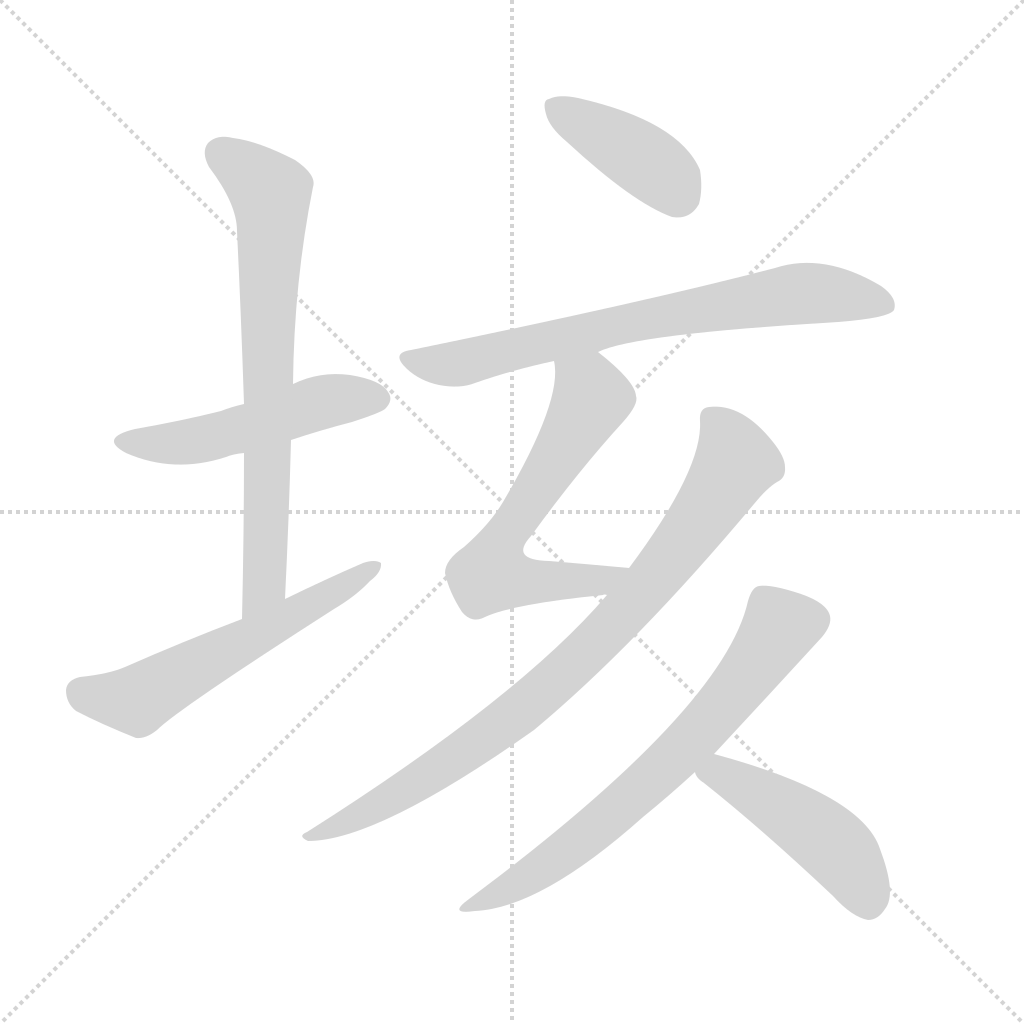
垓
Kangxi stroke count: 9
Page 227, Entry 40
Pronounced gai.
According to the Shuo Wen Jie Zi (Explicating Graphs and Explaining Characters), it means to encompass or cover the eight extremities of the earth. It cites the Discourses of the States (Guoyu): The Son of Heaven dwells in the fields of the nine outer boundaries. In Sima Xiangru's Records of the Feng and Shan Sacrifices, it is written: Ascending to permeate the nine outer boundaries.
Also a numerical name. According to the Comprehensive Customs (Fengsu Tong), one hundred million is called a zhao, ten zhao is called a jing, and ten jing is called a gai.
Also means a boundary or to guard. In the Admonitions by Yang Xiong, it is written: Heavily walled and layered in boundaries to guard against sudden violence.
Also, as cited in the Collected Rhymes (Jiyun), pronounced jie. It means a level or a layer. In the Records of the Grand Historian (Shiji), Records of the Feng and Shan Sacrifices, it states: The altar of the Great Yi consists of three levels. In the Songs of the Great Sacrifice of the Northern Qi, it is written: Three levels are arranged above, four stairways rise to the side.
Also a place name. In the Records of the Grand Historian (Shiji), Biography of Xiang Yu, it is written: The King of Han besieged Xiang Yu at Gaixia. The commentary notes: Gai is the name of an embankment located in Pei County. One source says it is the name of a gathered settlement. The True Meaning (Zhengyi) states: Gai is a high ridge; the settlement and the embankment are located by the side of the ridge, thus it is called Gai.
Also, rhyming with ji, pronounced ji. In Guo Pu's Poems on Wandering Transcendents, it is written: Chang'e raises a marvelous sound, Hongya nods his chin. Ascending and descending following the long mists, fluttering and playing in the nine outer boundaries.
Editorial Note: Regarding the citation of the Discourses of the Zhou (Zhouyu) in the original text, it has been corrected according to the original text of the Shuo Wen Jie Zi to cite the Discourses of the States (Guoyu): The Son of Heaven dwells in the fields of the nine outer boundaries.