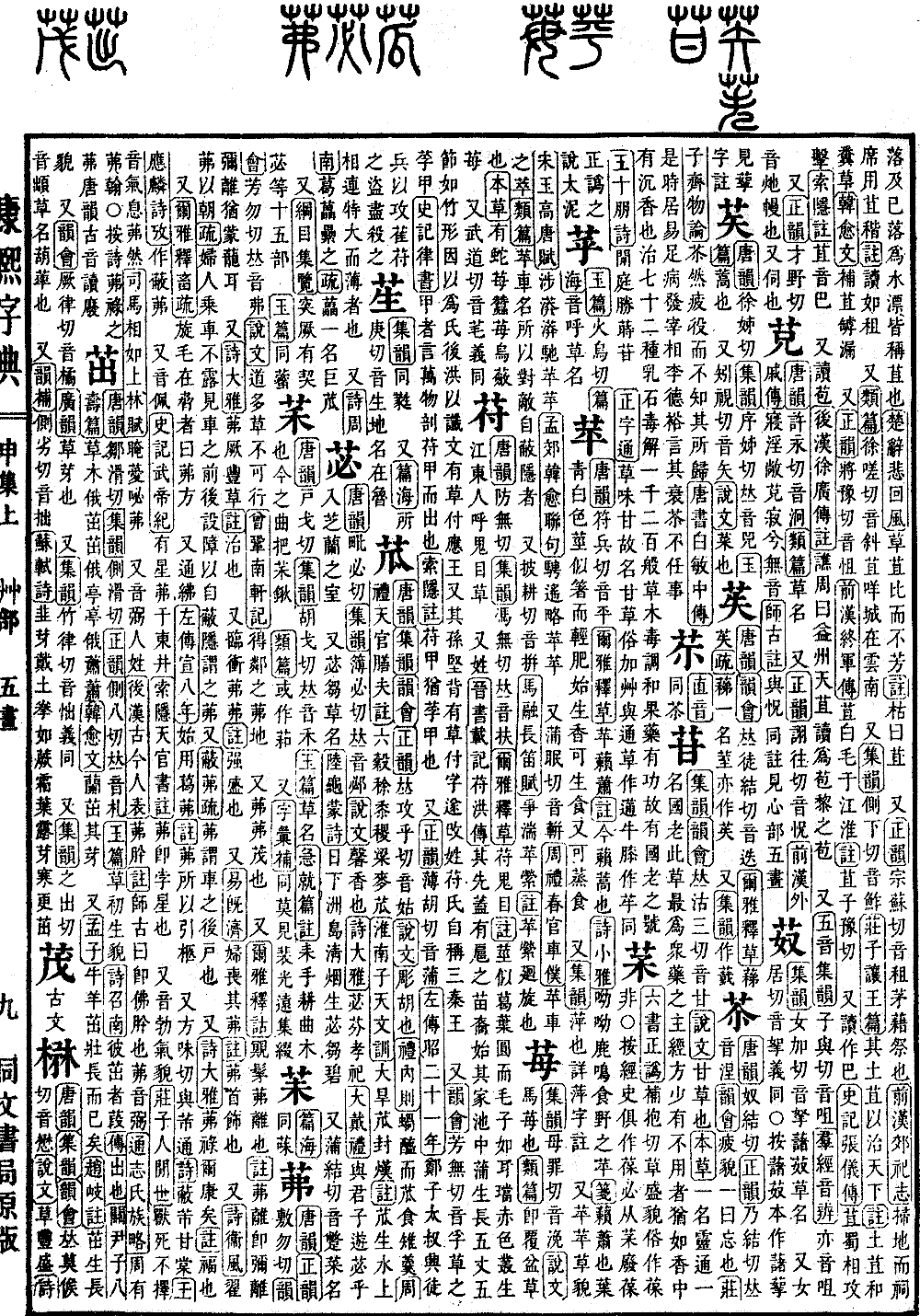
Shen Collection, Upper Volume
Radical: Grass (cǎo)
Kangxi Strokes: 11
Page 1025, Entry 18
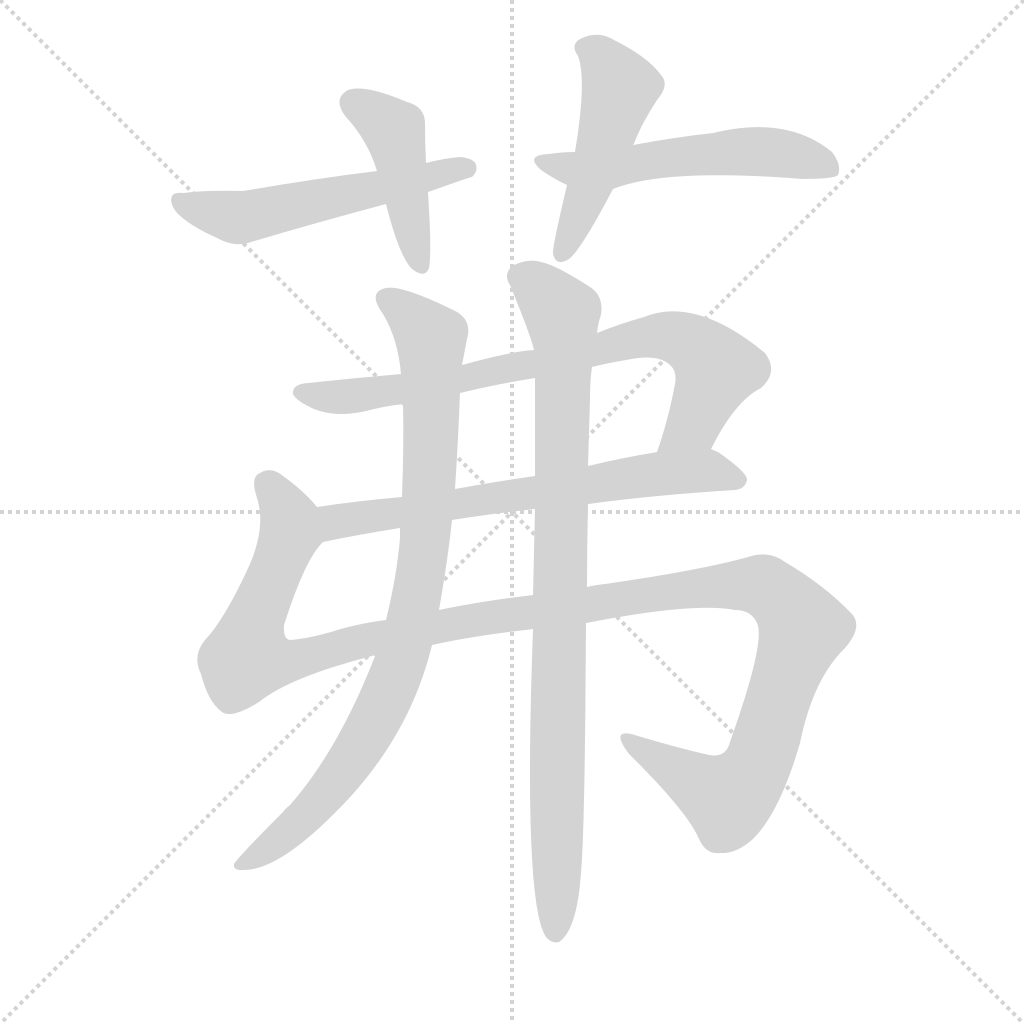
Tang Dynasty Rhyme (Tangyun), Correct Rhymes (Zhengyun): Pronounced fu. Rhyme Meeting (Yunhui): Pronounced fu. Pronounced fu.
Shuowen Jiezi: A road overgrown with grass that is impassable.
Zeng Gong, Record of the South Pavilion (Nanxuan Ji): Obtained the overgrown (fu) land from a neighbor.
Also, fu fu, meaning lush or flourishing.
Also, Erya, Interpretation of Ancient Terms (Shi Gu): Mengmao means fu li. Note: Fu li is the same as mi li; mi li simply means overgrown and dense.
Also, Book of Odes (Shijing), Greater Odes (Daya): Clear away (fu) the thick grass. Note: Meaning to cultivate or weed.
Also, the approach of the chariots is fu fu. Note: Meaning strong and flourishing.
Also, Book of Changes (Yijing), After Completion (Jiji): The wife loses her fu. Note: Fu is a head ornament.
Also, Book of Odes (Shijing), Odes of Wei (Weifeng): With pheasant feathers decorating the carriage (fu) to attend court. Commentary: When a woman rides in a carriage, she should not be exposed; a screen is set up at the front and back of the carriage to conceal her, which is called fu.
Also, Commentary on Concealing Screens (Bi fu shu): Fu refers to the rear door or covering of a carriage.
Also, Book of Odes (Shijing), Greater Odes (Daya): Happiness (fu) and emolument bring you peace. Note: Meaning good fortune (fu).
Also, Erya, Commentary on Interpretation of Domestic Animals (Shi chu shu): A swirl of hair on the flank is called fu fang.
Also, used interchangeably with fu (a mourning rope). Zuo Tradition (Zuozhuan), Eighth Year of Duke Xuan: First used the kudzu rope (fu). Note: Fu is that which is used to pull a hearse.
Also, pronounced wei. Used interchangeably with fei. Book of Odes (Shijing): Dense (fei) is the sweet pear tree. Wang Yinglin, Examination of the Odes (Shi kao): Written as bi fu.
Also, pronounced pei. Records of the Grand Historian (Shiji), Annals of Emperor Wu: A star appeared (fu) in the Dongjing constellation. Note, Commentary on the Universal Hidden Meaning (Suoyin), Commentary on the Treatise on Celestial Offices (Tianguan shu): Fu is the same as the comet (bo).
Also, pronounced bo. Appearance of breath or vapor. Zhuangzi, The Human World (Renjianshi): Animals about to die do not choose their cries, their breathing is labored (fu ran). Sima Xiangru, Rhapsody on the Upper Forest (Shanglin fu): Ai bi fu.
Also, pronounced bi. A human surname. History of the Former Han (Qianhan), Table of Ancient and Modern Persons: Fu Xi. Note: Yan Shigu says: This is the same as Bi Xi. Fu is pronounced bi. Comprehensive Records (Tongzhi), Biographies of Clans: In the Zhou dynasty, there was Fu Han. According to the Odes, the fu in the phrase fu lu (fortune and emolument), in the Tang Dynasty Rhymes (Tangyun), the archaic pronunciation is read as fei.
Textual Research: In the History of the Former Han (Qianhan), Table of Ancient and Modern Persons, it is recorded as Fu Xi. We have corrected the original text from History of the Later Han (Houhan) to History of the Former Han (Qianhan).