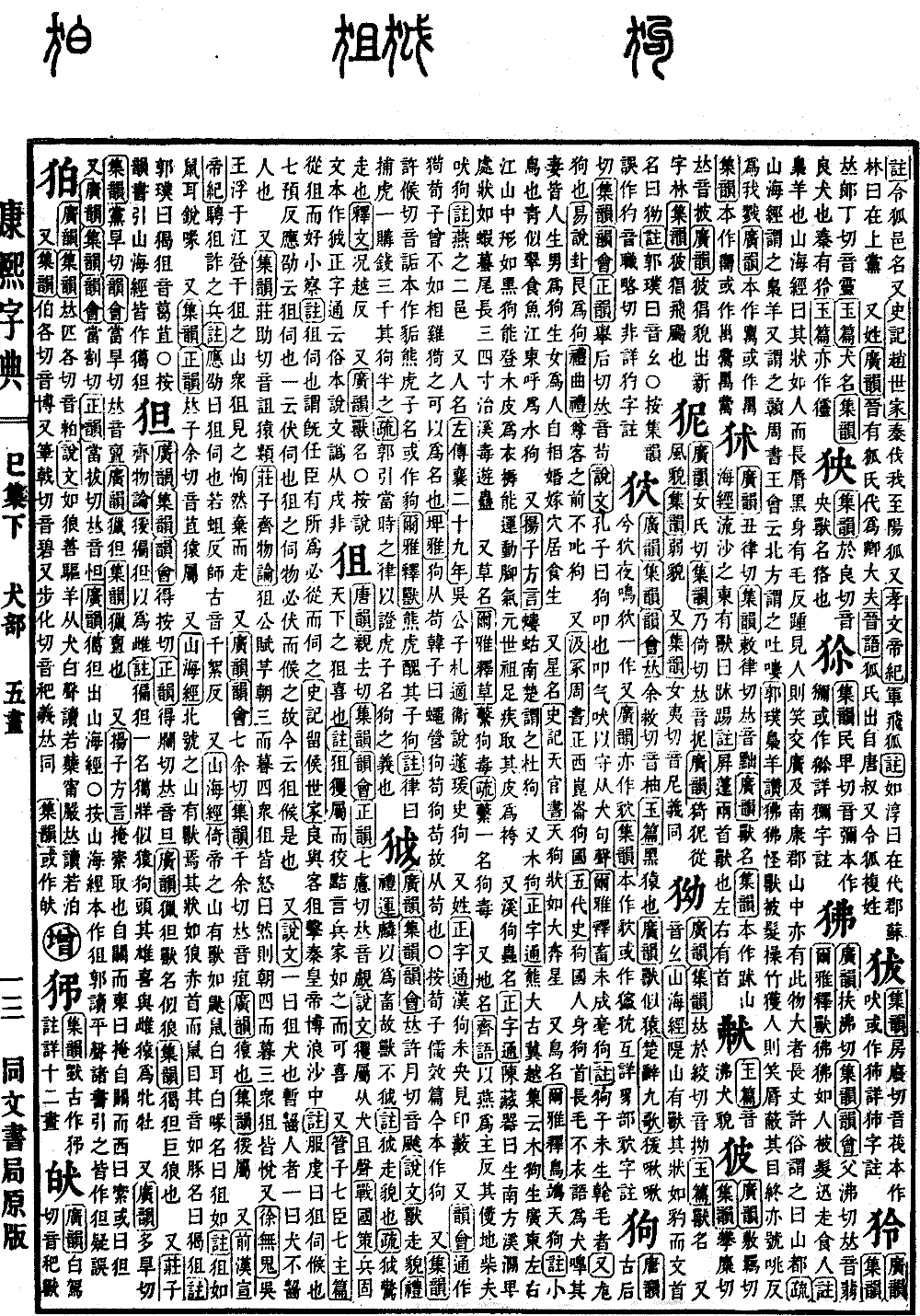
Si Collection, Lower Volume
Radical: Dog (quǎn)
狒
Kangxi Strokes: 9
Page 709, Entry 05
Broad Rimes (Guangyun): Pronounced fei (falling tone). Collected Rimes (Jiyun) and Rhyme Compendium (Yunhui): Pronounced fei (falling tone).
Erya (Erya): Explaining Beasts: The feifei resembles a human, with hair hanging loosely and disheveled, moves very quickly, and eats humans. Commentary: It is the same as the xiaoyang. The Classic of Mountains and Seas (Shanhaijing) states: Its appearance is like a human with long lips, a black body, covered in hair, with heels growing in reverse; it laughs when it sees humans. This creature also exists in the mountains of Jiaozhou, Guangzhou, and Nankang Prefecture, with the largest specimens reaching over one zhang in length; they are colloquially called shandu.
Sub-commentary: The Classic of Mountains and Seas (Shanhaijing) refers to it as xiaoyang, and also as gan. The Book of Zhou (Zhoushu), Chapter on Royal Assemblies (Wanghui Pian), states: In the north, it is called tulu.
Guo Pu, Eulogy for the Xiaoyang: The feifei is a type of strange beast that leaves its hair disheveled and carries a bamboo pole. When it captures a human, it laughs, and its lips are large enough to cover its eyes. Eventually, it will wail loudly and be killed by me.
Broad Rimes (Guangyun): Originally written as the character variant. Sometimes also written as the character variant. Collected Rimes (Jiyun): Originally written as the character variant. Sometimes also written as the character variant.