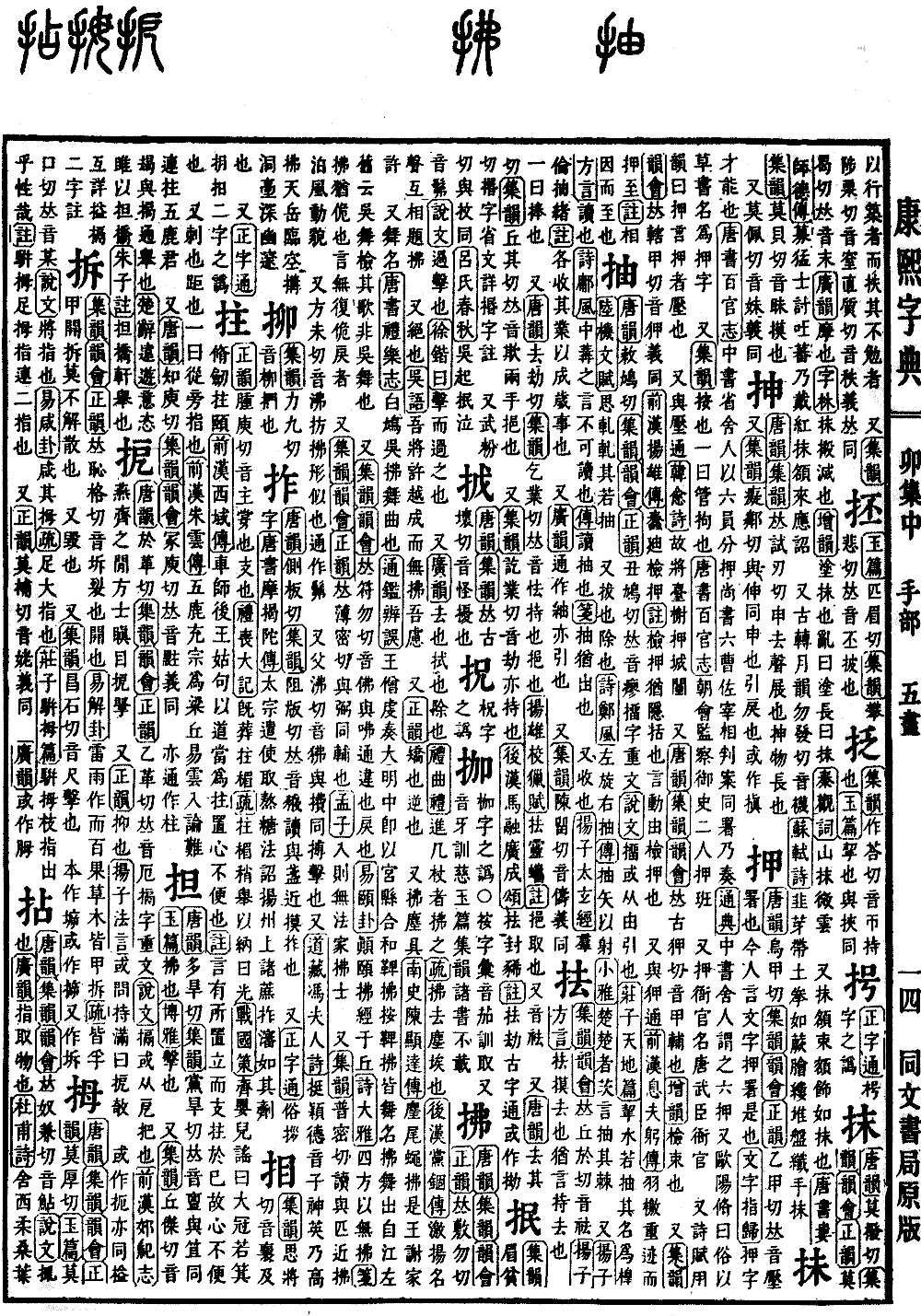
Mao Collection, Middle Volume
Radical: Hand (shǒu)
Page 424, Entry 14
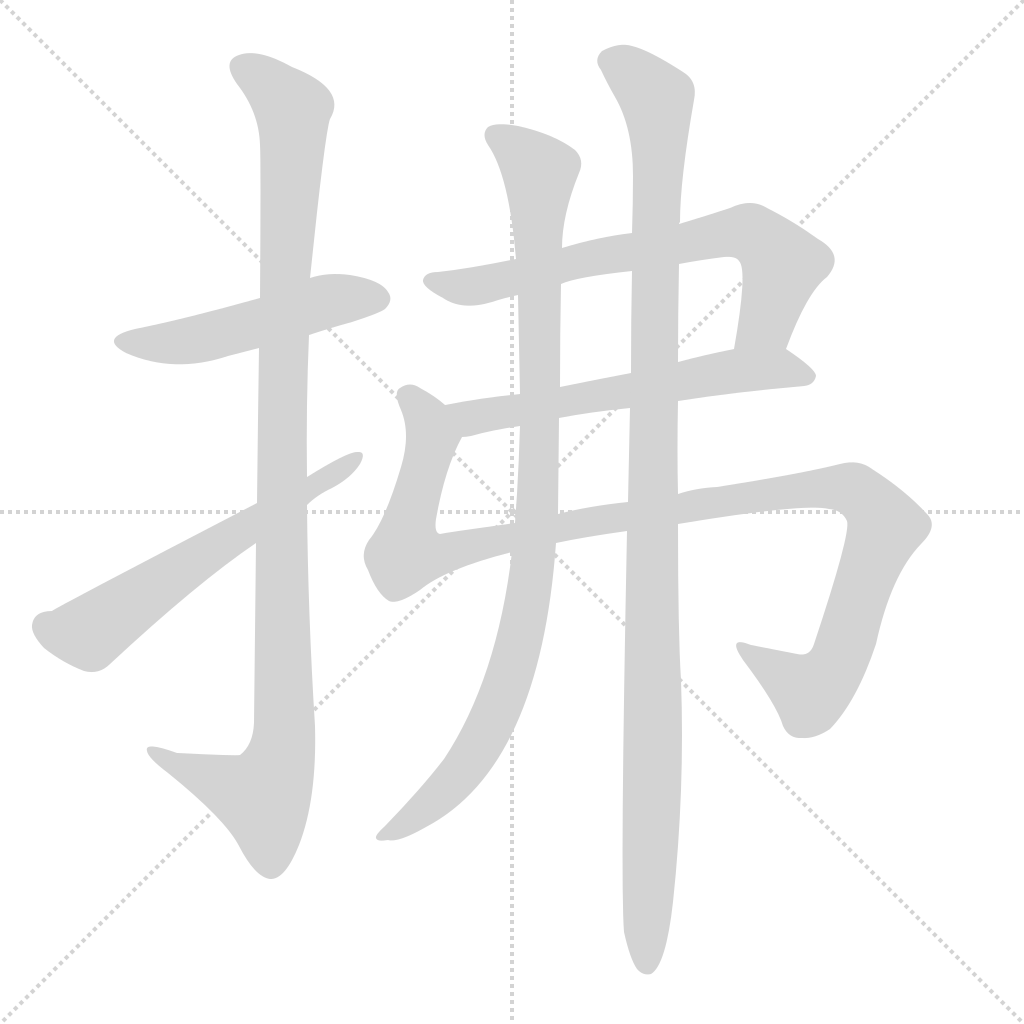
Tang Rhymes (Tangyun), Collection Rhymes (Jiyun), Rhyme Compendium (Yunhui), Correct Rhymes (Zhengyun): Pronounced fu. Pronunciation is the same as the character for a hairstyle resembling horns.
Shuowen Jiezi explains: To strike in passing. Xu Kai says: It means to strike as one passes by.
Guangyun: Also means to remove, wipe, or clear away.
Book of Rites (Liji), Songs on Rituals: Those who present desks and walking sticks must wipe them clean. Commentary: Refers to brushing away dust.
Book of the Later Han (Hou Hanshu), Biography of Partisan Prohibitions: To inspire and promote fame, mutually commending and praising one another.
Also means to sever.
Discourses of the States (Guoyu), Discourses of Wu: I shall agree to the peace request of the state of Yue, and will not go against my considerations.
Correct Rhymes (Zhengyun): Also means to correct or to disobey/defy.
Also refers to a tool known as a whisk. Book of Southern Dynasties (Nan Shi), Biography of Xianda: Antler tails and fly whisks are items that only elite clans such as the Wang and Xie families are permitted to use.
Also refers to a type of dance. Book of Tang (Tangshu), Treatise on Rites and Music: The White Dove Dance and the Wu Whisk Dance are both dance melodies. Commentary on the Comprehensive Mirror (Tongjian Bianwu): Wang Sengqian submitted a memorial stating that during the Daming era, the court orchestra was used to accompany the bell dance and the whisk dance. Note: The bell dance and the whisk dance are both names of dances; the whisk dance originated in the Jiangnan region. Older sources claim it is a dance of the Wu region, but an examination of its lyrics shows it is not a Wu dance.
Collection Rhymes (Jiyun), Rhyme Compendium (Yunhui): Pronounced fu. The pronunciation is the same as the character for Buddha. It is interchangeable with the character meaning to disobey or be perverse. Book of Changes (Yijing), Yi Hexagram: To invert the way of nourishment, going against reason in the hill garden. Book of Odes (Shijing), Greater Odes: Because of this, there were no disobedient people in the four quarters. Commentary: This means to be perverse, implying there were no longer any perverse or rebellious people.
Collection Rhymes (Jiyun), Rhyme Compendium (Yunhui), Correct Rhymes (Zhengyun): Pronounced bi. The same as the character for assist. Mencius: If within the country there are no ministers who uphold the laws and no virtuous worthies to provide assistance.
Collection Rhymes (Jiyun): Pronounced pi. Fubo describes the appearance of wind blowing.
Also pronounced fei. Refers to something similar in shape. Used as a loan character for the character for a hairstyle resembling horns.
Also pronounced fei. The same as the character for to strike or wrestle.
Daoist Canon (Daozang), Poem of Lady Feng: The outstanding, wise, and virtuous gentleman has a heroic and extraordinary spirit. Mount Tianyue is built against the sky, and its grottoes are deep, mysterious, and profound.