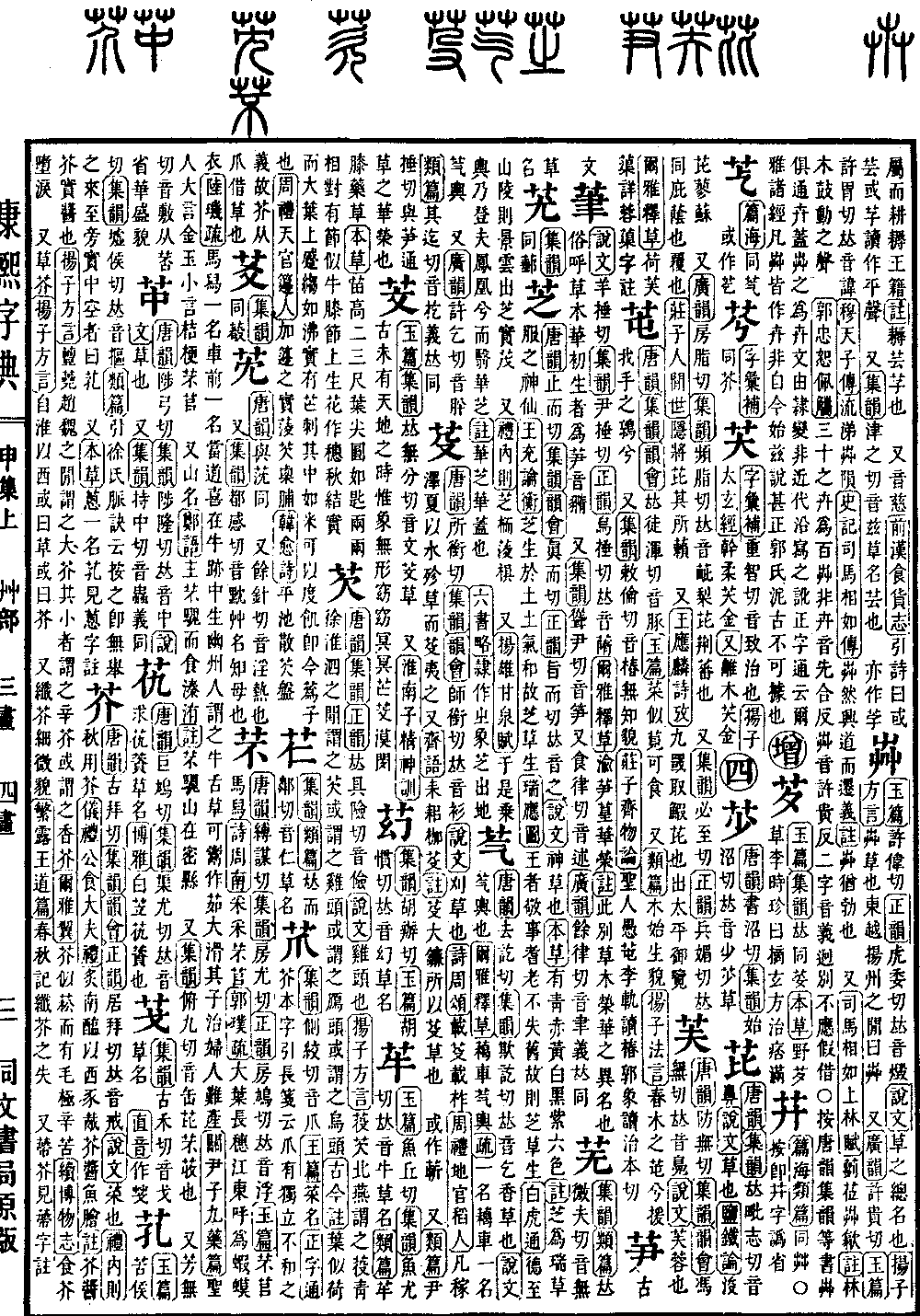
Shen Collection, Upper Volume
Radical: Grass (cǎo)
Kangxi Strokes: 10
Page 1019, Entry 26
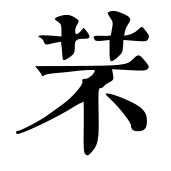
Pronounced fu.
According to the Erya (Approaching Elegance), the entry for grasses states that the plant known as fuyi is also called maxie, and maxie is also called cheqian (plantain). Guo Pu, in his commentary, notes that it has large leaves and long spikes, and in the region east of the Yangtze River, it is called hamayi (toad clothing).
In the Book of Odes (Shijing), it is written: "Gathering, gathering the fuyi." Lu Ji, in his sub-commentary, notes that it is also known as dangdao (blocking the road), as it prefers to grow in the ruts of ox carts. In the You province, it is called niushecao (ox-tongue grass). It can be boiled as a vegetable, as it is very slippery, and its seeds can be used to treat difficult childbirth in women.
In the Guanyinzi, in the chapter on Nine Medicines, it is written: "The sage speaks of major things like gold and jade, and minor things like platycodon and fuyi."
Also, the name of a mountain. In the Discourses of the States (Guoyu), it is written: "Ruling Fuyi and Kui, and eating from the Zhen and Wei rivers." The commentary notes that Fuyi Mountain is located in Mi County.
Also, pronounced fou. In the sense of biefou, meaning a type of mallow.
Also, pronounced fu. Derived from a simplified form. Describes the appearance of lush flowers.
Textual research: The original entry cited the Jade Records (Yupian) regarding fuyi and maxie, the Book of Odes, Guo Pu's sub-commentary, and Lu Ji's sub-commentary regarding maxie and cheqian. Given that the Mao commentary on the Book of Odes does not contain a sub-commentary by Guo Pu, the relevant thirty-six characters have been corrected to read: According to the Erya, the entry for grasses states that the plant known as fuyi is also called maxie, and maxie is also called cheqian. Guo Pu, in his commentary, notes that it has large leaves and long spikes, and in the region east of the Yangtze River, it is called hamayi. In the Book of Odes, it is written: "Gathering, gathering the fuyi." Lu Ji, in his sub-commentary, notes that it is also known as dangdao.