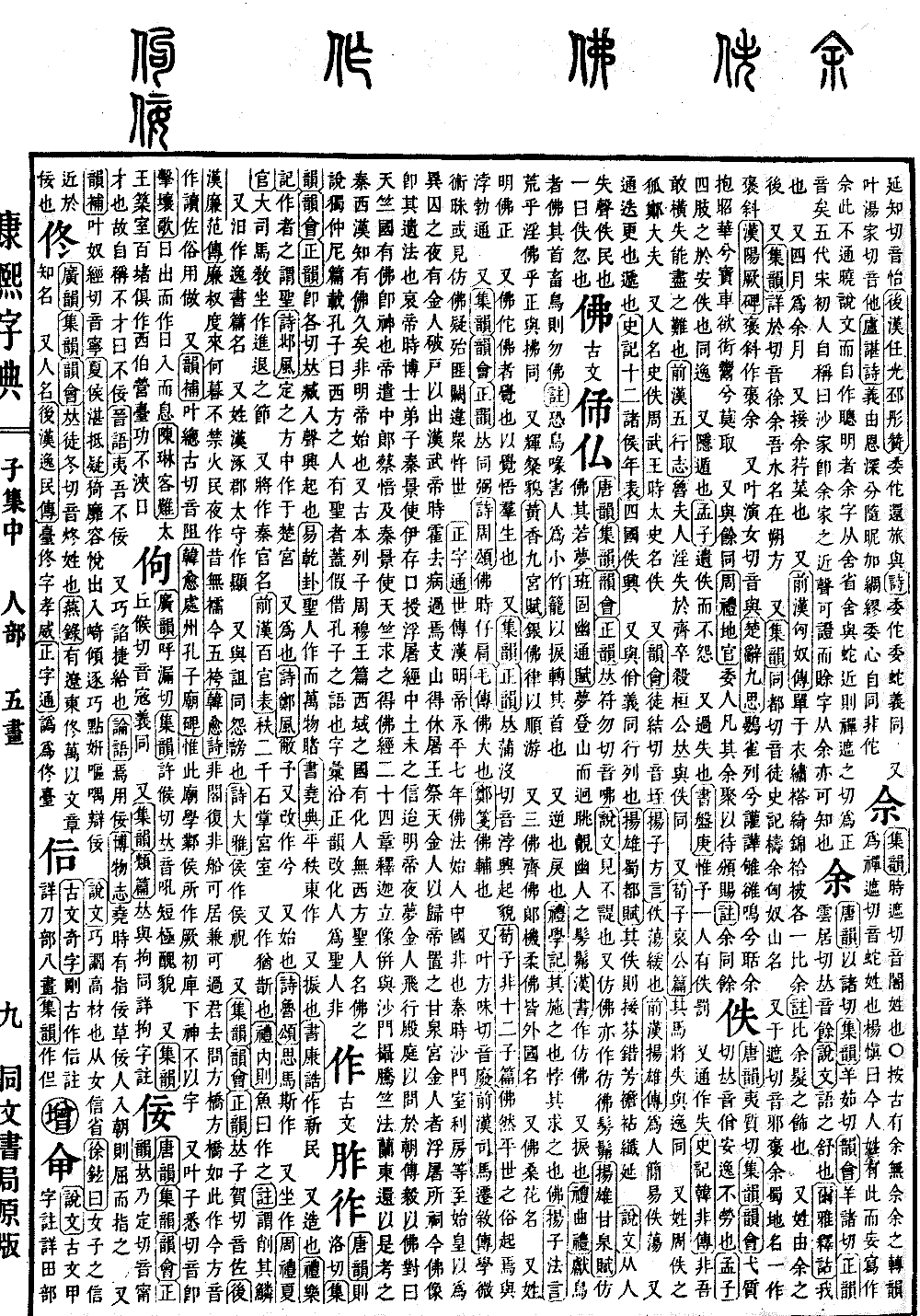
Zi Collection, Middle Volume
Radical: Person (ren)
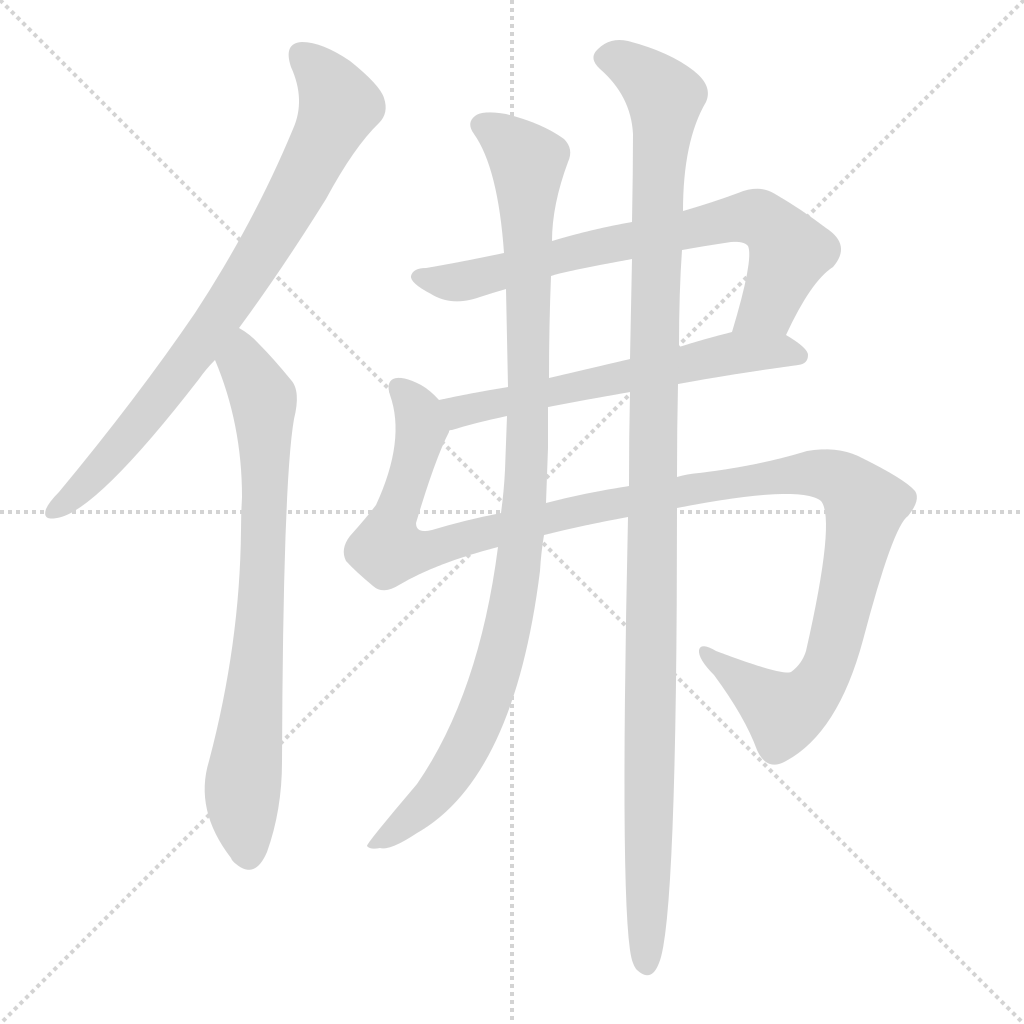
Fu
Kangxi stroke count: 7
Page 99, Number 04
Ancient script form written as fu.
Pronounced fu in Tang Rhymes (Tangyun), Collected Rhymes (Jiyun), Rhyme Meetings (Yunhui), and Correct Rhymes (Zhengyun).
To see indistinctly — Analytical Dictionary of Characters (Shuowen Jiezi).
Also used in the term fangfu, meaning seemingly or resembling.
It seemed like a dream — Ganquan Ode (Ganquan Fu) by Yang Xiong.
Dreaming of climbing a mountain to gaze afar, I glimpsed the faint image of a recluse — Ode on Communicating with the Hidden (Youtong Fu) by Ban Gu.
The Book of Han (Hanshu) writes this as fangfu.
Also means to twist.
When presenting a bird, one should twist its head; when raising a bird, do not twist it — Book of Rites (Liji), Rites of Qu (Quli).
The commentary notes: Fearing the bird's beak might harm people, a small bamboo cage is used to turn its head away.
Also means to go against or to be perverse.
What is given is contrary to reason, and what is sought is perverse — Book of Rites, Record on Education (Xueji).
Wild and licentious, going against what is correct — Model Sayings (Fayan) by Yangzi. In this sense, it is the same as the character fu meaning to brush away or oppose.
Also describes an appearance of brightness and splendor.
Silver brilliance flows smoothly — Ode to the Nine Palaces (Jiugong Fu) by Huang Xiang.
Also used in Sanfoqi for Srivijaya, Folangji for the Franks, and Roufo for Johor, all of which are names of foreign countries.
Also used in fusang, the name of a flower known as Chinese Hibiscus.
Also a surname; during the Ming dynasty, there was a person named Fu Zheng.
Also Fotuo. Buddha means an enlightened one, referring to one who awakens all living beings.
Pronounced bo in the Collected Rhymes and Correct Rhymes.
The appearance of rising up suddenly.
Suddenly the customs of a peaceful world arise — Xunzi, Chapter Against the Twelve Philosophers (Fei Shierzi Pian). In this context, it is used interchangeably with the character bo meaning to rise.
Pronounced bi in the Collected Rhymes, Rhyme Meetings, and Correct Rhymes, where it is used the same as the character bi meaning to assist.
Support this burden of responsibility — Book of Odes (Shijing), Sacrificial Odes of Zhou (Zhou Song).
The Mao Commentary (Mao Zhuan) states: Fu means great.
The Zheng Commentary (Zheng Jian) states: Fu means to assist.
Also rhymes as fei.
One’s learning is subtle and methods obscure; perhaps seeing indistinctly leads to doubt and danger without being complete, contradicting the masses and offending the world — History of the Former Han (Qian Hanshu), Postface of Sima Qian (Sima Qian Xuzhuan).
The Correct Character Guide (Zhengzitong) notes: Popular tradition states that the Buddhist law first entered China in the seventh year of the Yongping era of Emperor Ming of the Han dynasty, but this is incorrect. During the Qin dynasty, the monks Shilibang and others arrived; the First Emperor thought them strange and imprisoned them. At night, a golden figure broke the doors to let them out. During the time of Emperor Wu of the Han dynasty, Huo Qubing passed the Yanzhi Mountains and obtained the golden figure used by the King of Xiutu to worship Heaven and brought it back; the Emperor placed it in the Ganquan Palace. The golden figure was what the Buddhists worshipped, and modern Buddha statues follow this tradition. During the time of Emperor Ai, the student Qin Jing was orally taught Buddhist scriptures by Yicun, but it was not believed in the Central Plains. Later, Emperor Ming dreamed of a golden figure flying in the palace courtyard and asked his court about it. Fu Yi answered regarding the Buddha, saying: In the kingdom of Tianzhu, there is a Buddha, which is a deity. The Emperor sent Central Palace Attendant Cai Yin and Qin Jing to Tianzhu to seek it; they obtained twenty-four chapters of Buddhist scriptures and a standing statue of Shakyamuni, returning east with the monks Shemoteng and Zhu Falan. Based on this, the Qin and Western Han dynasties knew of the Buddha for a long time; it did not begin with Emperor Ming. Also, in the ancient text of Liezi, in the Chapter of King Mu of Zhou (Zhou Mu Wang Pian), it mentions transformed people from the Western Regions, but not the specific term Buddha for a Western sage. Only the Chapter of Zhongni (Zhongni Pian) records Confucius saying: Among the people of the West, there is a sage. This is likely borrowing the words of Confucius. The dictionary Zihui followed the Correct Rhymes and changed transformed people to sage, which is incorrect.