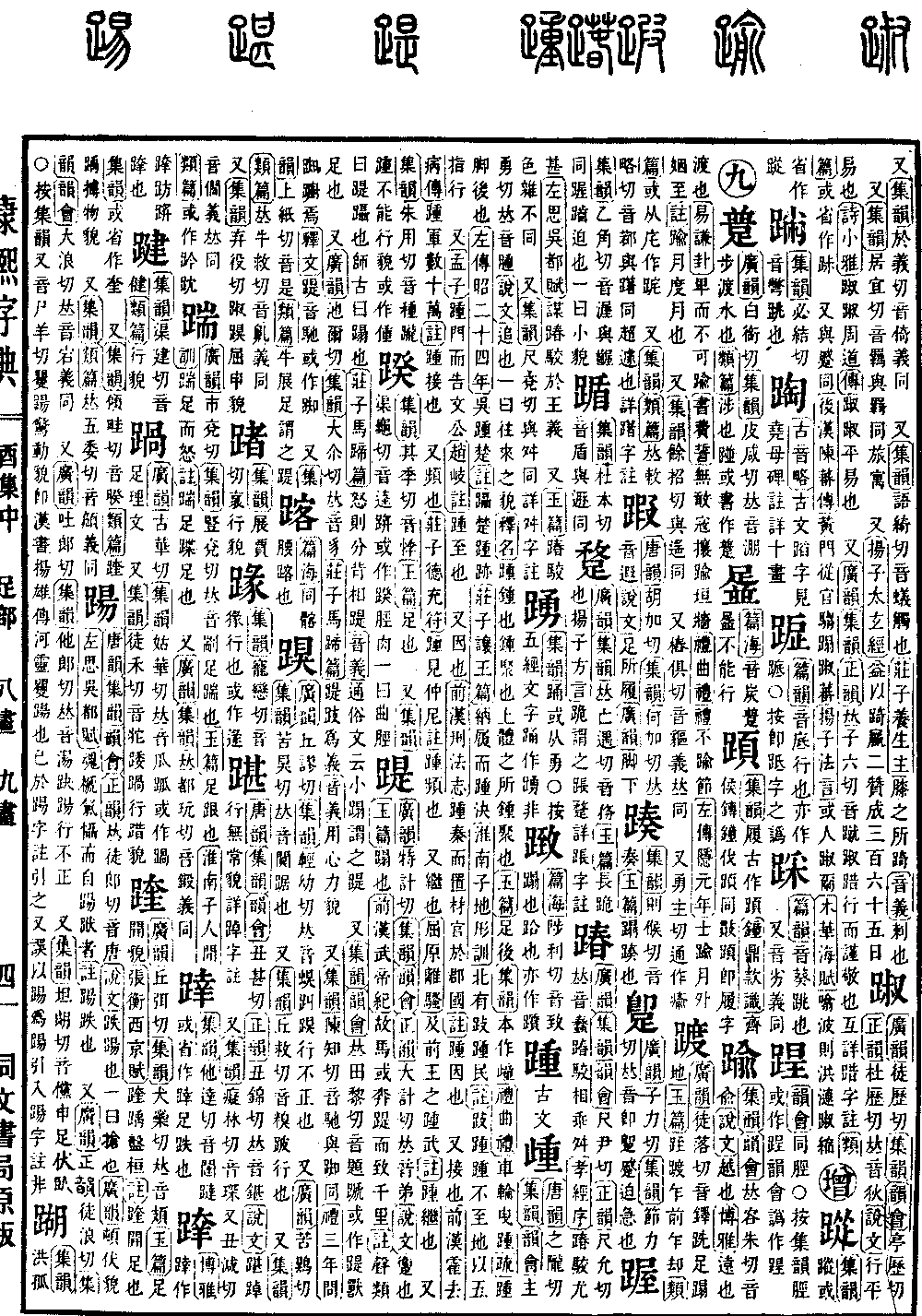
You Collection, Middle Volume
Radical: Foot (zú)
Character: di
Kangxi strokes: 16
Page 1229, Entry 25
Pronounced di (falling tone).
In the Shuowen Jiezi (Shuowen), it means to trample.
In the Yupian, it means to kick.
In the Book of Han (Hanshu), Biography of Emperor Wu, it is written: Therefore, some horses gallop and kick, thereby traveling a thousand li.
The commentary states: The Shenglei says, di means to tread. Yan Shigu states, it means to trample.
In the Zhuangzi, Horse Hooves (Matie) chapter: When angry, they turn their backs and kick each other.
The Sound and Meaning notes that the Tongsu Wen states: A small kick is called di.
Pronounced ti.
Sometimes written as a variant form for hoof, the foot of an animal.
Pronounced zhi (rising tone).
In the Zhuangzi, Horse Hooves (Matie) chapter: Moving with effort for the sake of righteousness.
The Sound and Meaning notes that this describes the appearance of exerting mental effort.
Pronounced chi.
Same as the variant form chi (hesitating).
In the Book of Rites (Liji), Questions on the Three Years of Mourning: Hesitating in place.
The Explanation of Text states: Di is pronounced chi. It is also written as chi.
Pronounced shi (rising tone).
In the Leipian, when an ox stretches its legs, it is called di.