You Collection, Upper Volume
Radical: Speech (yán)
Kangxi Strokes: 16
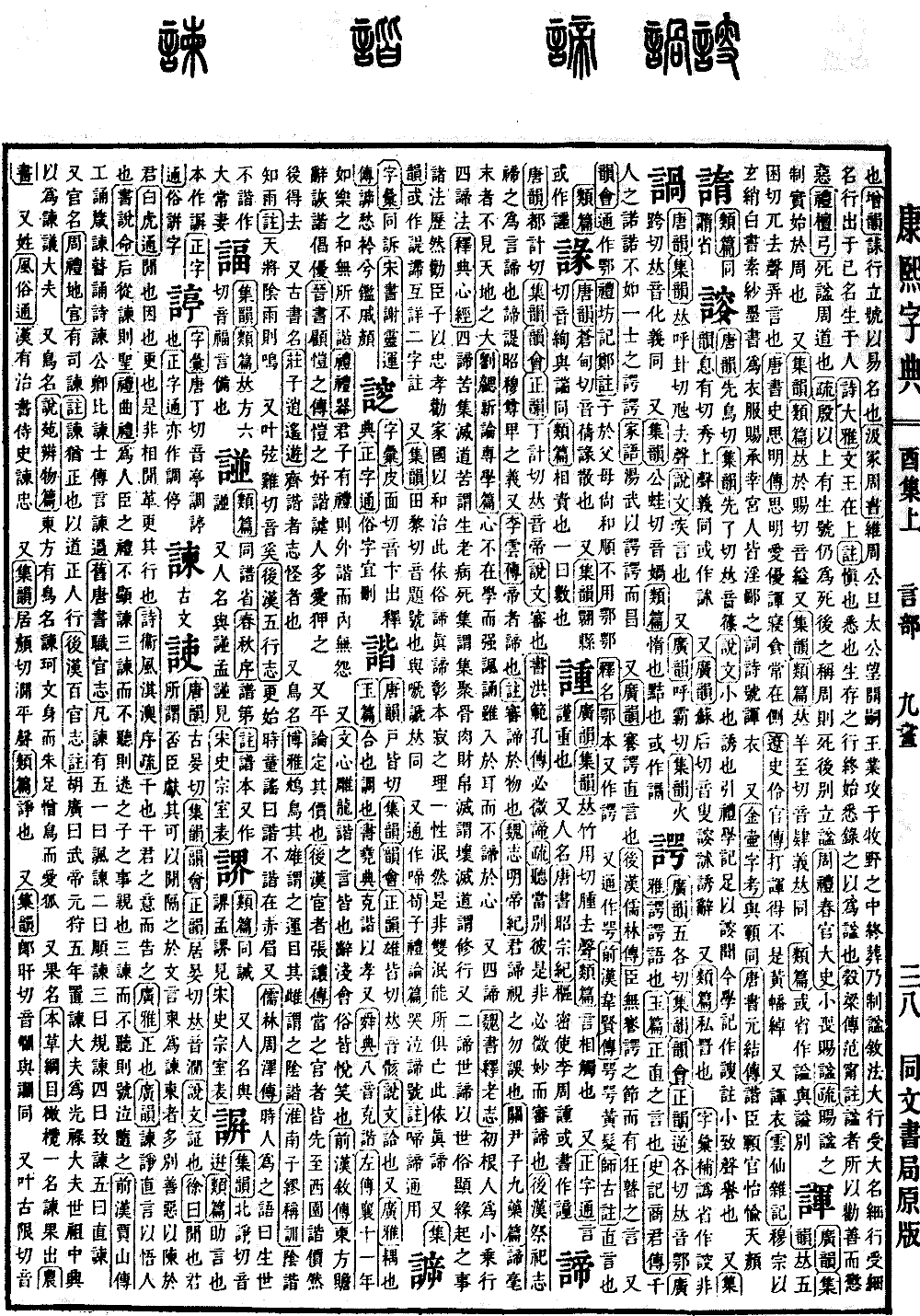
Page 1170, Entry 01
Pronounced dì (falling tone).
In the Tang Rhyme (Tangyun), the dictionary of the Tang dynasty, it is defined as the result of the characters du and ji. In the Collected Rhymes (Jiyun), the Rhyme Collection (Yunhui), and the Correct Rhymes (Zhengyun), it is defined as the result of the characters ding and ji.
According to the Explaining Graphs and Analyzing Characters (Shuowen Jiezi), it means to examine carefully.
In the commentary by Kong Anguo on the Great Plan (Hongfan) chapter of the Book of Documents (Shujing), it states: Must be subtle and examined carefully. The sub-commentary adds: Listening and distinguishing right from wrong requires a subtle and careful examination.
In the History of the Later Han (Hou Hanshu), section on sacrificial rites, it states: The word di (for royal ancestral sacrifice) means to examine carefully. It is the principle of clarifying the order of ancestors and showing them honor.
In the Biography of Li Yun, it states: The emperor is one who examines carefully. The commentary states: It means to observe things with careful scrutiny.
In the Records of the Three Kingdoms (Sanguozhi), the Biography of Emperor Ming of Wei, it states: You must observe it carefully and make no mistake.
In the Guan Yinzi, chapter on the Nine Medicines, it states: Those who focus on the minute details fail to see the greatness of heaven and earth.
In Liu Xie's New Treatises (Xinlun), chapter on Special Studies, it states: If the mind is not in the study but one forces oneself to recite, though it enters the ear, it is not carefully established in the heart.
Also, the Four Truths. In the Book of Wei (Weishu), section on Buddhism and Taoism, it states: At the beginning, people practiced the Lesser Vehicle and the method of the Four Truths.
In the Heart Sutra (Xinjing) of the Buddhist canon, the Four Truths are: Suffering, Accumulation, Cessation, and Path. Suffering refers to birth, old age, sickness, and death; Accumulation refers to the gathering of flesh, blood, and material wealth; Cessation refers to destruction and decay; Path refers to the practice of spiritual cultivation.
Also, the Two Truths: Worldly Truth explains the affairs of dependent origination through worldly conventions, where all phenomena are distinct; it encourages ministers and children to be loyal and filial, and encourages families and the state to be governed in harmony; this relies on Worldly Truth. Absolute Truth manifests the principle of original stillness, where the single nature is silent; right and wrong are both forgotten, and the ability and the object of cognition both perish; this relies on Absolute Truth.
According to the Collected Rhymes (Jiyun), it is sometimes written in a variant form (shi). Please see the notes for both characters for further details.
According to the Collected Rhymes (Jiyun), it is pronounced ti (rising tone). It means to cry out. This is synonymous with the characters (ti) and (ti).
It is also used interchangeably with the character for weeping (ti). In the Xunzi, chapter on the Discourse on Rites, it states: Weeping and crying out. The commentary states: The characters for weeping and crying out are used interchangeably.