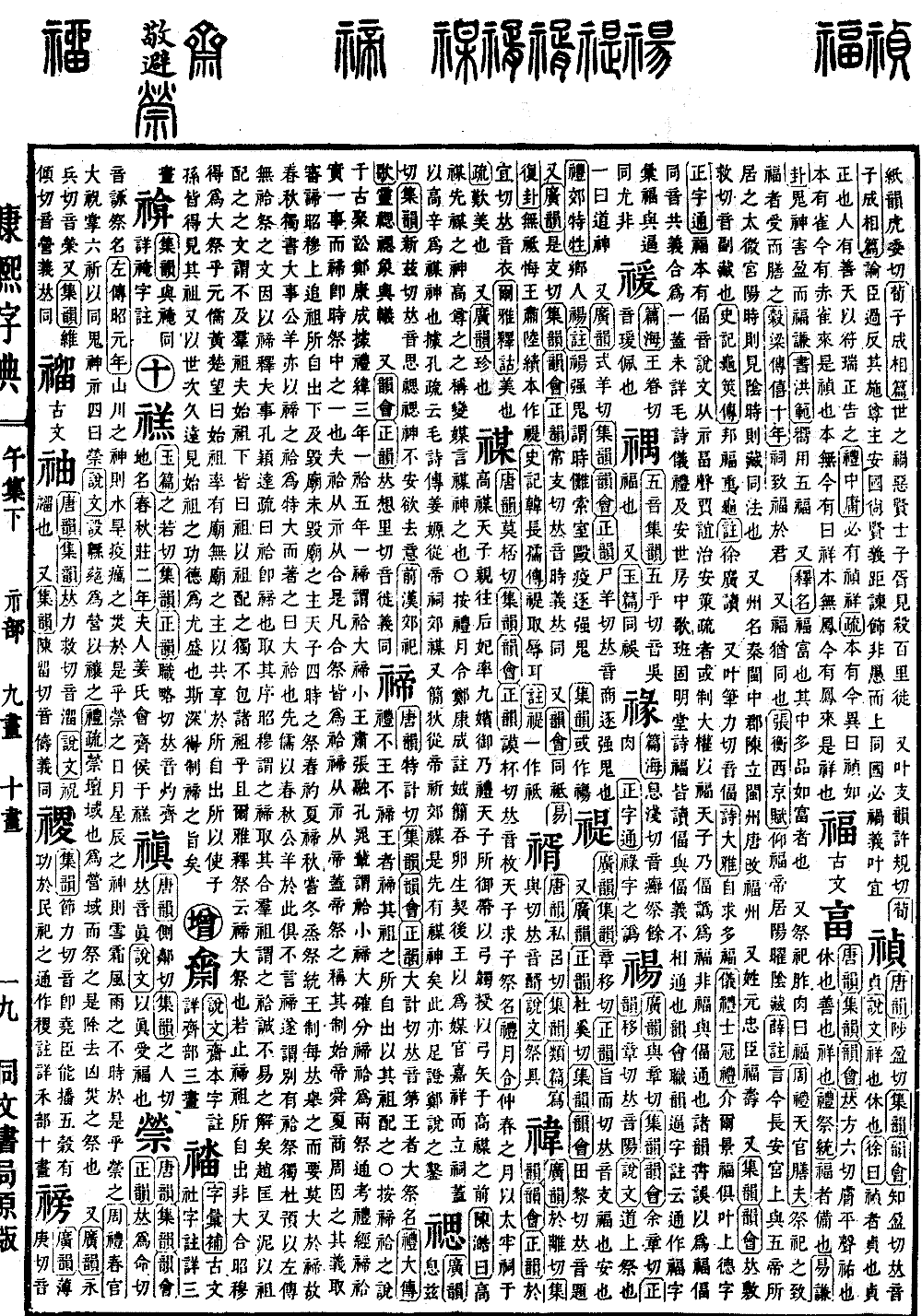
Wu Collection, Lower Volume
Radical: Reveal (shì)
Kangxi Strokes: 14
Page 845, Entry 13
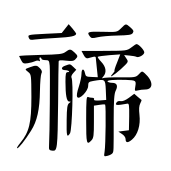
Pronounced dì. This is the name of a grand sacrificial ceremony held by emperors in ancient times.
Book of Rites (Liji), Great Traditions (Dazhuan): Ritual regulations state that only an emperor may perform the Di sacrifice. The emperor uses the Di sacrifice to honor the progenitor of his lineage, with the progenitor as the primary recipient of the offerings.
Commentary: The definitions of the Di sacrifice and the Xia sacrifice have been debated for thousands of years. Zheng Xuan, relying on the Ritual Weft (Liwei) statement that the Xia sacrifice occurs every three years and the Di sacrifice every five years, argued that the Xia sacrifice is grander in scale while the Di sacrifice is smaller. Wang Su, Zhang Rong, Kong Chao, and others argued the opposite, that the Xia sacrifice is smaller and the Di sacrifice is grander, clearly distinguishing them as two separate types of rituals.
A comprehensive examination of the Classic of Rites (Li) suggests that the Di sacrifice and the Xia sacrifice are actually the same thing, with the Di sacrifice being one of the four seasonal offerings. The character for Xia is composed of Reveal and Join, implying that any collective ritual is called Xia. The character for Di is composed of Reveal and Emperor, likely designating a sacrifice offered by the emperor. This system began with Emperor Shun and was continued through the Xia, Shang, and Zhou dynasties. Its significance lies in the careful determination of the ancestral order (zhaomu), reaching upward to honor the progenitor and downward to include the ancestral tablets of both moved and unmoved temples.
The seasonal sacrifices of the Son of Heaven are called Yue in spring, Di in summer, Chang in autumn, and Zheng in winter, as frequently mentioned in texts such as the Record of Sacrificial Rites (Jitong) and Royal Regulations (Wangzhi). Among these, none is more significant than the Di sacrifice. Therefore, the Spring and Autumn Annals (Chunqiu) records only great events, and the Commentary of Gongyang (Gongyang Zhuan) considers the collective ritual of the Di sacrifice to be of such great importance that it records it as a Great Xia.
Previous Confucian scholars, noting that neither the Spring and Autumn Annals nor the Commentary of Gongyang mentions the character Di here, concluded that there must be a separate Xia sacrifice. Only Du Yu, noting that the Commentary of Zuo (Zuo Zhuan) lacks text regarding the Xia sacrifice, used the Di sacrifice to explain the term great events. The commentary of Kong Yingda states: The Xia sacrifice is the Di sacrifice. When the focus is on the arrangement of the ancestral order, it is called Di; when the focus is on the gathering of many ancestors for collective worship, it is called Xia. This is truly an immutable explanation.
Zhao Kuang, however, clung to the phrase "with the progenitor as the primary recipient," arguing that it does not involve other ancestors. All those after the progenitor are called ancestors; does "with the progenitor as the primary recipient" not include all the various ancestors? Furthermore, the Erya defines sacrifice as "Di, a great sacrifice." If it only honored the progenitor and did not involve the large-scale gathering of all ancestors in their hierarchical order, could it be called a great sacrifice?
Yuan dynasty scholar Huang Chuwang stated: The progenitor leads the ancestral tablets of both those with temples and those without, to share in the offerings at the source of the progenitor. This is done so that descendants may see their ancestors, and because the lineage is long, the virtue of witnessing the progenitor is especially grand. This demonstrates a profound understanding of the purpose behind the establishment of the Di sacrifice system.