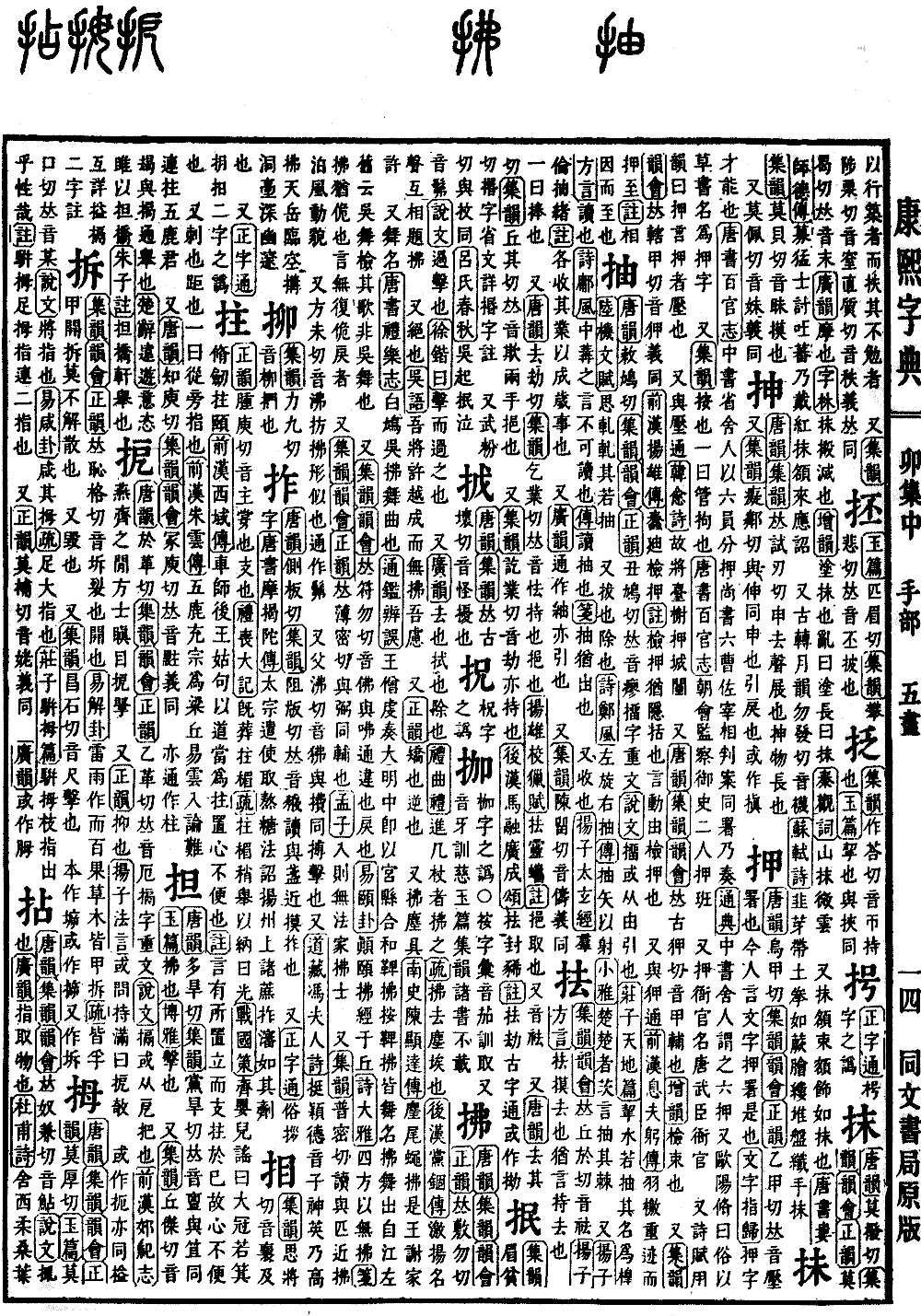
Mao Collection, Middle Volume. Radical: Hand (shǒu). Kangxi strokes: 17. Page 424, Entry 19.
Pronounced dan. Equivalent to the variant form (xie). According to the Jade Chapter (Yupian), to brush or flick away. According to the Broad Accents (Boya), to strike. Also pronounced qie. Equivalent to the variant form (jie), meaning to lift or raise. In the Songs of Chu (Chuci), Distant Travels (Yuanyou): Intentions wild and unrestrained, lifting and raising. Zhu Xi's commentary states: Lifting and raising means to elevate high.
Pronounced dan (level tone). Equivalent to the variant form (dan). Carrying on the back is called load; carrying on the shoulder is called dan. According to the Explanation of Names (Shiming): Dan refers to a responsibility, that which one is capable of bearing. In the Book of Changes (Yijing), Commentary on the Appended Statements: To bear on the back means to carry things. In the Strategies of the Warring States (Zhan Guo Ce): Su Qin wrapped his legs and wore sandals, carrying books and shouldering a bag. Also, Zuodan is a place name. According to Ren Yu's Records of Yizhou: North of Yinping County is the Zuodan Road; it is west of Chengdu, and for those traveling from the north, the load rests on the left shoulder and cannot be shifted to the right. Also, Wudan is a mountain name located northwest of Chengdu. In the Records of Shu (Shuzhi), Commentary on the Biography of the First Ruler: When the King of Shu's wife died, he dispatched soldiers to carry earth to the outskirts of Chengdu to bury her; it was seventy feet high, and was called Wudan.
Also pronounced dan (falling tone), referring to the weight that is carried. In the Zuo Tradition (Zuo Zhuan), twenty-second year of Duke Zhuang: Relaxed from the burdens of carrying. Also pronounced shan. To borrow. In the Book of Rites (Liji), Four Principles of Mourning Apparel: Why is the staff used? It represents rank. Some say it is a borrowed role. In the Ceremonial Rites (Yili), Mourning Apparel: Why does one who lacks rank carry a staff? It is a borrowed role. The commentary states: One is granted a staff to honor the role of the primary mourner. Also pronounced yan. The meaning is the same.