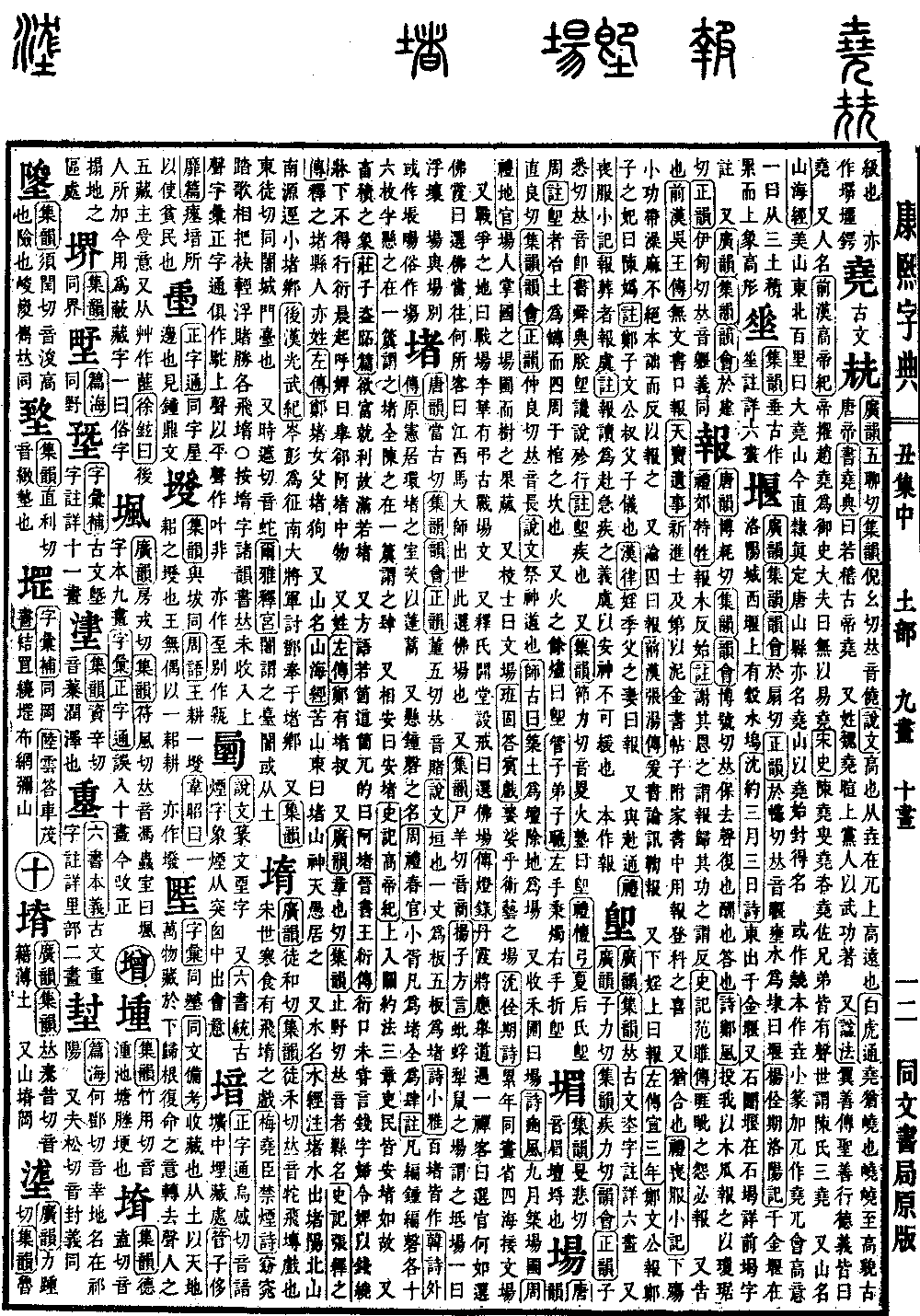
Chou Collection, Middle Volume. Radical: Earth (tǔ). Kangxi Strokes: 12. Page 234, Entry 08.
Pronounced chang (level tone). According to the Shuowen Jiezi (Dictionary of Characters), it refers to a path for making offerings to spirits. Shigu states: Earth is piled to form an altar, and the ground is cleared to create a field. Also, a garden for gathering grain is called a field. In the Book of Odes (Shijing), it is written: In the ninth month, we prepare the threshing floor and the garden. In the Rites of Zhou (Zhouli), it is written: The field official oversees the nation's fields and gardens, planting fruits and melons there. Also, a place for testing scholars is called a literary field. In Ban Gu's Response to the Guest (Da Bin Xi), it is written: Dancing in the field of arts. In Shen Quanqi's poem, it is written: For years we shared the government office, and across the four seas we met in the literary field. Also, a place of war is called a battlefield. Li Hua wrote the Essay on Lamenting the Ancient Battlefield. Also, when Buddhist masters hold a hall for ordinations, it is called a field for selecting Buddhas. In the Record of the Transmission of the Lamp (Chuandeng Lu), it is written: Danxia was going to take the imperial examination when he met a meditation traveler on the road who said: Selecting officials is not as good as selecting Buddhas. Danxia asked: Where should one go to select a Buddha? The traveler said: Master Ma has appeared in the world in Jiangxi; that is the field for selecting Buddhas.
Also pronounced shang (level tone). According to the Dialect (Fangyan) by Yang Xiong, the area where ants and mole crickets dig is called a chi field, also known as floating soil. Note that the character for field (chang) is different from the character for boundary (yi). Sometimes written in a variant form (chang). The common form is written as (chang).