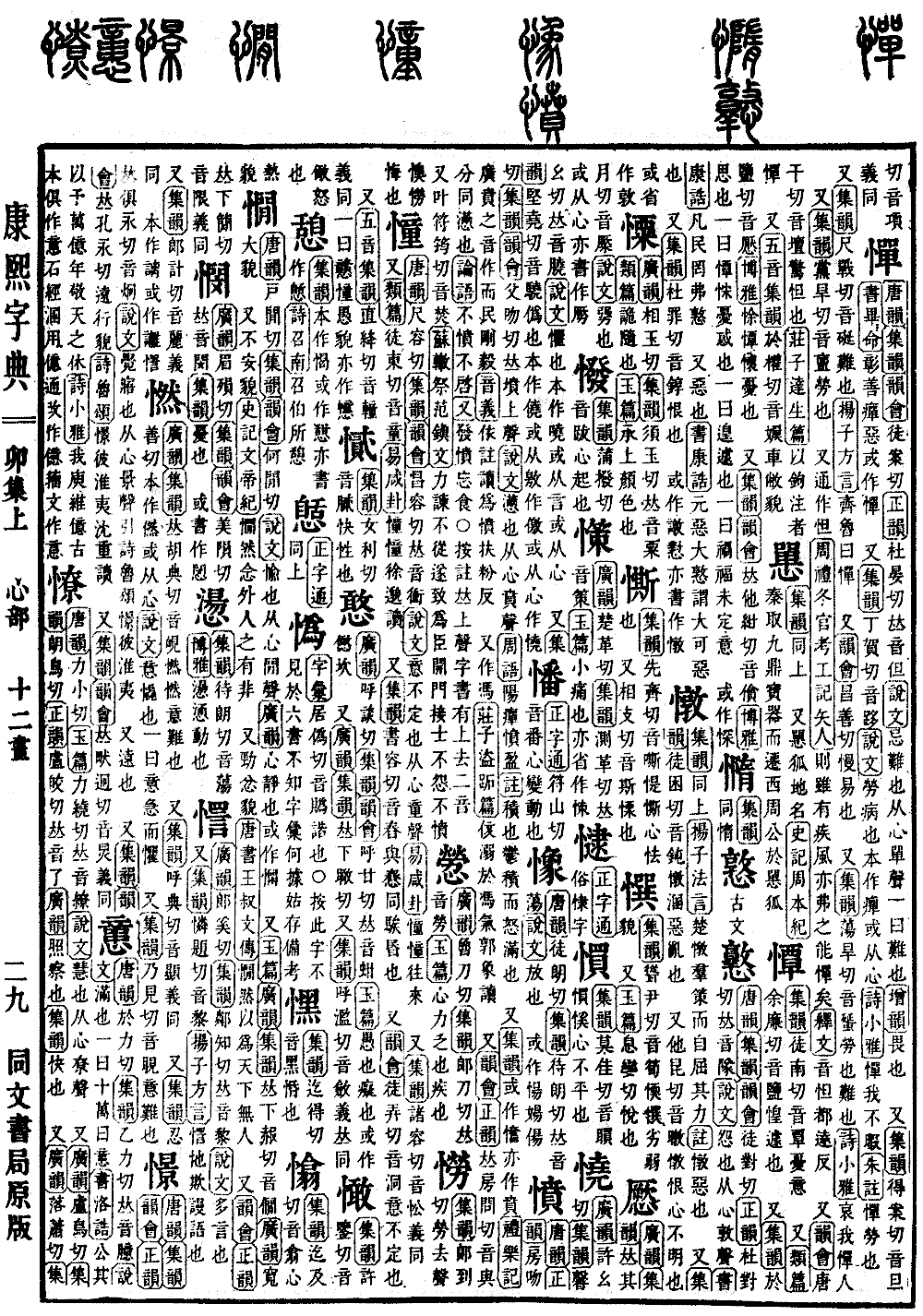
Mao Collection, Upper Volume
Radical: Heart (xīn)
Dan
Kangxi Stroke Count: 16
Page 403, Entry 01
Pronounced dan (falling tone).
According to the Analytical Dictionary of Characters (Shuowen Jiezi), it means to dread or perceive difficulty. Formed from the Heart radical with a phonetic component. Another definition is difficulty.
According to the Augmented Rhymes (Zengyun), it means to fear.
Also, pronounced dan (falling tone).
In the Book of Documents (Shangshu), specifically the Bi Ming chapter: to manifest goodness and punish evil. Sometimes written as this character.
Also, pronounced duo (falling tone).
According to the Analytical Dictionary of Characters (Shuowen Jiezi), it means exhaustion or illness. Originally written as a different character, sometimes written with the Heart radical.
In the Book of Odes (Shijing), Xiaoya section: I am exhausted and have no leisure.
Zhu Xi’s commentary states: This means exhaustion.
Also, pronounced chan (falling tone).
Meaning to dread or difficulty.
According to the Dialects (Fangyan) by Yang Xiong: In the regions of Qi and Lu, this is called dan.
Also, pronounced chan (falling tone).
Meaning to treat with slowness or contempt.
Also, pronounced dan (falling tone).
Meaning exhaustion or difficulty.
In the Book of Odes (Shijing), Xiaoya section: Pity us, the exhausted people.
Also, pronounced dan (rising tone).
Meaning exhaustion.
Also, used interchangeably with the character pronounced da (rising tone).
In the Rites of Zhou (Zhouli), section on the Artificers Record: Even if there are strong winds, they will not be able to impede it.
In the Explanation of Text (Shuowen Shiwen), the pronunciation is noted as da.
Also, pronounced tan (level tone).
Meaning to be startled or alarmed.
In the Book of Master Zhuang (Zhuangzi), Datisheng chapter: Those who use hooks and weights are startled.
Also, pronounced dan (level tone).
The appearance of a worn-out carriage.