Wu Collection, Lower Volume
Radical: Spirit (shì)
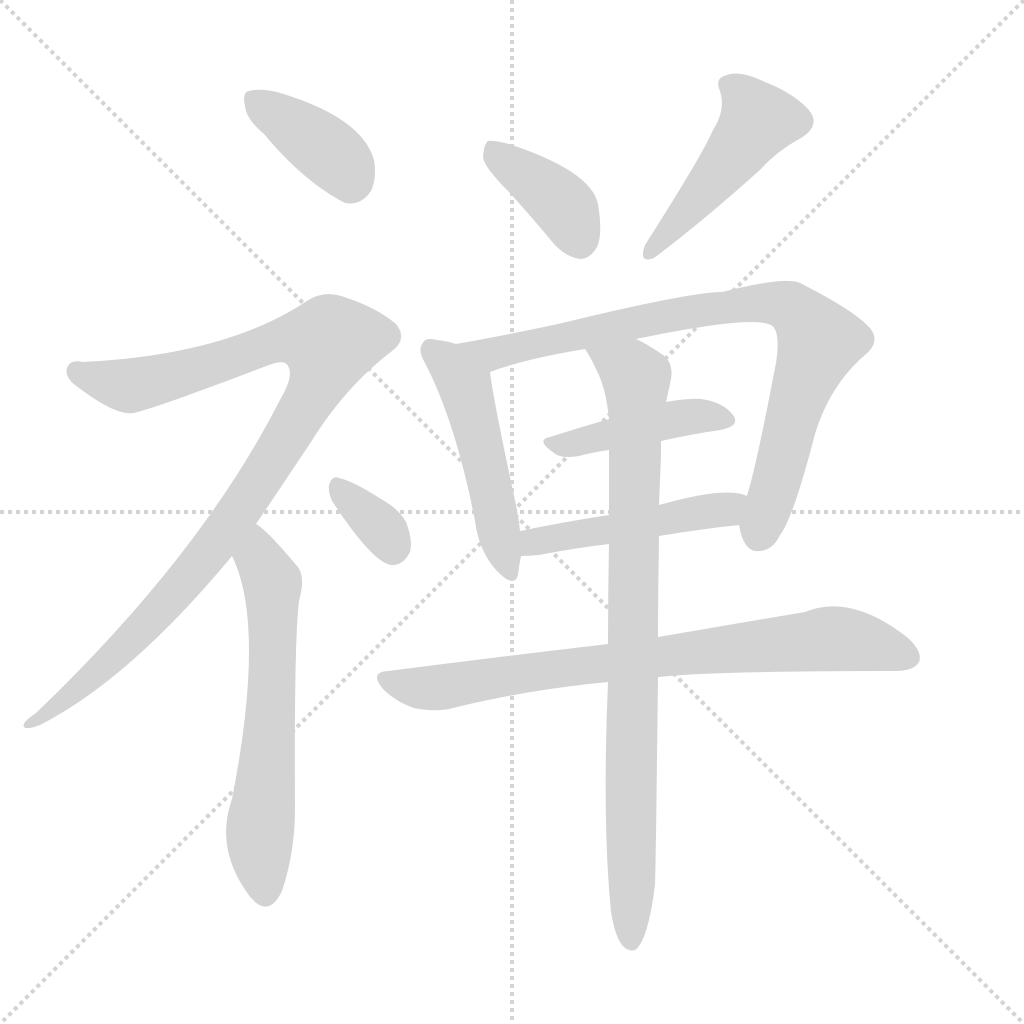
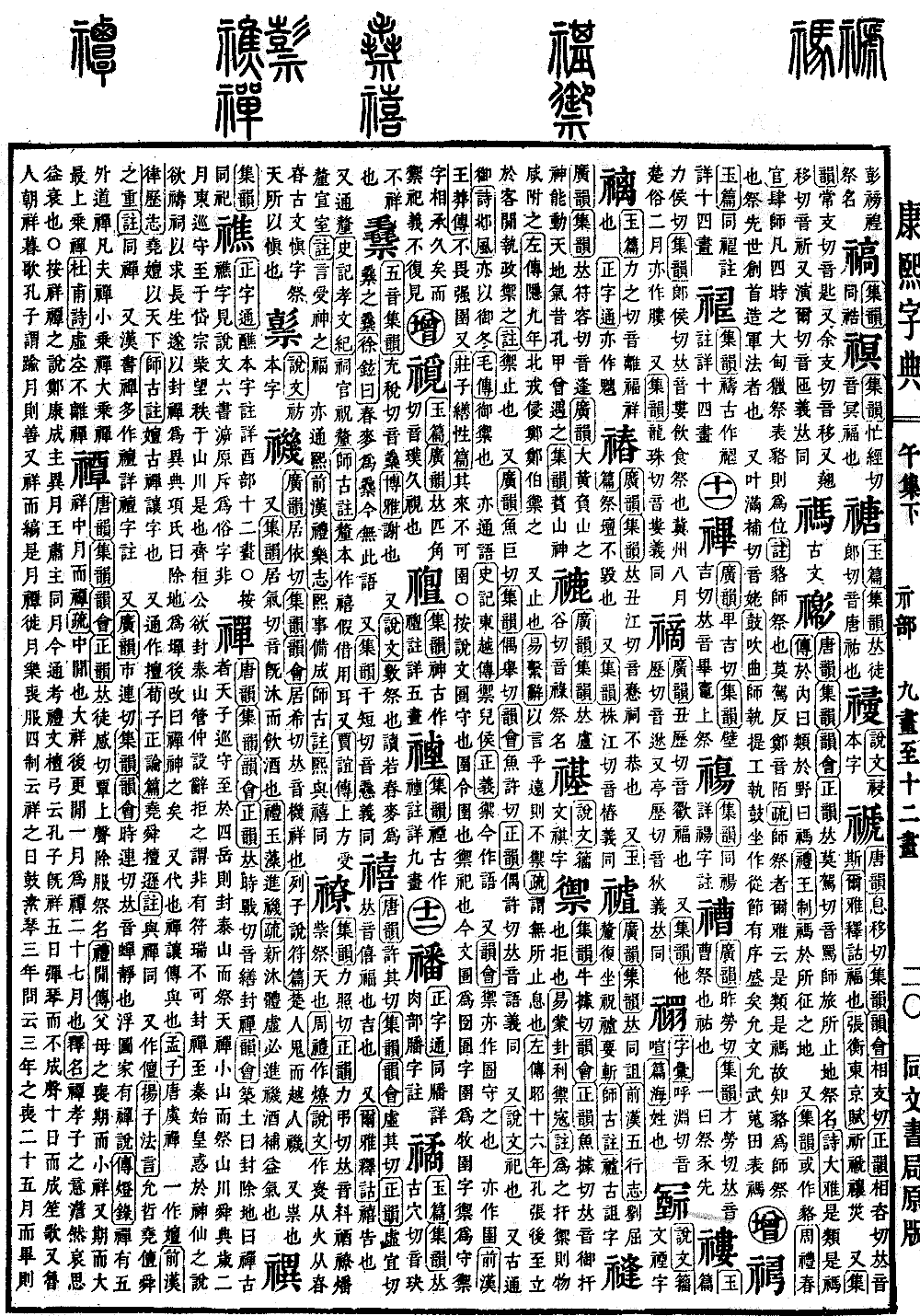
Chan (shàn)
Kangxi brush strokes: 17
Page 846, Entry 01
Pronounced shan (falling tone).
To perform the Feng and Shan sacrifices. The Rhyme Compilation (Yunhui) states: Piling up earth to create an altar for the worship of heaven is called Feng; clearing a space to worship the earth is called Shan. When ancient emperors toured their domains and reached the four sacred peaks, they would build altars on Mount Tai to worship heaven and clear sites on smaller hills to worship the mountains and rivers. The Canon of Shun (Shundian) records that in the second month of each year, the emperor would tour east to Mount Tai, burn wood to offer sacrifices to heaven, and perform rituals for the mountains and rivers in sequence; this is what is meant. When Duke Huan of Qi desired to perform the Feng and Shan sacrifices at Mount Tai, Guan Zhong dissuaded him by claiming that in the absence of auspicious omens, such rituals could not be conducted. By the time of the First Emperor of Qin, he had become deluded by the talk of immortals and sought to achieve immortality through sacrificial prayer, thus elevating the Feng and Shan sacrifices to a special ceremony. Master Xiang says: A cleared space is called a "shan" (earthen altar), and later it was renamed "chan" (to mysticalize) to give it a divine character.
Also refers to abdication or succession. Abdication refers to passing the throne to another. The Mencius (Mengzi) records that Yao and Shun practiced abdication. It is also written as "shan" (to change or evolve). The Annals of Law and Calendar (Lüli Zhi) of the Former Han records Yao passing the world to Shun. Yan Shigu comments: Shan is the ancient term for abdication.
It is also used interchangeably with "shan" (to act on one's own authority). The Rectification of Terms (Zhenglun) by Xunzi writes "Yao and Shun acted in accordance with abdication." The commentary states that "shan" (to act on one's own authority) is the same as "chan" (abdication). It is also written as "tan." The Exemplary Sayings (Fayan) by Yang Xiong writes "Truly wise Yao and tan (abdication) of Shun's importance." The commentary states that "tan" is the same as "chan." Furthermore, the character for "chan" in the Book of Han is often written as a variant. See the detailed entry for the variant character.
Pronounced chan (rising tone).
Refers to dhyana, or meditative practice. Buddhism holds the doctrine of meditation. The Record of the Transmission of the Lamp (Chuandenglu) lists five types of meditation: externalist meditation, commoner meditation, lesser vehicle meditation, great vehicle meditation, and the supreme vehicle meditation. The poet Du Fu writes: Voidness is inseparable from meditation.