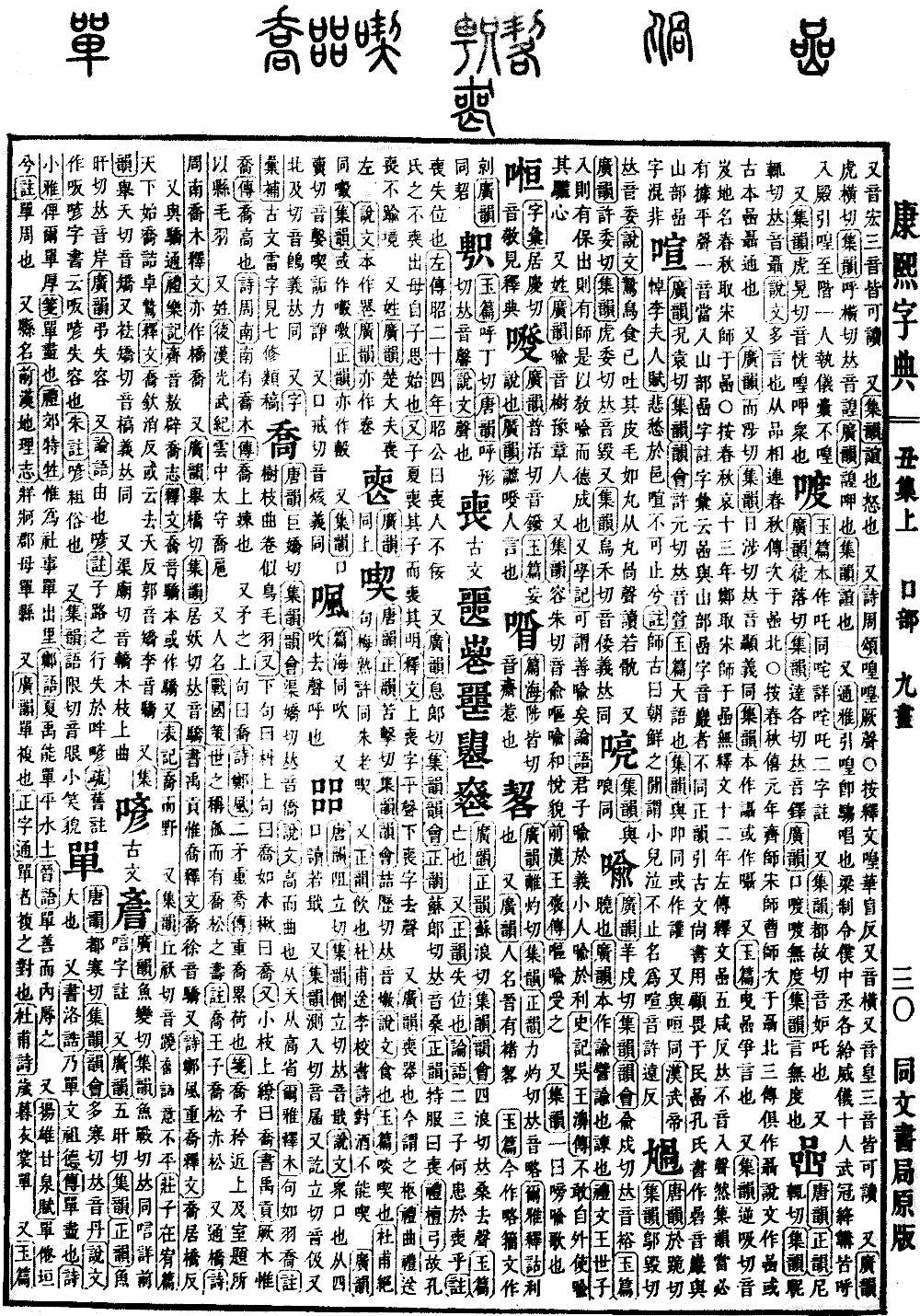
Chou Collection, Upper Volume
Radical: Mouth (kǒu)
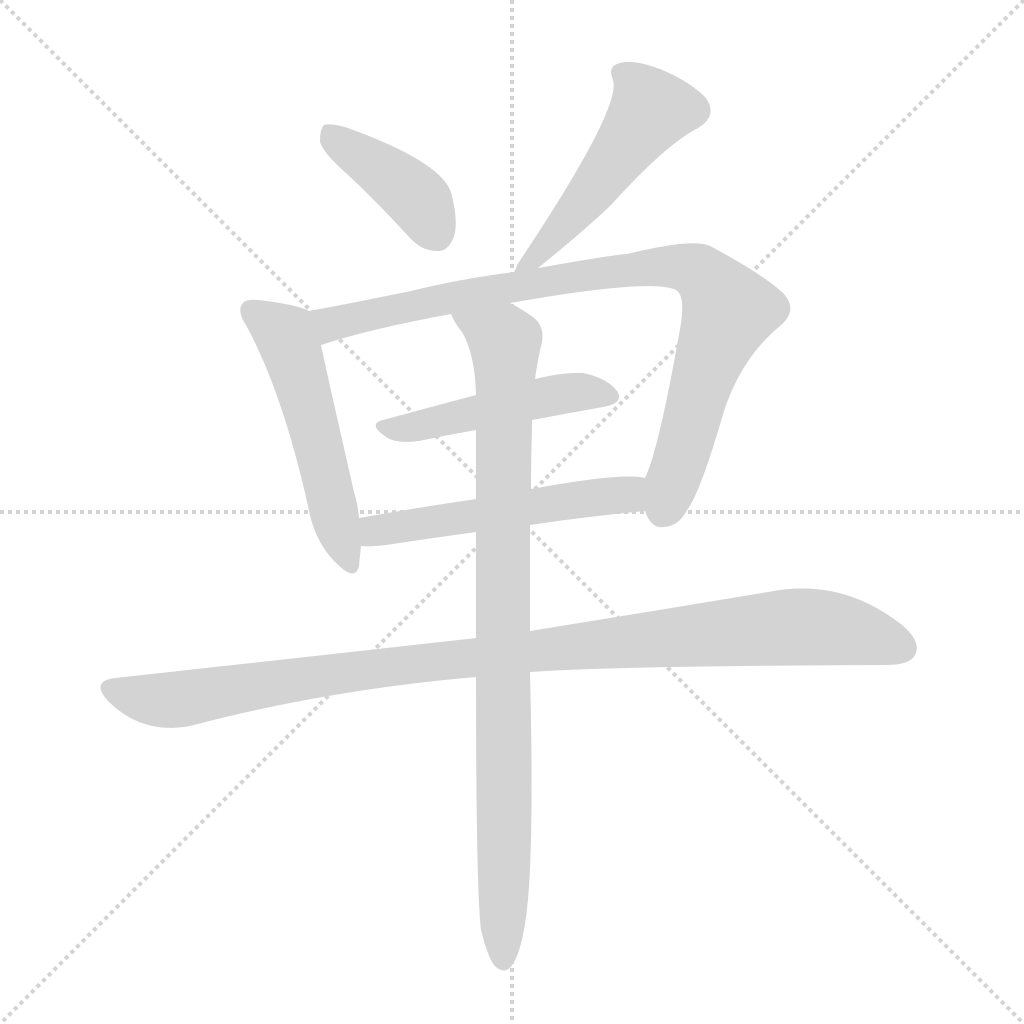
Character: Dan
Kangxi Stroke Count: 12
Page 200, Entry 01
Pronounced dan.
In the Shuowen Jiezi (Dictionary of Explaining Characters), it means great.
In the Book of Documents (Shujing), specifically the Luo Gao chapter: To thoroughly record the virtues of the ancestors. The commentary states: Dan means to exhaust or complete.
In the Book of Odes (Shijing), specifically the Xiao Ya section: To make you thoroughly generous. The commentary states: Dan means to exhaust.
In the Book of Rites (Liji), specifically the Jiao Te Sheng chapter: Only for the sacrifice to the god of the soil does one go out from the village alone.
In the Discourses of the States (Guoyu), specifically the Zheng Yu section: Xia Yu was able to completely level the water and soil.
In the Discourses of the States (Guoyu), specifically the Jin Yu section: One whose goodness is limited and who suffers internal disgrace.
Also, in the Ganquan Fu by Yang Xiong: A surrounding wall. The commentary states: Dan means to encircle.
Also a county name. In the History of the Former Han (Hanshu), specifically the Treatise on Geography: Mu-Dan County in Zangke Commandery.
Also, according to the Guangyun dictionary, dan means the opposite of double (single). The Zhengzitong dictionary states: Dan is the opposite of double. In a poem by Du Fu: At the end of the year, my clothes are thin.
Also, according to the Yupian dictionary: One, or single. In the Book of Odes (Shijing), specifically the Da Ya section: The army consists of three single units. The commentary states: In the system of a great state, the three armies use their surplus soldiers to form the reserves; single units refer to those without reserve soldiers.
In the Book of Rites (Liji), specifically the Li Qi chapter: For offerings to spirits, use a single mat.
In the Records of the Grand Historian (Shiji), specifically the Biography of Lord Xinling: Now he comes to replace him with a single carriage.
In the History of the Later Han (Houhanshu), specifically the Biography of Geng Gong: Using a single troop to hold the isolated city.
In the Biography of Gao Biao: A family known for being solitary and poor.
Also a surname. According to the Guangyun dictionary, the Kedan clan later changed their name to Dan.
Also, pronounced tan. Also a surname. In the state of Zheng, there was an official of Li named Dan Bo. Often written as the character tan.
Also, pronounced chan. According to the Guangyun dictionary: Chanyu (a title for the Xiongnu leader). In the History of the Former Han (Hanshu), specifically the Account of the Xiongnu: Chanyu is a term meaning vast and grand. It is said that its form resembles the heavens, hence the name Chanyu.
Also, in the Erya dictionary, specifically the Shi Tian section: When the year star is in the mao position, it is called dan-yan. The commentary notes: Dan is pronounced chan, also pronounced dan, and sometimes pronounced shan.
Also, pronounced shan. According to the Yupian dictionary: Great.
Also a county name. In the History of the Former Han (Hanshu), specifically the Treatise on Geography: Shanfu County in Shanyang Commandery. The commentary by Shigu states: Pronounced shan-fu.
Also a surname. According to the Guangyun dictionary, a descendant of Duke Shan Xiang.
In the Records of the Grand Historian (Shiji), specifically the Biographies of Scholars: Huan Sheng and Dan Ci. The commentary notes: Dan is pronounced shan; Dan is the surname, Ci is the given name.
Also a person's name. In the Preface to the Book of Documents (Shujing): Jiu Dan composed the Ming Ju. The commentary states: Jiu Dan is the name of a minister, an official in charge of land. The commentary notes: Dan is pronounced shan.
Also, pronounced chan. Same as the character chan. See the later note on the character chan.
Also, pronounced dan. According to the Jiyun dictionary, it was originally written as dan, meaning abundant grain. Another meaning is sincere or generous.
In the Book of Documents (Shujing), specifically the Luo Gao chapter: To thoroughly record the virtues of the ancestors. The commentary notes: Dan is pronounced dan, also pronounced dan (rising tone), meaning sincere.
In the Book of Odes (Shijing), specifically the Xiao Ya section: To make you thoroughly generous. The commentary states: Dan means sincere; some say it means generous. The commentary notes: Dan is pronounced dan by Mao, and pronounced dan by Zheng.
In the Book of Odes (Shijing), specifically the Zhou Song section: To fully exert one's heart. The commentary states: Dan means generous. The commentary notes: Pronounced dan (rising tone).
Also used interchangeably with dan. In the Records of the Grand Historian (Shiji), specifically the Treatise on the Calendar: The second year of Duanmeng Dan-yan. The commentary notes: Dan-yan is also written as dan-an.
Also, pronounced tan. Similar to the character tan, a town name.
Also, pronounced zhan. Dan-zhi, describing a light, fleeting appearance.
Also, pronounced shan. Shanfu, a town name. Also a surname.
Correction: In the Ganquan Fu by Yang Xiong, the original text used the character juan; it has been corrected to the character juan (meaning to encircle).