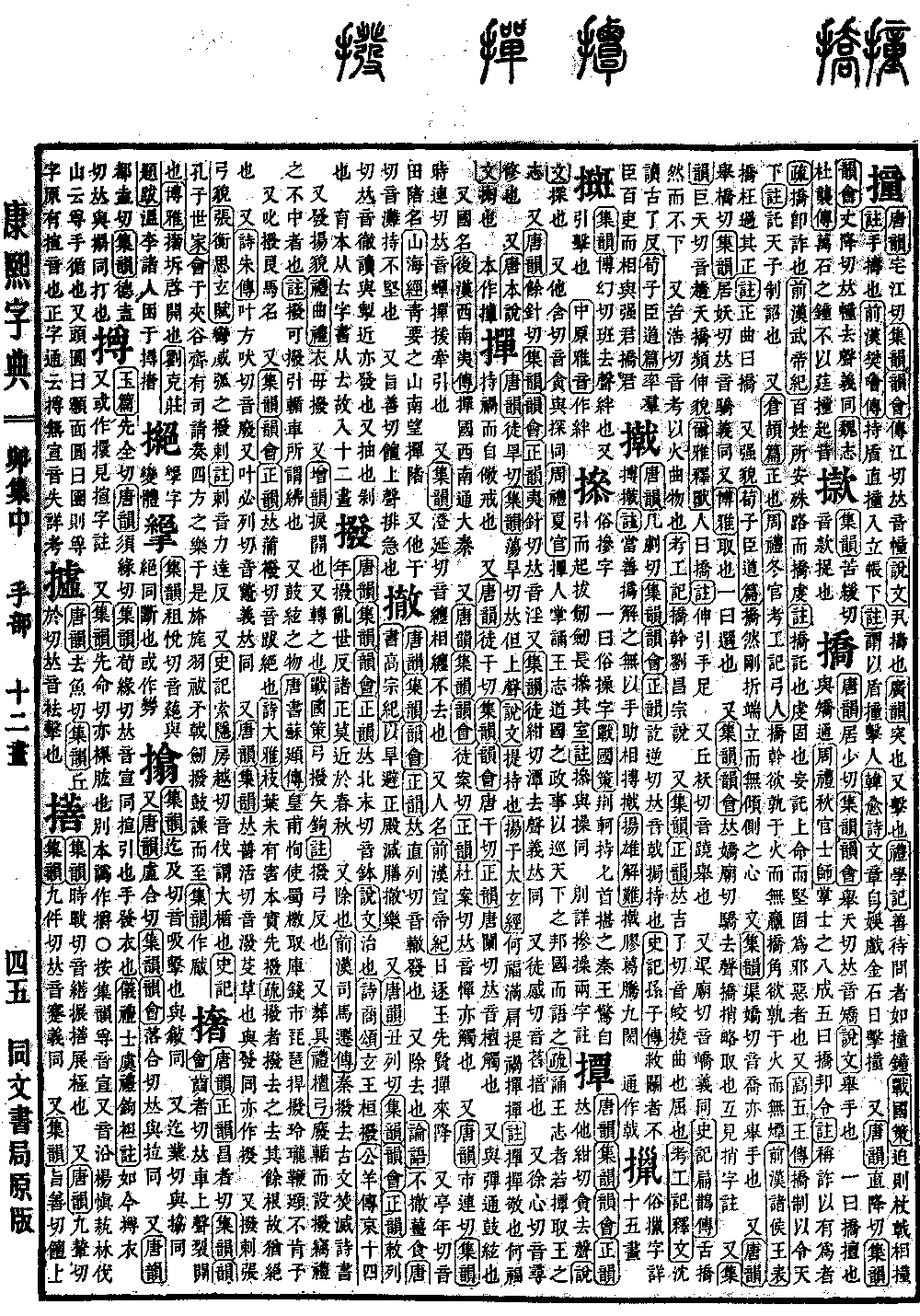
Mao Collection, Middle Volume
Radical: Hand (shǒu)
Kangxi Strokes: 16
Page 455, Entry 06
Pronounced dan (rising tone).
Shuowen Jiezi (Explanation of Simple and Compound Characters): To lift or hold.
Taixuanjing (Canon of Supreme Mystery) by Yangzi: What blessings fill the shoulders, carrying misfortune with caution.
Annotation: Dan-dan means respect. Carrying misfortune while being self-vigilant.
Also pronounced tan.
To touch.
Also used interchangeably with tan. To pluck a string.
Also the name of a country.
History of the Later Han (Hou Hanshu), Biography of the Southwestern Barbarians: The country of Shan, which communicates with the Roman Empire (Da Qin) in the southwest.
Also pronounced dan (falling tone).
Also means to touch.
Also pronounced chan.
Shan-yuan, to pull or drag.
Also pronounced chan.
To be entangled and not leave.
Also a personal name.
History of the Former Han (Hanshu), Annals of Emperor Xuan: The Prince of Rizhu, Xianxian Shan, came to surrender.
Also pronounced tian.
Name of an islet.
Classic of Mountains and Seas (Shanhaijing): South of Qingyao Mountain, looking toward Shan Islet.
Also pronounced tan.
To hold something insecurely.
Also pronounced zhan (rising tone).
To push or urge rapidly.