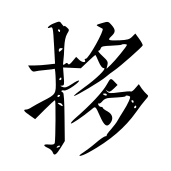
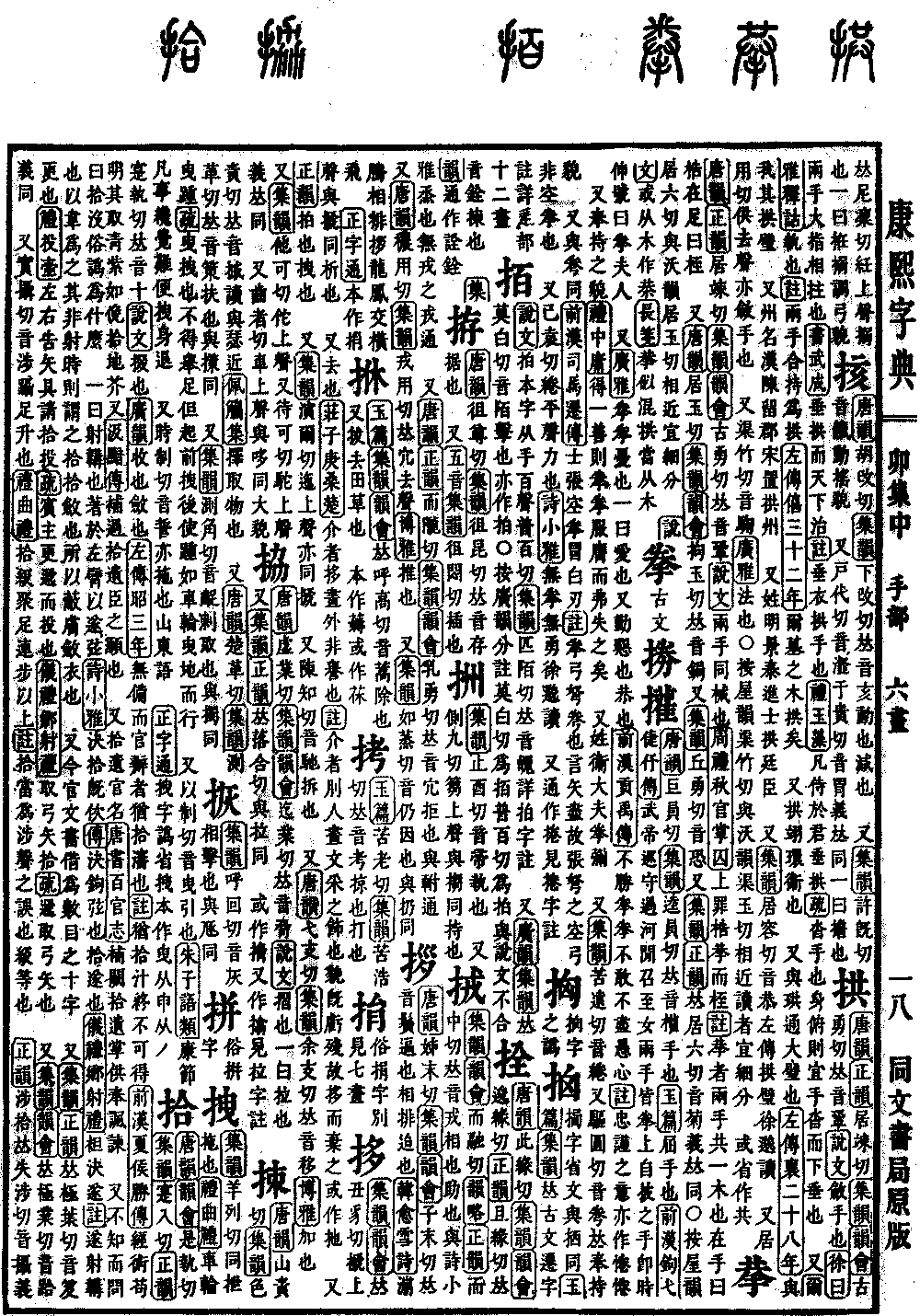
Mao Collection, Middle Volume. Radical: Hand (shǒu). Kangxi strokes: 10. Page 428, Entry 18.
According to Collected Rhymes (Jiyun) and Rhymes of the Empire (Yunhui), pronounced chi (rising tone). It is equivalent to chuai. It means to analyze or separate. It also signifies to remove or to depart. In The Master Who Embraces Life (Zhuangzi), it is written: Those who are physically mutilated cast aside painted patterns and disregard external praise or blame. The commentary notes that those who have suffered the punishment of foot amputation cast aside the ornamentation of patterns, as their physical form is already damaged; thus, they discard and abandon them. It is sometimes written as a variant form (tuo).
According to Orthography (Zhengyun), it means to pat or to drag.
According to Collected Rhymes (Jiyun), pronounced yan (rising tone). It is also equivalent to chuai.
Also pronounced zhi. It means to dismantle or tear apart.
According to Tang Rhymes (Tangyun) and Collected Rhymes (Jiyun), pronounced yi. According to Extensive Refinements (Boya), it means to increase.
According to Collected Rhymes (Jiyun), pronounced tuo (rising tone). Also pronounced tuo (rising tone). The meaning is the same.
Also pronounced che (rising tone). It is equivalent to duo. It describes something that is wide or expansive.