Wu Collection, Upper Volume
Radical: Field (tián)
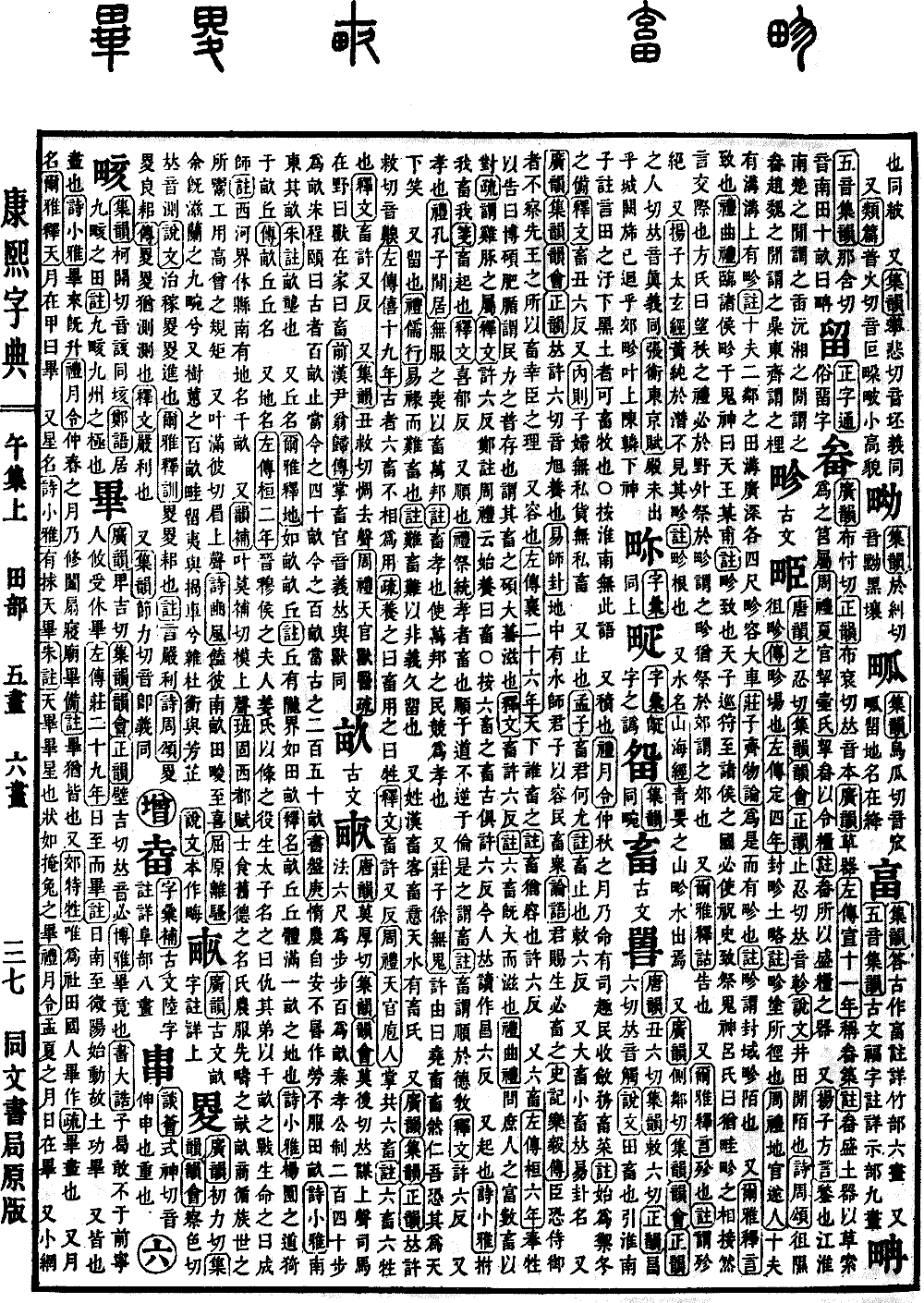
Mu
Kangxi Strokes: 10
Page 761, Entry 14
Ancient text. Pronounced mou (rising tone). According to the Sima Fa (Method of the Sima), six feet equal one pace, and one hundred paces equal one mu. During the reign of Duke Xiao of Qin, it was stipulated that two hundred and forty paces equal one mu. The Song dynasty Neo-Confucian Cheng Yi stated: The one hundred mu of antiquity is equivalent to only forty mu of the present day; one hundred mu of the present day is equivalent to two hundred and fifty mu of antiquity. In the Book of Documents (Shujing), specifically the Pan Geng chapter: Lazy farmers who are greedy for ease, do not work diligently, and do not attend to plowing in the fields. In the Book of Odes (Shijing), specifically the Xiaoya section: The fields running north-south or east-west. In the Zhu Commentary: Mu refers to the ridges between fields.
Also the name of a hill. In the Erya (Approaching Elegance), specifically the Shi Di (Explanation of Earth) chapter: A hill resembling a field mu. Commentary: Hills have boundaries like field ridges, similar to cultivated land. In the Shiming (Explanation of Names): Muqiu refers to a hill with a base the size of one mu. In the Book of Odes (Shijing), specifically the Xiaoya section: The road to Yangyuan winds its way to Muqiu. Commentary: Muqiu is the name of a hill.
Also a place name. In the Zuo Zhuan (Chronicle of Zuo), specifically the second year of Duke Huan: The wife of the Marquis of Jin, Lady Jiang, gave birth to the crown prince during the campaign at Tiao, and named him Chou. Her younger brother was born during the battle of Qianmu, and was named Chengshi. Commentary: There is a place called Qianmu to the south of Jiexiu County in the Xihe Commandery.
Also, according to the Yunbu (Supplement to the Rhymes), pronounced mu (rising tone). In Ban Gu's Western Capital Rhapsody (Xidu Fu): Scholars enjoy the reputations brought by the virtuous deeds of their ancestors, farmers till the fields left by their ancestors, merchants manage trades passed down for generations, and craftsmen follow the rules handed down by their great-great-grandfathers and great-grandfathers.
Also pronounced mei (rising tone). In the Book of Odes (Shijing), specifically the Binfeng section: Bringing food to those southern fields, the field officials are happy to see it. In Qu Yuan's Encountering Sorrow (Lisao): I have cultivated nine wan of orchids, and planted one hundred mu of fragrant herbs, planting the li-yi and jie-che in separate ridges, intermingled with du-heng and fang-zhi. In the Shuowen Jiezi (Explanation of Characters): Originally written as mu.
Research Notes: In the Zuo Zhuan (Chronicle of Zuo), second year of Duke Huan, regarding the wife of the Marquis of Jin, Lady Jiang, giving birth to the crown prince at Tiao and naming him Chou: strictly following the original text, the phrase has been corrected from naming him to commanding him to be named. In Ban Gu's Western Capital Rhapsody (Xidu Fu), regarding farmers tilling the fields: strictly following the original text, the character mu has been corrected to quan.