Wu Collection, Middle Volume
Radical: White (bái)
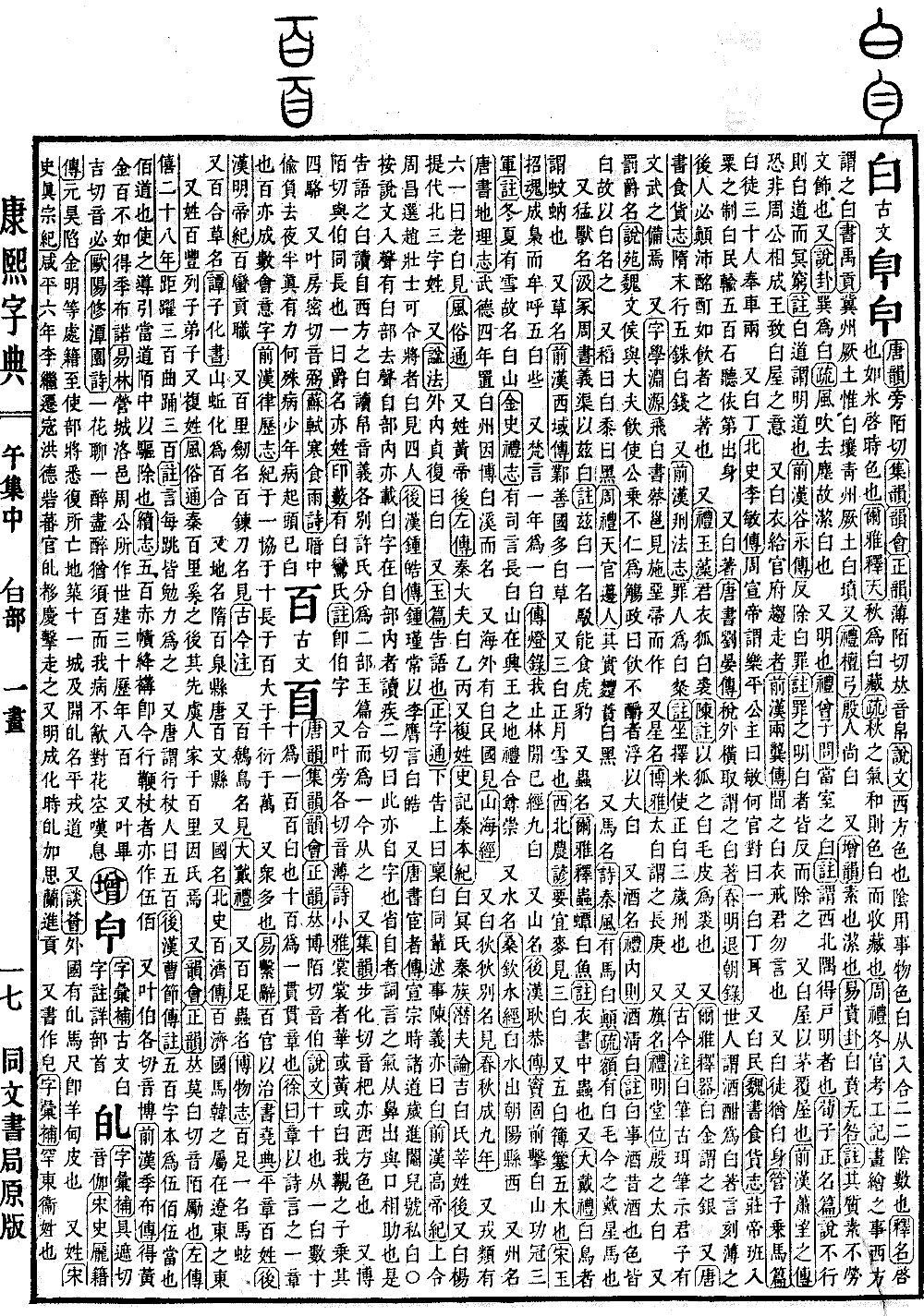
百
Kangxi strokes: 6
Page 785, Entry 04
Ancient literary records: Tang Rhymes (Tangyun), Collection of Rhymes (Jiyun), Rhyme Meetings (Yunhui), and Orthodox Rhymes (Zhengyun) state the pronunciation is bo (entering tone). It is pronounced the same as bo. Explaining Characters (Shuowen Jiezi) defines it as ten tens. The character structure is composed of one and white. Several tens of tens make one hundred. Hundred is related to white. Ten hundreds make one guan. Guan means a section. Xu Kai notes: A section is like a stanza in poetry. Hundred is also a complete number. This is an ideographic character. History of the Former Han (Qian Hanshu), Treatise on Harmonics and Calendars, records: Numbers begin with one, tens are reconciled, one hundred is a unit of length, a thousand is larger, and ten thousand is an extension. It also indicates a multitude. Book of Changes (Yijing), Treatise on the Appended Remarks: The hundred officials use it to govern affairs. Classic of History (Shangshu), Canon of Yao: Impartially manage the affairs of the hundred surnames. Book of the Later Han (Hou Hanshu), Annals of Emperor Ming: Tribes of all races came to offer tribute. It is also the name of a sword, the Hundred-Refined Sword. See Records of Ancient and Modern Times (Gujin Zhu). There is also the hundred-liao, a type of bird. See Elder Dai's Book of Rites (Da Dai Liji). There is also the hundred-foot, a type of insect. Records of Broad Observations (Bowuzhi) records: The hundred-foot is also called the horse-millipede. There is also the lily, a type of plant. Tanzi's Book of Transformations (Tanzi Huashu) records: Mountain earthworms transform into lilies. It is also a place name. There was Baiquan County in the Sui Dynasty and Baiwen County in the Tang Dynasty. It is also a nation name. History of the Northern Dynasties (Beishi), Account of Baekje, records: The nation of Baekje, which belongs to Mahan, is located east of Liaodong. It is also a surname. Baifeng was a disciple of Liezi. There are also compound surnames. General Customs (Fengsutong) records: The descendants of Baili Xi of the Qin state, whose ancestors were from the Yu state and lived in a place called Baili, took Baili as their surname. Also, Rhyme Meetings (Yunhui) and Orthodox Rhymes (Zhengyun) state the pronunciation is mo (entering tone). It is pronounced the same as mo. It means to exert oneself. Zuo Commentary (Zuozhuan), 28th Year of Duke Xi, records: Jump forward three hundred times, jump upward three hundred times. The commentary states: This means to do each jump with all one's might. In the Tang Dynasty, those who carried out floggings were called five-hundreds. The commentary to the Book of the Later Han (Hou Hanshu), Biography of Cao Jie, states: The characters for five-hundred were originally written as wu-bai. Wu means to match or pair, and bai refers to a road. They were made to lead in the front and drive away pedestrians on the road. The Sequel to the History of the Han (Xu Hanshu), Treatises, records: Five-hundreds wore red headscarves and deep red clothing; these are the modern equivalents of those who carry out whippings and floggings, also written as wu-bai. It is also phonetically matched to the pronunciation bo (entering tone). History of the Former Han (Qian Hanshu), Biography of Ji Bu: Obtaining one hundred catties of gold is not as good as obtaining a single promise from Ji Bu. Forest of Changes (Yilin): The building of the city of Luoyi was carried out by the Duke of Zhou. It continued for thirty generations, lasting eight hundred years. It is also phonetically matched to the pronunciation bi. Ouyang Xiu, Poem on Tanyuan: One flower may accompany one bout of drunkenness; to fully enjoy, one needs one hundred cups. But I am ill and cannot drink; I can only sigh in vain before the flowers.