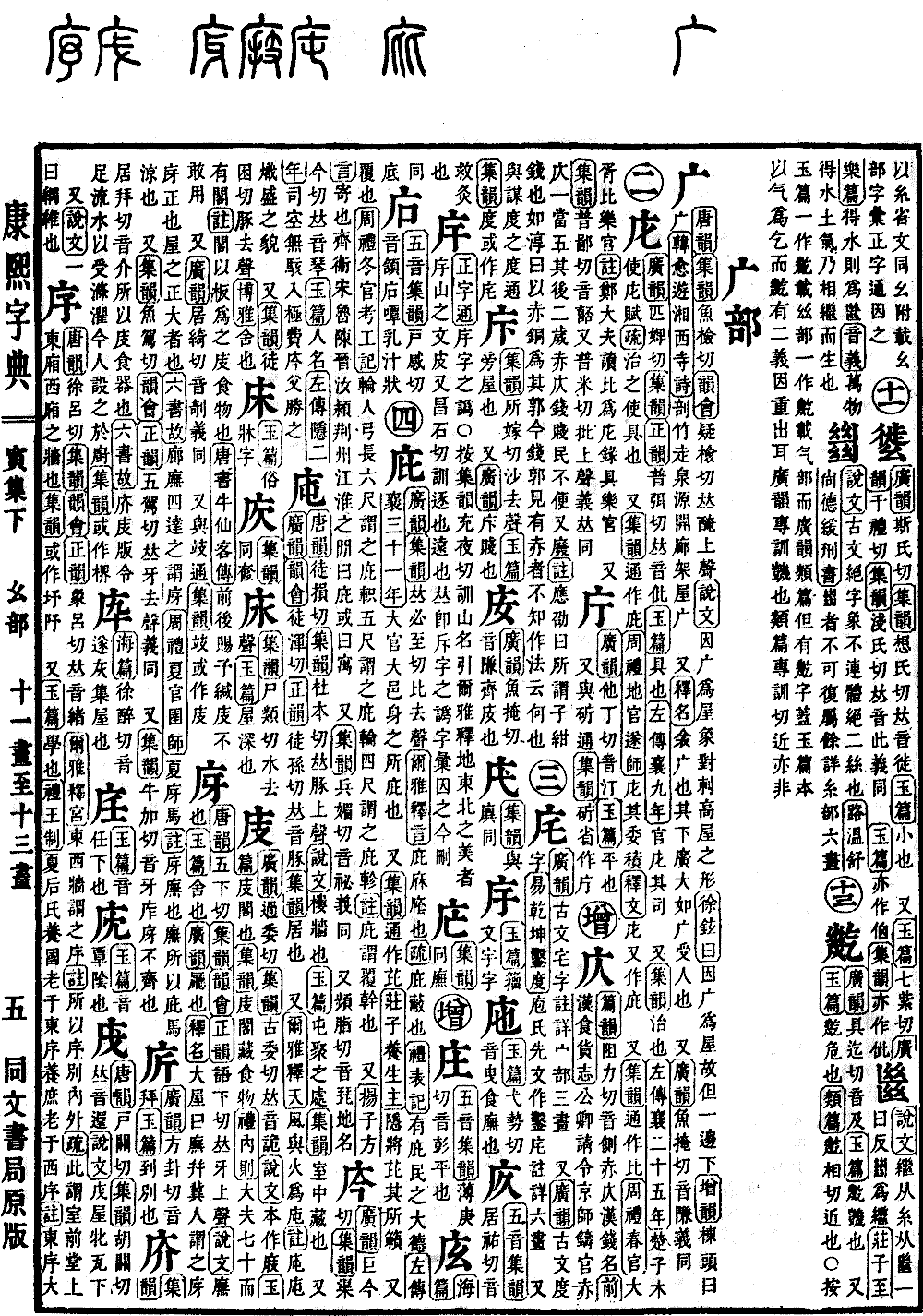
Yin Collection, Lower Volume
Radical: Broad (guǎng)
Kangxi stroke count: 7
Page 343, Entry 21
According to the Guangyun (Guangyun) and Jiyun (Jiyun), it is pronounced bi (falling-rising tone), the same as the sound of bi (falling tone).
Erya: Explanation of Words (Erya Shiyan): Bi means the same as xiu (shade), referring to sheltering or covering.
Commentary: Bi means to shade or cover.
Book of Rites (Liji): Possessing the great virtue of sheltering the common people.
Zuo Tradition (Zuozhuan): High official positions and fiefs are the means upon which one relies for protection.
Also, according to Jiyun (Jiyun), it is also written in the variant form pi (pi).
Zhuangzi: Master of Nourishing Life (Zhuangzi Yangshengzhu): To hide oneself, and thereby use it to shelter one's place of rest.
It also carries the meaning of covering.
Rites of Zhou: Winter Offices, Record of Tradesmen (Zhouli Dongguan Kaogongji): Wheelwrights call a six-foot bow a bi-zhi, a five-foot bow a bi-lun, and a four-foot bow a bi-zhen.
Annotation: Bi refers to covering the axle.
According to Yang Xiong’s Dialects (Fangyan): It means to reside temporarily; in the regions of Qi, Wei, Song, Lu, Jin, Ru, Ying, Jingzhou, and the areas between the Yangtze and Huai rivers, it is called bi, while in some places it is also called yu (to reside).
According to Jiyun (Jiyun), it is also pronounced mi (falling-rising tone). The meaning remains the same.
It is also pronounced pi (level tone). It is a place name.