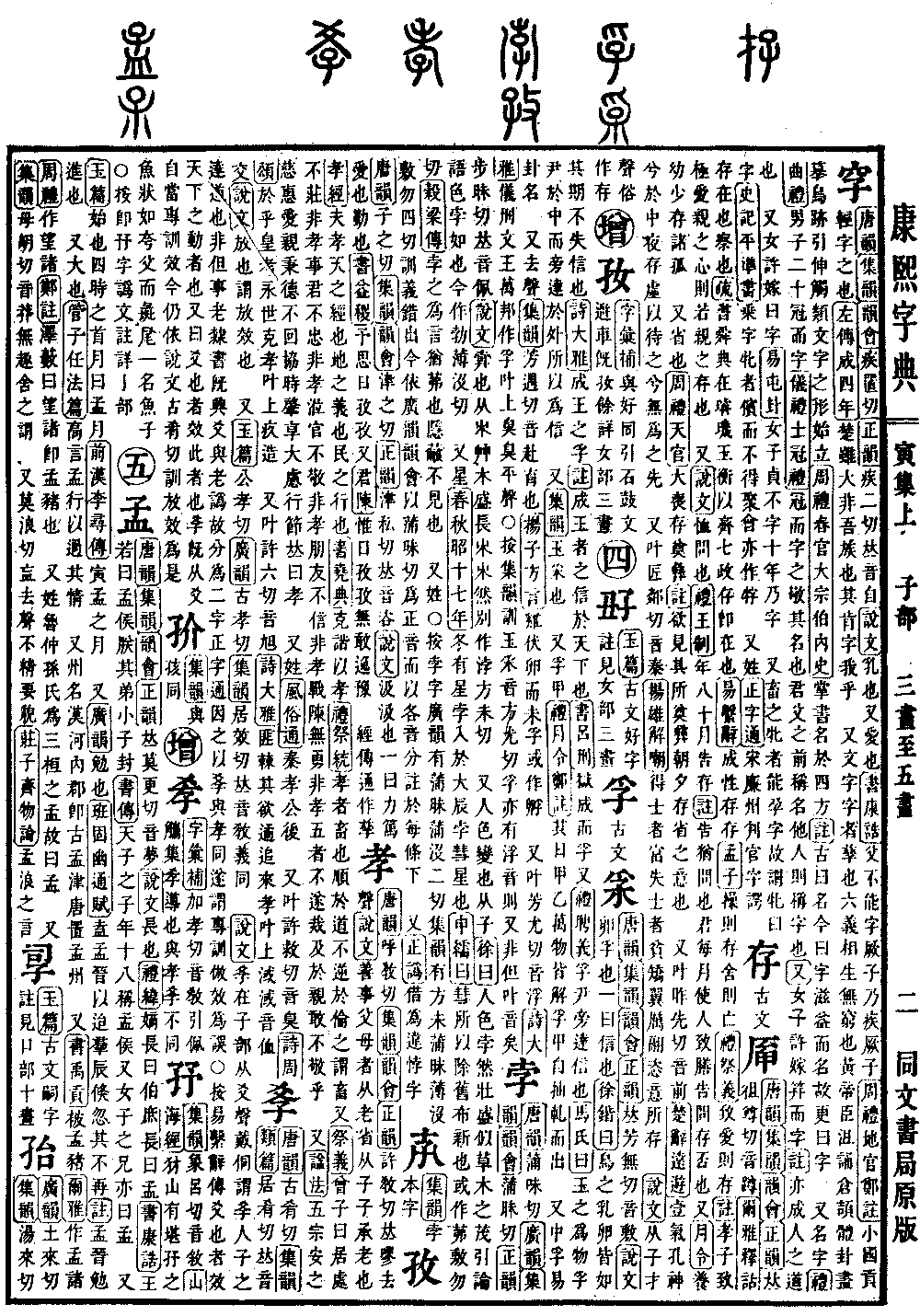
Yin Collection, Upper Volume. Radical: Child (zǐ). Kangxi stroke count: 7. Page 278, Entry 08.
Pronounced pei (falling tone).
According to the Explaining Graphs and Analyzing Characters (Shuowen Jiezi), it signifies the same meaning as bo, with a graph derived from the character for plants, representing the appearance of lush vegetation. It is also written as a variant form (bo), which is pronounced fang wei (falling tone).
It also refers to a sudden change in a person’s facial expression, with the graph derived from the character for child (zǐ). Xu says: When a person’s expression suddenly becomes intense, it is like the lushness of vegetation, citing the passage in the Analects of Confucius (Lunyu) which states, "His expression changed suddenly." It is currently written as bo, and is pronounced bo (entering tone).
It also refers to a comet. In the Zuo Tradition (Zuozhuan), seventeenth year of Duke Zhao, it is written: In winter, a comet appeared to the west of the Great Stellar Division (Dachen) extending to the Milky Way. Shen Xu stated: A comet is a phenomenon used to remove the old and introduce the new. Sometimes it is written as fu, and is pronounced fu (entering tone). The Guliang Tradition (Guliang Zhuan) states: The meaning of this character is similar to fu, signifying something concealed or invisible.
It is also a surname. Regarding the character, the Broad Rhymes (Guangyun) provides two pronunciations: pu mei (falling tone) and pu mo (entering tone). The Collected Rhymes (Jiyun) provides four pronunciations: fang wei (falling tone), pu mei (falling tone), bo mo (entering tone), and fu wu (entering tone). The definitions appear in an overlapping manner. Here, we follow the Broad Rhymes (Guangyun) and the Rhyme Collection (Yunhui) to establish pu mei (falling tone) as the standard pronunciation, with other pronunciations noted beneath their respective definitions.
Also, according to the Rectification of Errors (Zhenge), it is used as a loanword for the character bei meaning to disobey or contradict.
Verification: Also refers to a star. In the Spring and Autumn Annals (Chunqiu), seventeenth year of Duke Zhao, it is written: In winter, a comet entered the region of the Great Stellar Division. The character signifies a comet. Shen Xu stated: A comet is used to remove the old and introduce the new. We note that the explanation that this character is a comet is not the original text of the Spring and Autumn Annals. It has been cautiously corrected to read: Also a comet. In the Zuo Tradition (Zuozhuan), seventeenth year of Duke Zhao: In winter, there was a star, a comet, to the west of the Great Stellar Division extending to the Milky Way. Shen Xu (corrected from Shen Shu).