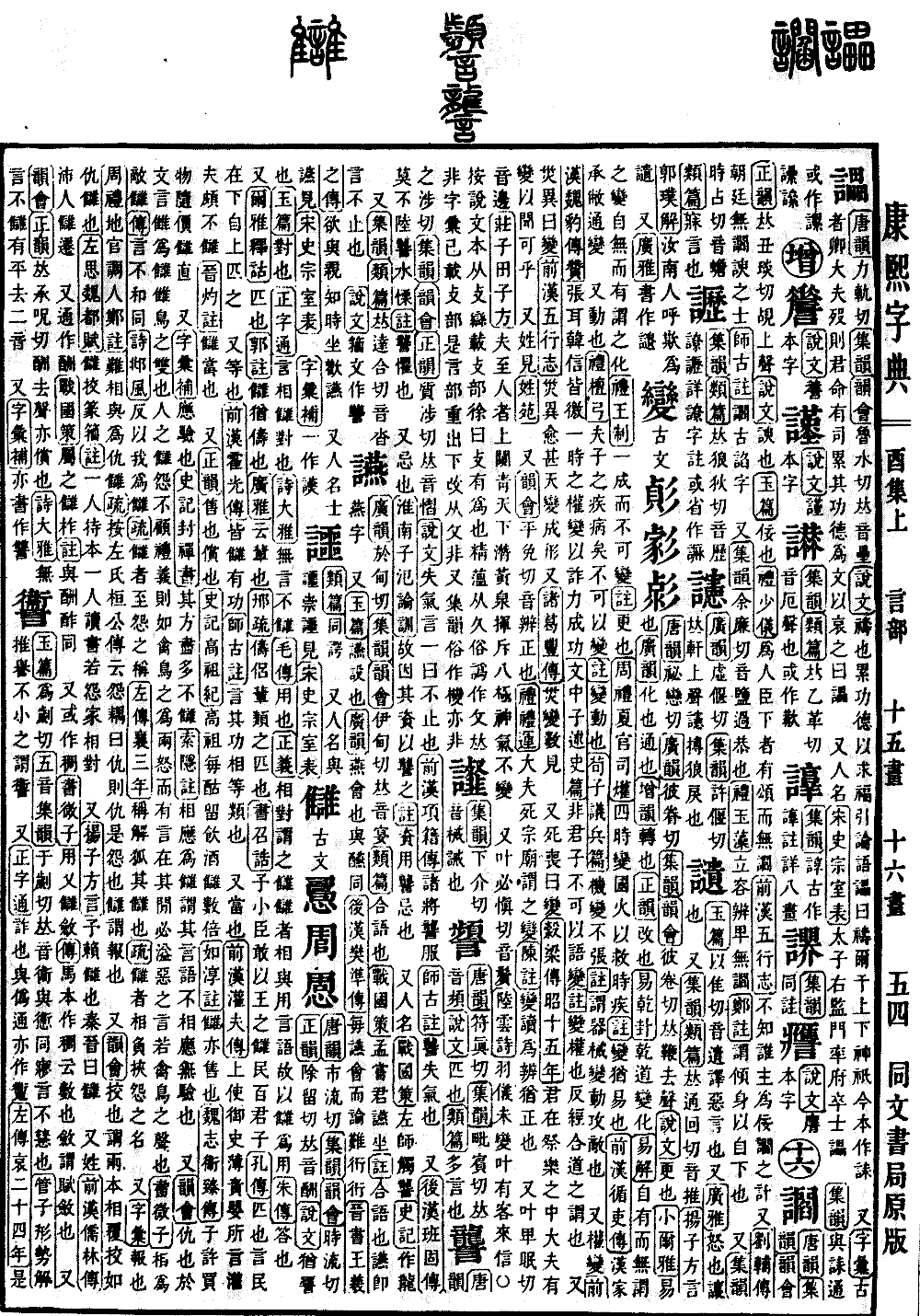
You Collection, Upper Volume
Radical: Speech (yán)
Kangxi Strokes: 23
Page 1186, Entry 03
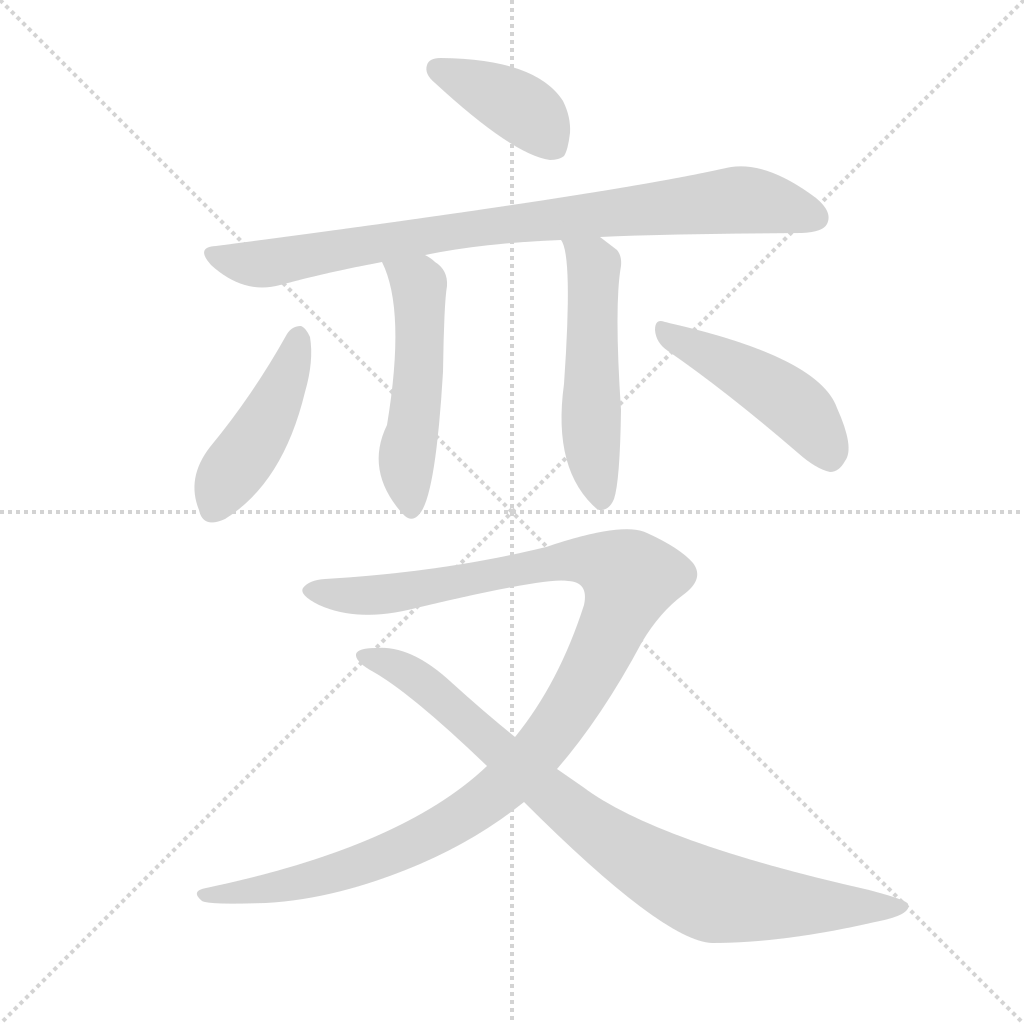
Ancient characters. Pronounced bian (falling tone). Pronounced bian (falling tone). Pronounced bian (falling tone), bian (falling tone) also.
Shuowen Jiezi (Shuowen): To change.
Xiao Erya (Xiao Erya): To alter.
Guangyun (Guangyun): To transform, to circulate.
Zengyun (Zengyun): To rotate.
Zhengyun (Zhengyun): To modify.
Book of Changes (Yijing), Qian Hexagram: The way of heaven changes and transforms.
Explanation of the Changes (Yijie): Changing from existence to non-existence is called bian (change); changing from non-existence to existence is called hua (transformation).
Book of Rites (Liji), Royal Regulations (Wangzhi): Once established, it cannot be changed.
Commentary: To alter.
Rites of Zhou (Zhouli), Summer Offices, Director of Fire (Si Guan): Each of the four seasons changes the state fire to mitigate seasonal illness.
Commentary: Bian means to alter.
History of the Former Han (Qian Hanshu), Biographies of Meritorious Officials (Xunli Zhuan): The Han dynasty accepted the dilapidated state and implemented changes.
Also means to move.
Book of Rites (Liji), Tangong: The Master's illness had become critical, and one should not move or disturb him.
Commentary: Bian means to move.
Xunzi, Discussion on Military Affairs (Yi Bing): Tactical maneuvers were not deployed.
Commentary: This refers to the movement of mechanical apparatus to attack the enemy.
Also means expedient adaptation.
History of the Former Han (Qian Hanshu), Biography of Wei Bao: Zhang Er and Han Xin both relied on temporary expedient adaptations, using deceit and force to achieve success.
Wenzhongzi, On History (Shushi): One cannot discuss expedient adaptation with anyone other than a gentleman.
Commentary: Bian means authority and flexibility. Violating the standard way while remaining in accordance with moral duty is called bian.
Also, disasters and anomalies are called bian.
History of the Former Han (Qian Hanshu), Treatise on the Five Phases (Wuxing Zhi): Disasters and anomalies became increasingly severe; heaven assumed a new form.
Biography of Zhuge Feng: Disasters and anomalies appeared frequently.
Also, death and mourning are called bian.
Guliang Commentary (Guliang Zhuan), Year 15 of Duke Zhao: When a ruler is in the midst of sacrificial rites and music, may a grandee inform him of a death in the family?
Also a surname; see Surname Garden (Xingyuan).
Pronounced bian (falling tone), sounds like the character for distinguish. To rectify.
Book of Rites (Liji), Evolution of Rites (Liyun): The death of a grandee at the ancestral temple is called bian.
Commentary: Bian is read as the character for distinguish. It is similar to the meaning of to rectify.
Also rhyming with bian (level tone).
Zhuangzi, Tian Zifang: That perfect person gazes up at the blue heaven, dives deep into the yellow springs, and wields power over the furthest reaches of the eight directions; his spirit and energy remain unchanged.
Also rhyming with bin (falling tone).
Poem by Lu Yun: The feathered rites have not yet changed; there is news that a guest arrives.
Note: In the Shuowen Jiezi (Shuowen), the character originally follows the radical for tap (pu) and is listed under that radical. Xu Shen states: Tap indicates action. The Jingyun version follows the character for long (jiu); the popular form mistakenly uses the radical for strike (wen), which is incorrect. The Dictionary of Characters (Zihui) has already included it under the radical for tap (pu). This entry under the radical for speech (yan) is a repetition. Changing the component below to the radical for strike (wen) is incorrect. The Jiyun (Jiyun) also contains the vulgar form with the radical for wood (mu) as a component, which is also incorrect.
Textual Research: In the Book of Rites (Liji), Tangong entry, the text stated the Master's illness, which has been corrected to critical illness according to the original text.