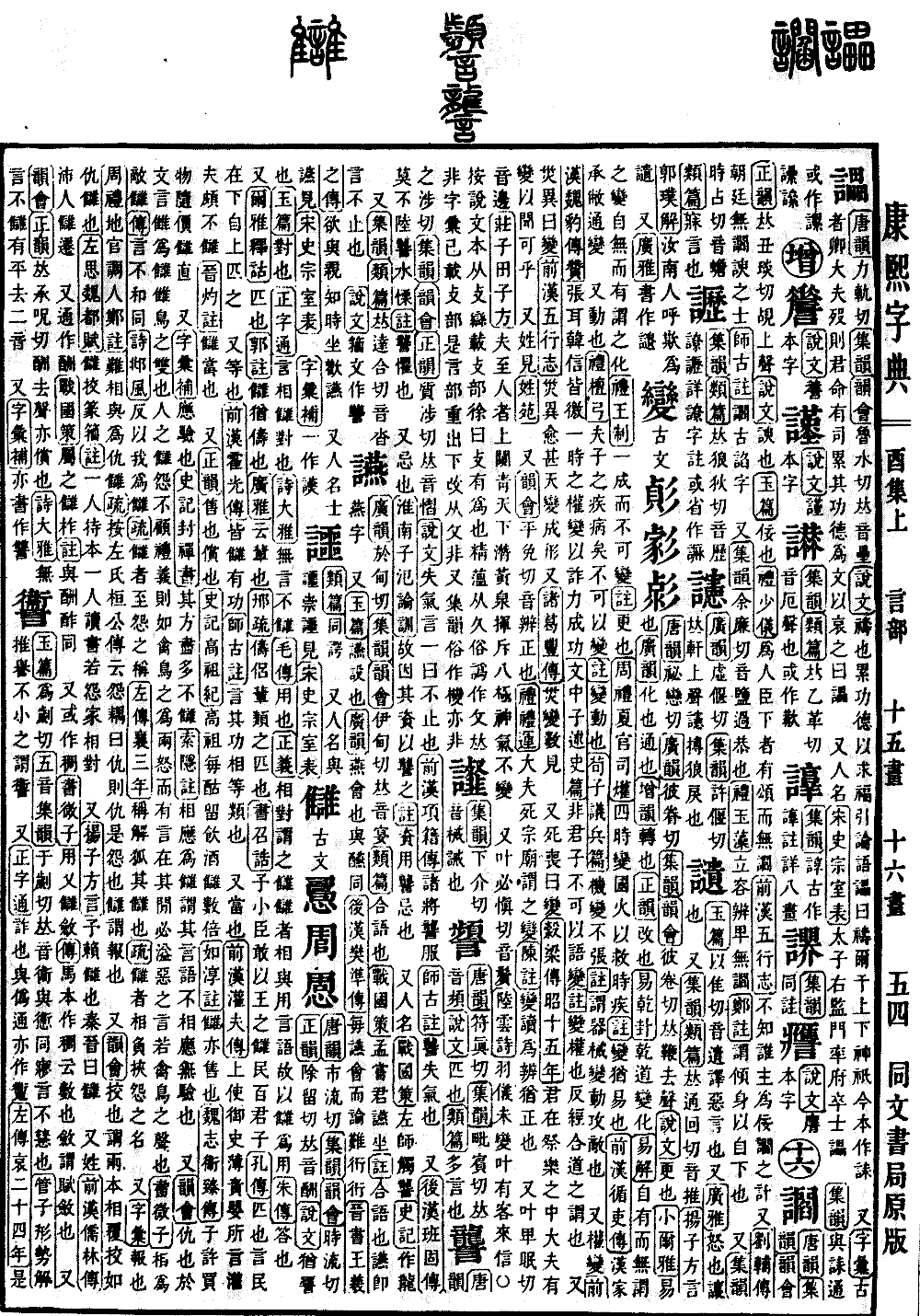
You Collection, Upper Volume
Radical: Speech (yán)
Kangxi Strokes: 23
Page 1186, Entry 12
Ancient character. Pronounced lian (falling tone) according to Tang Rhyme (Tangyun), pronounced juan (falling tone) according to Extensive Rhyme (Guangyun), and pronounced juan (falling tone) according to Collected Rhymes (Jiyun) and Rhyme Collection (Yunhui). Also pronounced bian (falling tone). According to Explaining Graphs and Analyzing Characters (Shuowen), it means to alter. In Small Er Ya (Xiao Erya), it means to change. According to Extensive Rhyme (Guangyun), it means to transform or to penetrate. In Supplemented Rhymes (Zengyun), it means to rotate. In Correct Rhymes (Zhengyun), it means to rectify. In Book of Changes (Yijing), Qian Hexagram: The way of heaven involves transformation and change. In Explanation of the Changes (Yijie): Changing from existence to non-existence is called bian, while changing from non-existence to existence is called hua (transformation). In Book of Rites (Liji), Royal Regulations: Once completed, it cannot be altered. Commentary: It means to change. In Rites of Zhou (Zhouli), Summer Offices, Fire Official: During the four seasons, change the state fire to prevent seasonal illnesses. Commentary: Bian means to exchange. In History of the Former Han Dynasty (Qian Hanshu), Biographies of Meritorious Officials: The Han dynasty took over the decadence and adapted to change. Also, to move. In Book of Rites (Liji), Tan Gong: The Master’s illness is critical; he cannot be moved. Commentary: Bian means to move. In Xunzi, Discussion on Warfare: If the mechanism of change is not deployed. Commentary: This refers to the movement of military equipment to attack the enemy. Also, expedient change. In History of the Former Han Dynasty (Qian Hanshu), Biography of Wei Bao: Zhang Er and Han Xin both sought momentary expedient change to achieve success through deceit and force. In Master Wen (Wenzhongzi), On History: One cannot discuss expedient change unless one is a gentleman. Commentary: Bian means authority. It refers to deviating from the norm while aligning with the path. Also, disasters and anomalies are called bian. In History of the Former Han Dynasty (Qian Hanshu), Treatise on the Five Elements: Disasters and anomalies became more frequent, and heaven took form through change. Also, in Biography of Zhuge Feng: Disasters and changes appeared repeatedly. Also, death and mourning are called bian. In Guliang’s Commentary (Guliangzhuan), 15th Year of Duke Zhao: If the ruler is in the midst of ritual music, is it appropriate for an official to report a death? Also, a surname, found in Garden of Surnames (Xingyuan). Also, pronounced bian (falling tone), meaning to rectify. In Book of Rites (Liji), Evolution of Rites: When an official dies in the ancestral temple, it is called bian. Commentary: Read bian as bian, meaning to rectify. Also rhyming with mian, pronounced bian. In Zhuangzi, Tian Zifang: The perfected person gazes at the blue sky above and dives into the yellow springs below, roaming the eight extremes, their spirit and energy unchanging. Also rhyming with shen, pronounced bin. In the poem by Lu Yun: The feather ornaments have not changed, and a guest has arrived with a message. Note: According to Explaining Graphs and Analyzing Characters (Shuowen), the character originally follows the radical Strike (pu) and is recorded in the Strike section. Xu says: Strike implies taking action. The Essential Meaning (Jingyun) suggests it follows a long duration, but common usage mistakenly uses the radical for strike as a variant, which is incorrect. The Character Dictionary (Zihui) already recorded it in the Strike section, so its inclusion in the Speech section is a redundancy. Changing it to the variant form in the lower section is incorrect. The collected version using a tree radical variant is also incorrect.
Textual research: In Book of Rites (Liji), Tan Gong, the text reads: The Master’s illness is critical. Following the original text, corrected from illness to critical illness.