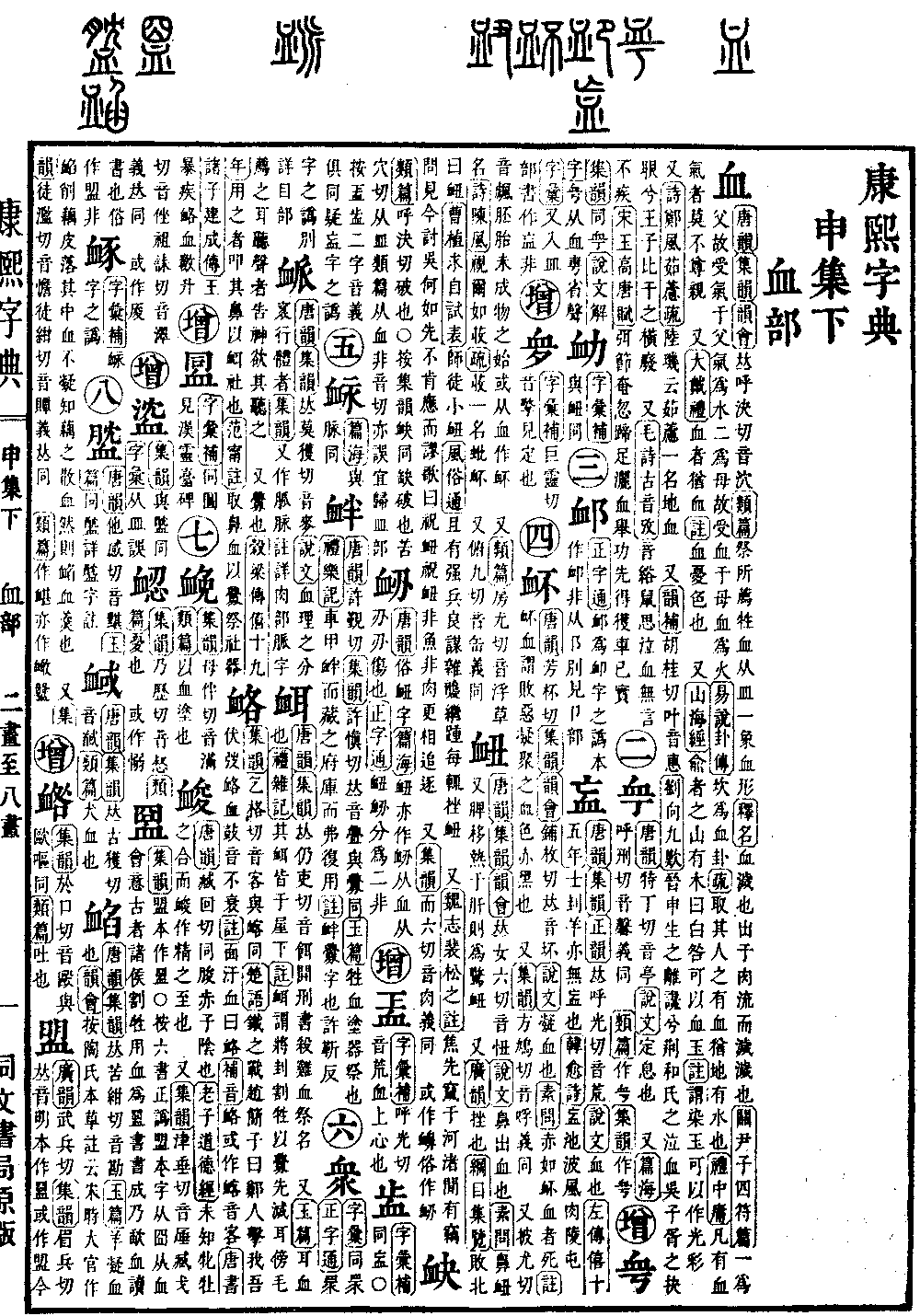
Shen Collection, Lower Volume
Radical: Blood (xuè)
Kangxi Strokes: 6
Page 1107, Entry 01
Pronounced jué. According to the Classified Dictionary of Chinese Characters (Leipian), it refers to the blood of sacrificial animals presented during rituals. The character structure originates from the vessel radical, with a horizontal stroke added to represent the form of blood.
In the Explanations of Names (Shiming), it is noted that blood relates to the concept of gushing, referring to the way it flows from the flesh continuously.
In the Master Guanyin (Guanyinzi), Four Symbols Chapter, it states: The first is the father, from whom one inherits vital breath, which corresponds to the element of water. The second is the mother, from whom one inherits blood, which corresponds to the element of fire.
In the Book of Changes (Yijing), Explanation of the Trigrams (Shuogua Zhuan), it is written that the Kan trigram is the blood trigram. The commentary notes that this is derived from the idea that humans possess blood just as the earth possesses water.
In the Book of Rites (Liji), Doctrine of the Mean (Zhongyong), it says: All beings that possess blood and breath have no one who does not respect their parents and relatives.
Also, in the Record of Rites by Dai the Elder (Da Dai Liji), it is written: Blood is like blood. The commentary notes this refers to a melancholy complexion.
Also, in the Classic of Mountains and Seas (Shanhaijing), it mentions that on Mount Yu there is a tree called the white jiu, which can be used to stain jade to make it luminous.
Also, in the Classic of Poetry (Shijing), Zheng Odes, Commentary on the Madder Plant, Lu Ji says: The madder plant is also known as earth blood.
Also, in the Rhyme Supplement (Yunbu), it is pronounced huì (rhyming). In Liu Xiang’s Nine Laments (Jiutan), he writes: Prince Shensheng of the Jin state suffered from slander; Bian He of the Chu state wept tears of blood; Wu Zixu of the Wu state had his eyes gouged out; and Prince Bigan was disemboweled and died.
Also, in the Investigation of Ancient Pronunciations of the Mao Odes (Maoshi Guyin Kao), it is pronounced xì: Thinking of the mouse, I weep blood; there is no word that does not carry pain.
In Song Yu’s Rhapsody on Gaotang (Gaotang Fu), it describes: Halting the carriage for a brief moment, the hooves splash with fresh blood. Those who are awarded for their merits are first to be satisfied; the hunting carriages are already filled.