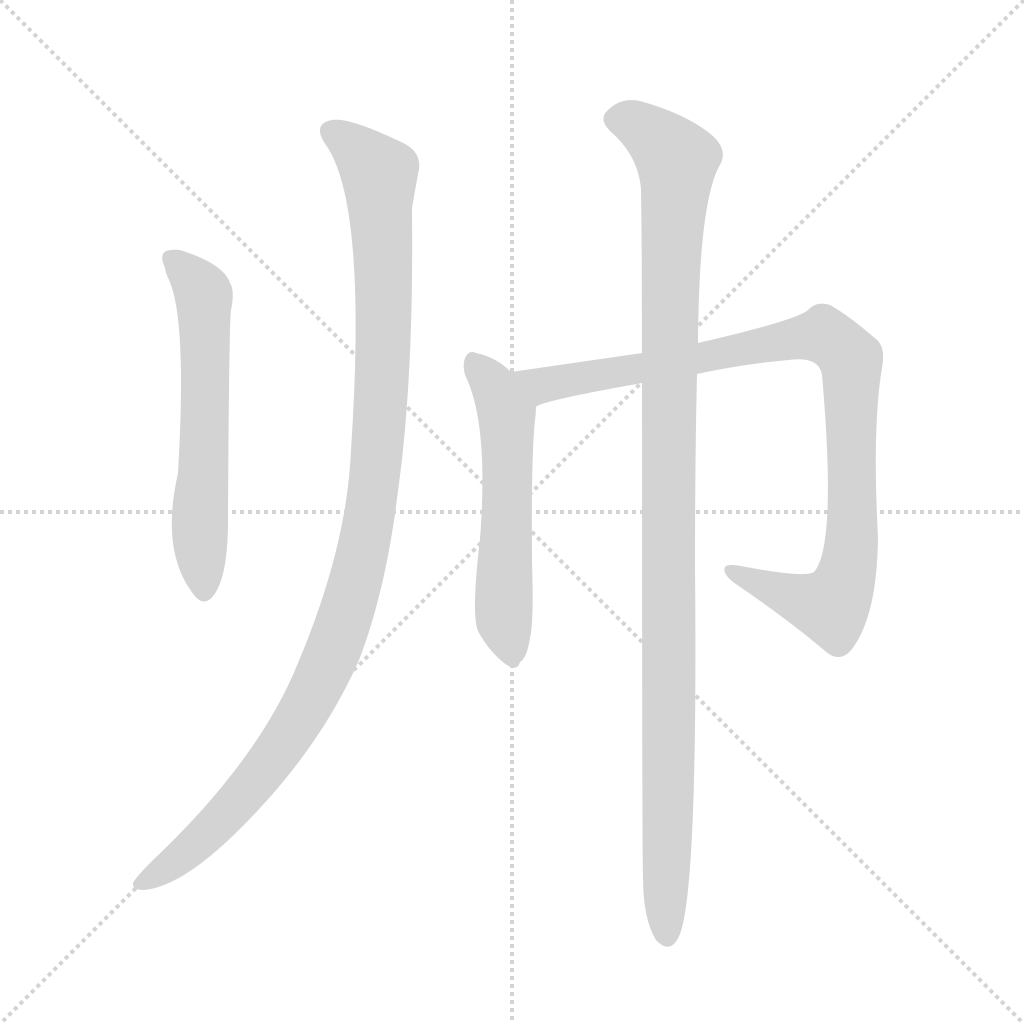
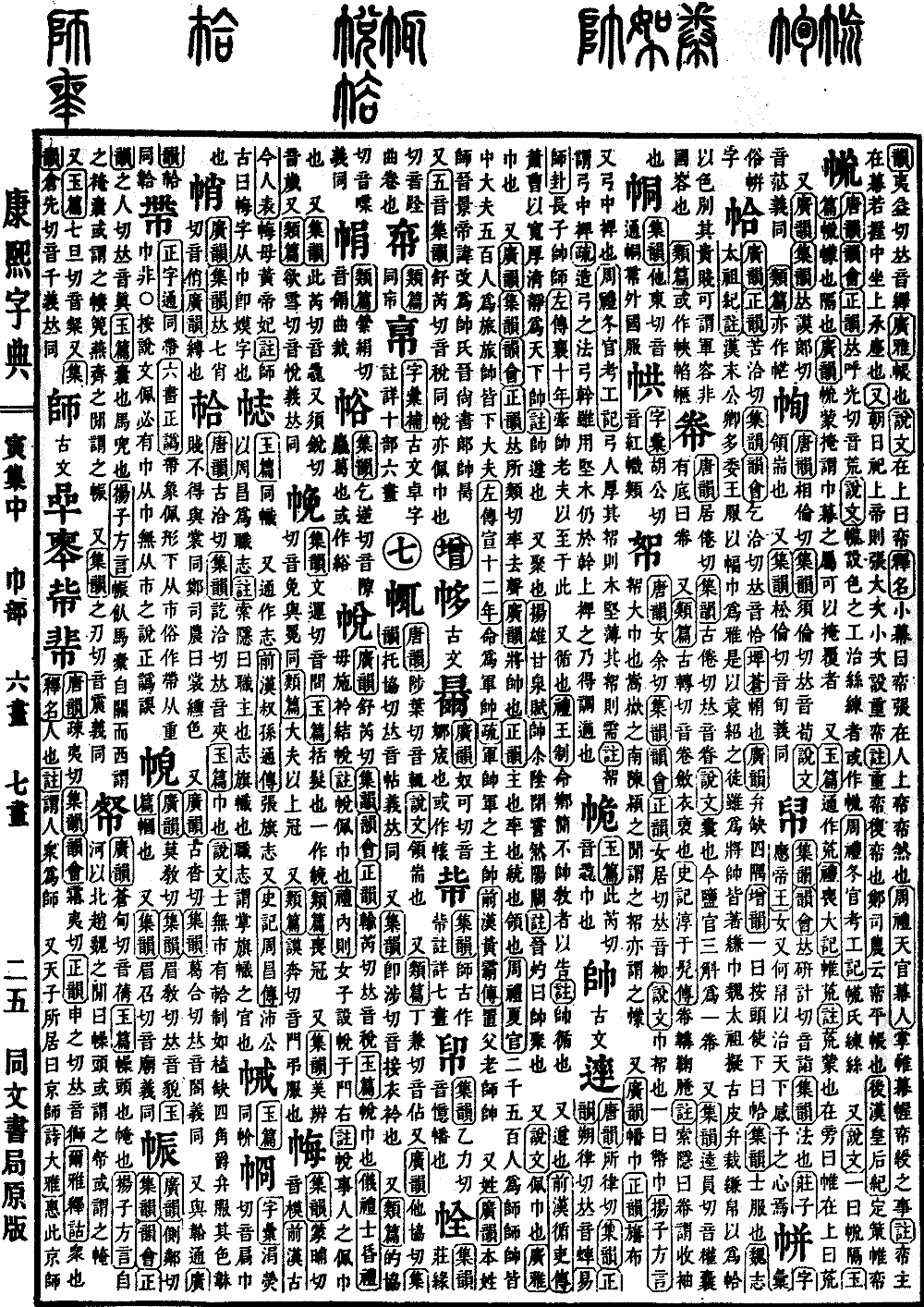
Yin Collection, Middle Volume
Radical: Towel (jīn)
Kangxi Strokes: 9
Page 331, Entry 01
Ancient character.
Pronounced shuai.
Book of Changes (Yijing), Hexagram Shi: The eldest son leads the army.
Commentary of Zuo (Zuozhuan), Tenth Year of Duke Xiang: Implicating an old man like me, leading to this.
Also means to follow.
Book of Rites (Liji), Royal Regulations: Order the villages to report those who do not follow instructions.
Note: Shuai means to follow.
Also means to comply with.
History of the Former Han (Qianhan), Biography of Upright Officials: Xiao He and Cao Can, through leniency and tranquility, became models that the people of the world complied with.
Note: Shuai means to comply with.
Also means to gather.
Yang Xiong, Ganquan Rhapsody (Ganquan Fu): Gathering yin energy and closing it; suddenly yang energy disperses.
Note: Jin Zhuo says: Shuai means to gather.
Also, according to the Shuo Wen (Dictionary of Explanations of Characters), a towel worn at the waist.
According to the Guang Ya (Expanded Dictionary), it means a towel.
Also pronounced shuai (falling tone).
Guang Yun (Wide Rhyme): A general or commander.
Zheng Yun (Correct Rhymes): Means a master, to lead, to command, to guide.
Rites of Zhou (Zhouli), Ministry of Summer: Two thousand five hundred men constitute a shi, and the shi commander is a mid-level grandee. Five hundred men constitute a lü, and the lü commander is a lower-level grandee.
Commentary of Zuo, Twelfth Year of Duke Xuan: Appointed as a military commander.
Sub-commentary: Military commander refers to the chief of the army.
History of the Former Han, Biography of Huang Ba: Appointing elders, teachers, and officials.
Also a surname.
Guang Yun: Originally the surname Shi, but because of the taboo of Emperor Jing of Jin, it was changed to the Shuai surname. There was a Secretariat Drafter named Shuai Bing during the Jin dynasty.
Also pronounced shui.
Equivalent to a waist towel.