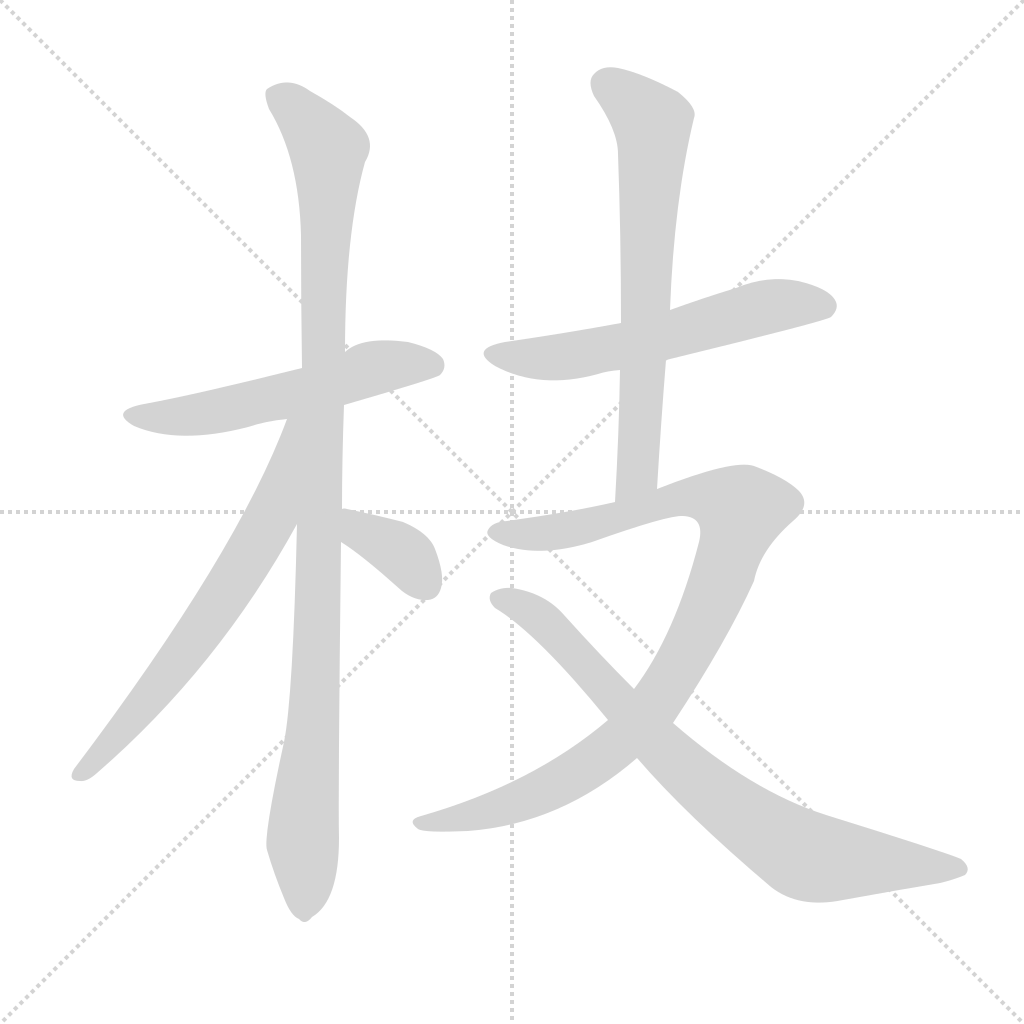
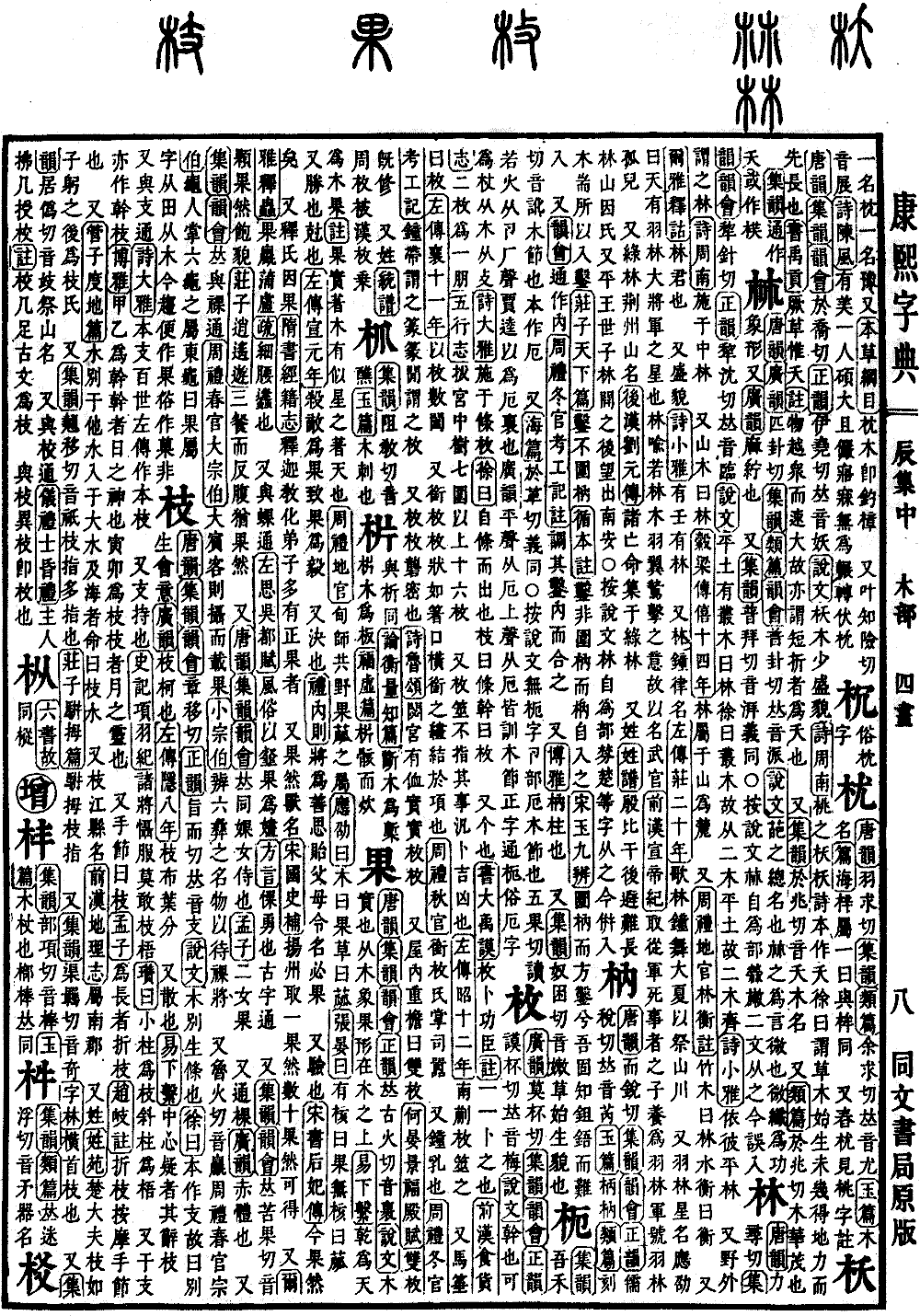
Chen Collection, Middle Volume. Radical: Tree (mù). Kangxi stroke count: 8. Page 516, Entry 12.
Pronounced zhi.
Shuowen Jiezi (Explaining Single-component Characters and Analyzing Compound Characters): Refers to the branches growing from a tree. Xu says: Since it separates from the main trunk, it is called a separate growth. Guangyun (Broad Rhymes): Refers to tree branches.
Zuo Zhuan (Chronicle of Zuo): Branches are sparse and leaves are distributed.
It also carries the meaning of being scattered.
I Ching (Book of Changes): A person with inner doubt will speak in a scattered manner.
It is also interchangeable with the character zhi.
Book of Odes (Shijing): The root and branches shall last for a hundred generations. Zuo Zhuan (Chronicle of Zuo) writes this as root and branch.
It also carries the meaning of support.
Records of the Grand Historian (Shiji): The various generals were fearful and submissive, none dared to resist. Zan says: Small pillars are called zhi, and slanted pillars are called wu.
It is also used for the Heavenly Stems and Earthly Branches, sometimes written as stem and branch.
Boya (Broad Refinements): Jia and Yi are stems. Stems are the primal spirit of the sun. Yin and Mao are branches. Branches are the spiritual energy of the moon.
It also refers to finger joints.
Mencius (Mengzi): To break off a branch for an elder. Zhao Qi commentary: To break off a branch means to massage the finger joints.
Guanzi (The Book of Master Guan): Water that separates from other flows to enter a large river or the sea is called a branch stream.
Zhijiang is the name of a county.
Book of Han (Hanshu): Geography Treatise: It belonged to Nanjun.
It is also a surname.
Surname Garden (Xingyuan): The Chu state grandee Zhiru, descendants of Zigong, became the Zhi clan.
Pronounced qi. Zhi-zhi refers to an extra finger.
Zhuangzi (The Book of Master Zhuang): Webbed toes and extra fingers.
Pronounced ji.
Zilin (Forest of Characters): Refers to cross-headed branches.
Pronounced gui. This is the name of a sacrifice to the mountains.
It is also interchangeable with jiao.
Book of Etiquette and Ceremonial (Yili): The host wipes the table and passes the legs of the table. Commentary: Jiao is the leg of a table; the ancient text is written as zhi. It is different from yi. It means a stalk.
Textual research: Originally written as zhi. Therefore, it is said that it is a separate growth, which is an ideographic character. Strictly following the original text, it has been changed to from the root and separates, so it is called separate growth.
Zuo Zhuan (Chronicle of Zuo): Branches distributed and leaves separated. Strictly noting that the citation is from the commentary, not the main text. Strictly following the original book, the word commentary has been added under the eighth year.