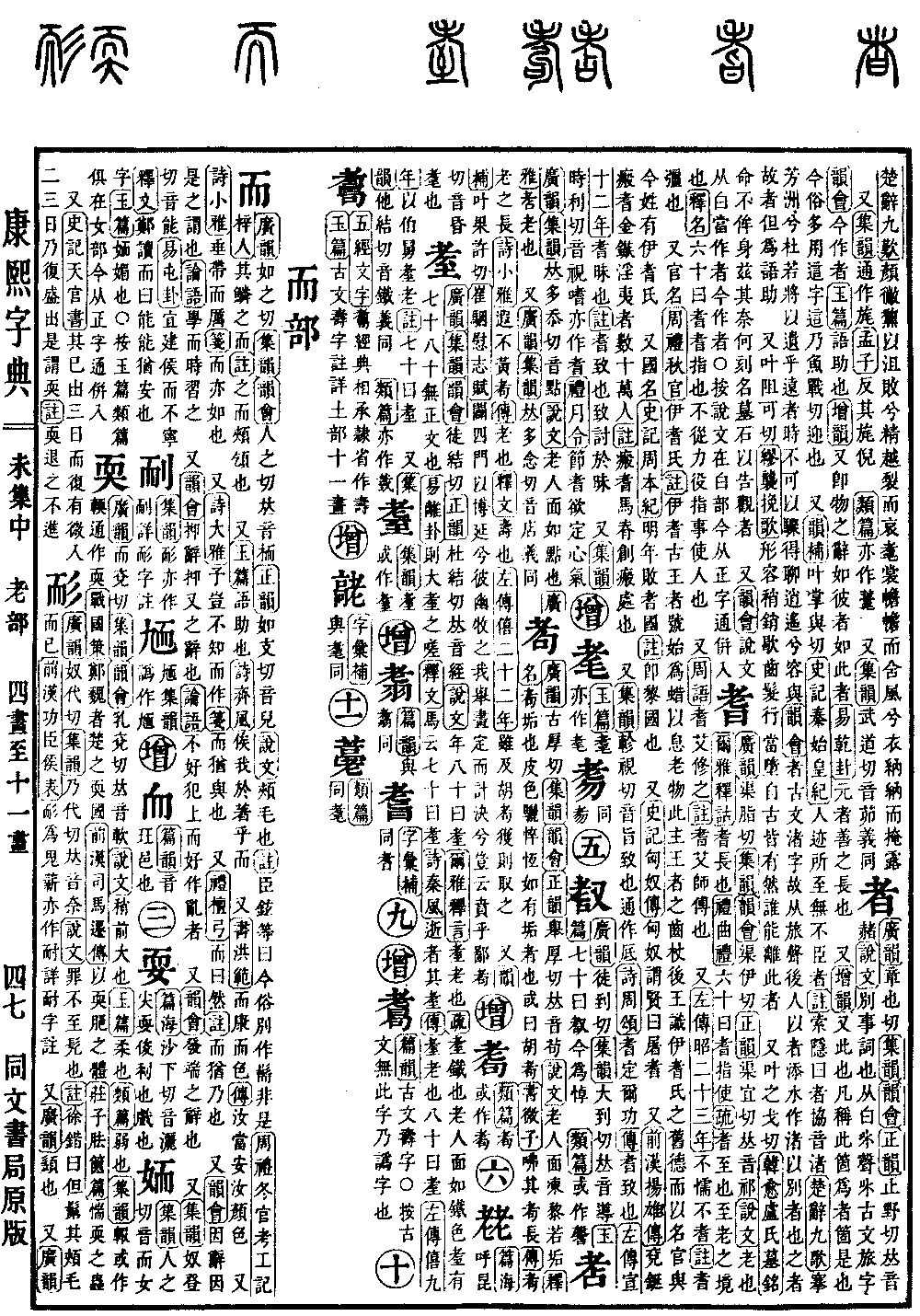
Wei Collection, Middle Volume
Radical: Old (lǎo)
Kangxi strokes: 10
Page 961, Entry 01
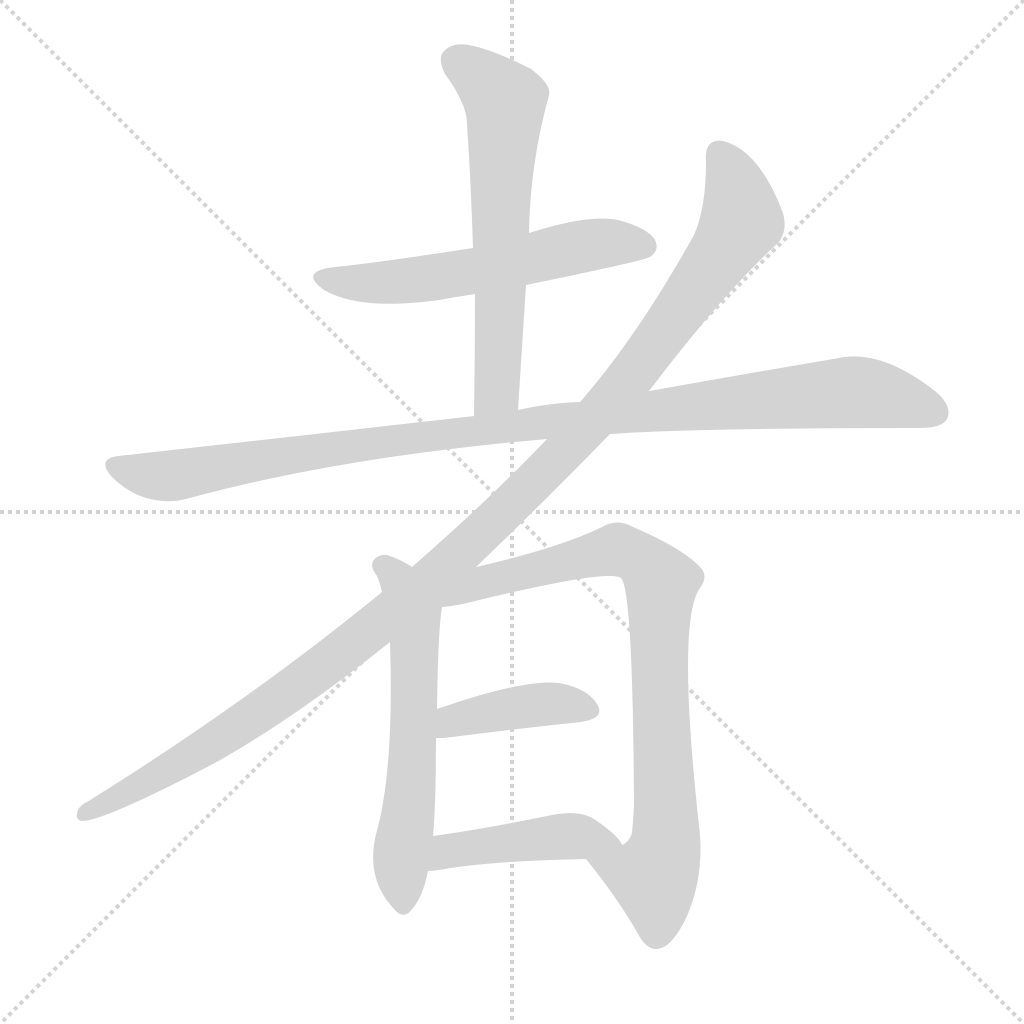
Pronounced zhe.
As defined in the Analytical Dictionary of Characters (Shuowen Jiezi), it is a particle used to distinguish matters. It derives from the white (bai) phonetic element. It is an ancient form of the character for travel or reside (lü).
As defined in the Rhyme Treasury (Yunhui), it is currently written as the character for author or to do (zuo).
As defined in the Jade Chapters (Yupian), it is a grammatical particle.
As defined in the Expanded Rhymes (Zengyun), it is a term for referencing objects, such as in the phrases "like that" or "like this."
In the Book of Changes (I Ching), specifically the Qian hexagram, it is written: "The great (yuan) is the head of excellence."
The Expanded Rhymes further notes that it also means "this," as in referring to "this one." Currently, colloquial usage often employs the character (zhe), which is pronounced zhan (entering tone) and means to meet.
Also noted in Rhyme Supplements (Yunbu): harmonizes with the rhyme of zhang. In the Records of the Grand Historian (Shiji), within the annals of the First Emperor of Qin, it is written: "Wherever human footprints reach, there is none who does not submit." The commentary by Sima Zhen (Suoyin) says: "The character zhe is read as zhu here to match the rhyme."
In the Songs of Chu (Chuci), specifically the Nine Songs (Jiuge), it is written: "I pluck the fragrant aromatic herbs from the islet, intending to present them to one who is far away; time cannot be easily captured, I shall linger and wander at ease."
The Rhyme Treasury (Yunhui) states: "The character zhe is the ancient form of the character for islet (zhu), which is why it contains the phonetic element for travel/reside (lü). Later generations added the water radical to distinguish it from the grammatical particle zhe, leaving the original character to serve only as a particle."
Also harmonizes with the rhyme of zuo and ke. In the Funeral Odes of Miao Xi (Miao Xi Wange), it is written: "The appearance gradually fades, teeth and hair will inevitably fall; this has been true since ancient times, who can escape this?"
Also harmonizes with the rhyme of zhi and ge. In the Tomb Inscription for the Lu Family by Han Yu, it is written: "Fate does not match the person, how can this be helped? I carve a name upon the tombstone, to inform those who view it."
The Rhyme Treasury (Yunhui) notes: "The Analytical Dictionary of Characters (Shuowen Jiezi) lists this under the white (bai) radical; now it is placed here according to the Corrected Dictionary (Zhengzitong). The character may also derive its sound from white (bai). The character is an ancient form of the character for trapped (kun)."