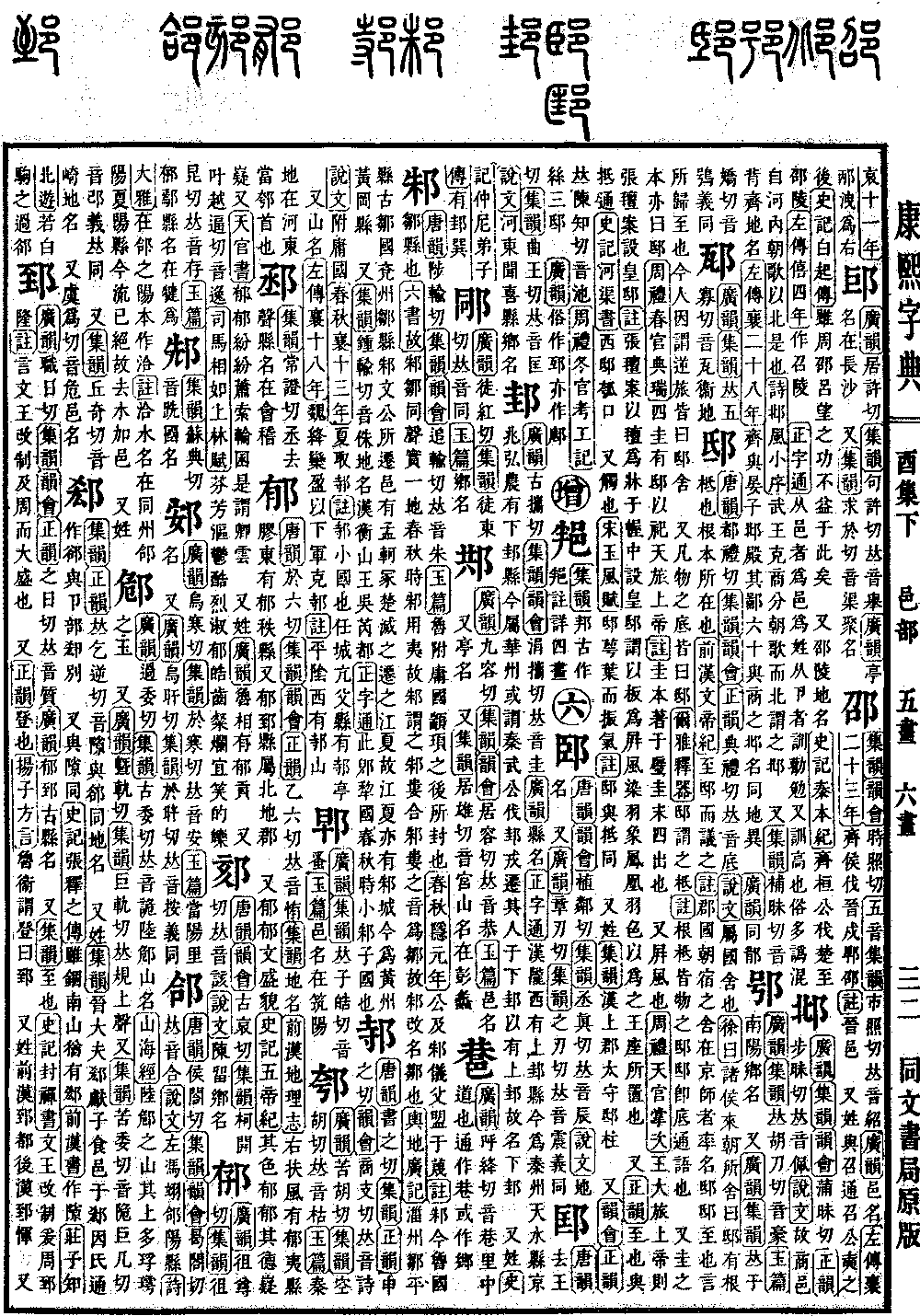
You Collection, Lower Volume. Radical: City (yì). Zhi. Kangxi strokes: 13. Page 1270, number 27.
Broad Rimes (Guangyun) gives the pronunciation as zhí rì qiè. Collected Rimes (Jiyun), Rime Rhymes (Yunhui), and Correct Rimes (Zhengyun) give the pronunciation as zhī rì qiè, sounding the same as zhì.
Broad Rimes states it refers to Yuzhi, which is an ancient county name.
Collected Rimes also defines it as reaching the extreme or utmost.
King Wen reformed the systems, and by the time of the Zhou dynasty, it reached the peak of prosperity — Records of the Grand Historian (Shiji) in the Biography of Sima Xiangru (Sima Xiangru zhuan). The commentary explains that King Wen reformed the systems, reaching the peak of prosperity by the Zhou dynasty.
Correct Rimes also defines it as to ascend, namely to rise.
In the regions between Lu and Wei, to ascend is called zhi — Yangzi's Dialects (Fangyan).
It is also used as a surname. In the Former Han dynasty there was Zhi Du, and in the Later Han dynasty there was Zhi Yun.
Collected Rimes also gives the pronunciation as zhì lì qiè, sounding like zhì. The meaning is the same as mentioned above.
Collected Rimes also gives the pronunciation as jī zhì qiè, sounding like jié. The term zhìjié describes the appearance of a pole or mast.
How beautifully the banners and tall masts flutter — Yang Xiong's Rhapsody on the Sweet Springs (Ganquan fu).
Textual Research: The original quote in the Book of Feng and Shan (Fengshan shu) of the Records of the Grand Historian was: King Wen reformed the systems, and by the time of the Zhou dynasty, it reached the peak of prosperity. This sentence actually originates from the Biography of Sima Xiangru, and the text has been corrected accordingly.