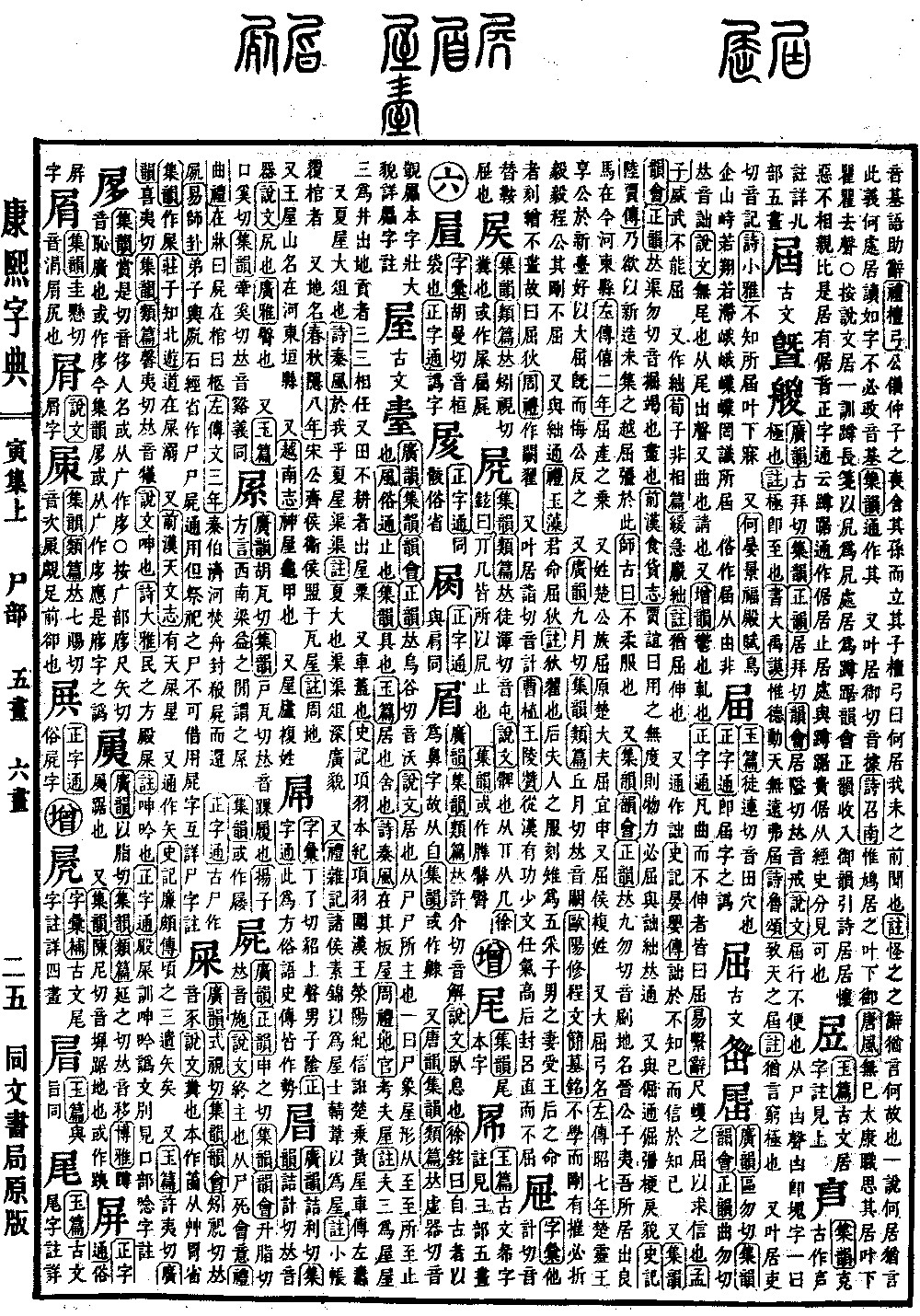
Yin Collection, Upper Volume
Radical: Corpse (shī)
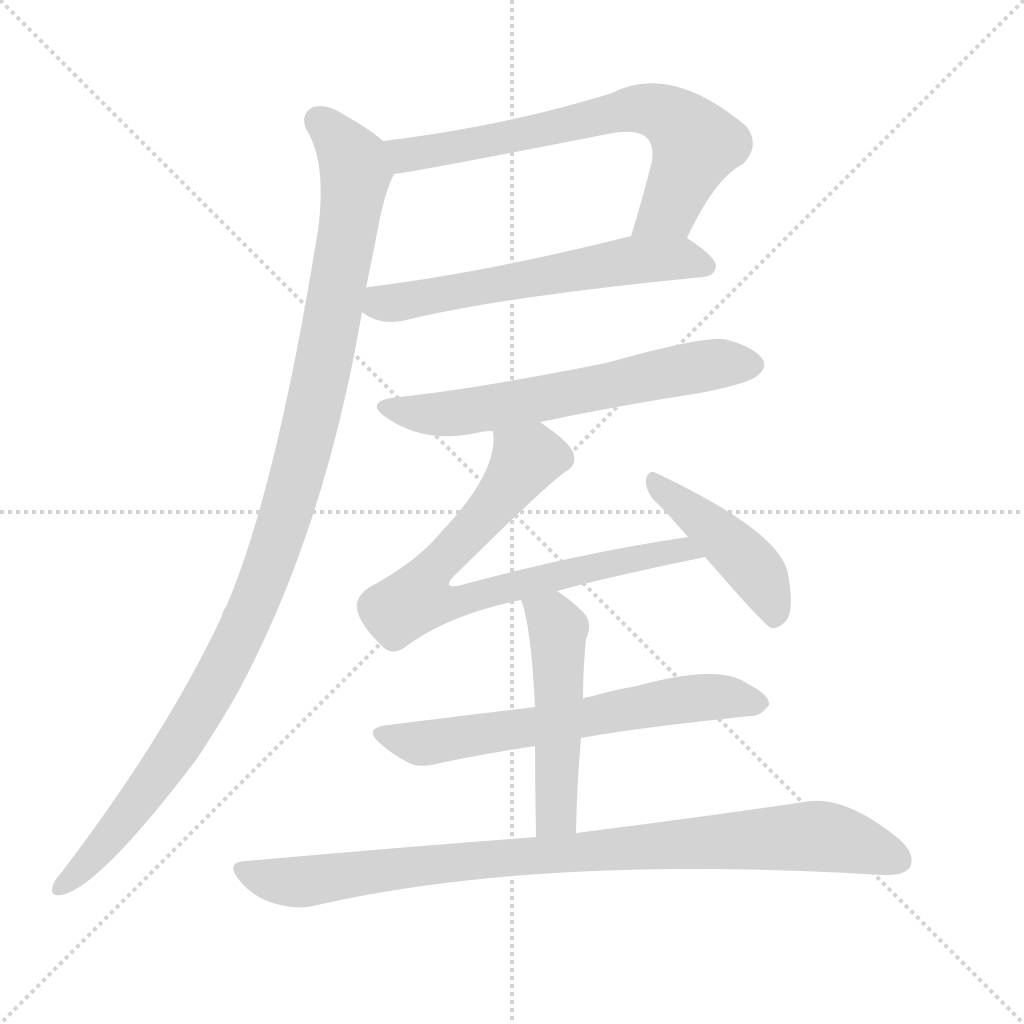
House. 9 Kangxi strokes. Page 301, Entry 19.
Ancient script. According to the Broad Rhymes (Guangyun), Gathered Rhymes (Jiyun), Rhyme Meetings (Yunhui), and Orthodox Rhymes (Zhengyun), it is pronounced wo. According to the Discussion of Writing (Shuowen), it is a place where one resides. It follows the radical for corpse, indicating that the corpse represents the owner of the house. Another theory suggests the corpse symbolizes the shape of a house, and it follows the radical for arrive, signifying that one stops once reaching this point. According to the Customs (Fengsutong), it means a place to stop and rest. According to the Gathered Rhymes (Jiyun), it means to be equipped. According to the Jade Chapters (Yupian), it is a place of residence or a dwelling. In the Book of Odes (Shijing), Qin Wind section, it says: In their plank-roofed houses. In the Rites of Zhou (Zhouli), Earth Official section, it mentions examining the houses of the husbands; the commentary notes that three husbands make one house, and three houses make one well, responsible for land tribute; families of three guarantee each other, and uncultivated land is subject to house tax. It also refers to a carriage canopy. In the Records of the Grand Historian (Shiji), Biography of Xiang Yu, it states that when Xiang Yu besieged the King of Han at Xingyang, Ji Xin deceived the Chu army by riding in a yellow-canopied carriage, with a yak-tail banner to the left. Also, large sacrificial stand, referring to a large vessel used for offerings in ancient rituals. In the Book of Odes (Shijing), Qin Wind section, it says: To me, the large sacrificial stand is deep and wide. The commentary notes that large means grand, and the expression describes a stand that is deep and wide. Also, according to the Record of Rites (Liji), Miscellaneous Records section, feudal lords used white silk to make a canopy, and scholars used reed mats on a funeral carriage to make a canopy. The commentary notes this refers to the small curtain covering a coffin. Also a place name. According to the Spring and Autumn Annals (Chunqiu), in the eighth year of Duke Yin, the Duke of Song, the Marquis of Qi, and the Marquis of Wei met at Wuwu. The commentary notes this was a place in the Zhou dynasty. Also Wangwu, a mountain name, located in the Yuan county of Hedong. Also, according to the Records of Vietnam (Yuenanzhi), divine house refers to tortoise shells. Also Wulu, a double-character surname.
Textual research: In the Records of the Grand Historian, Biography of Xiang Yu, the text states Xiang Yu besieged the King of Han at Xingyang, Ji Xin deceived the Chu army, rode a yellow-canopied carriage, and displayed a left-side banner. The word translated as displayed has been corrected based on the original text. In the Record of Rites, Miscellaneous Records, the text mentions feudal lords used plain silk to make a canopy, and scholars used reed mats on a funeral carriage to make a canopy. The word mat has been added after reeds based on the original text.