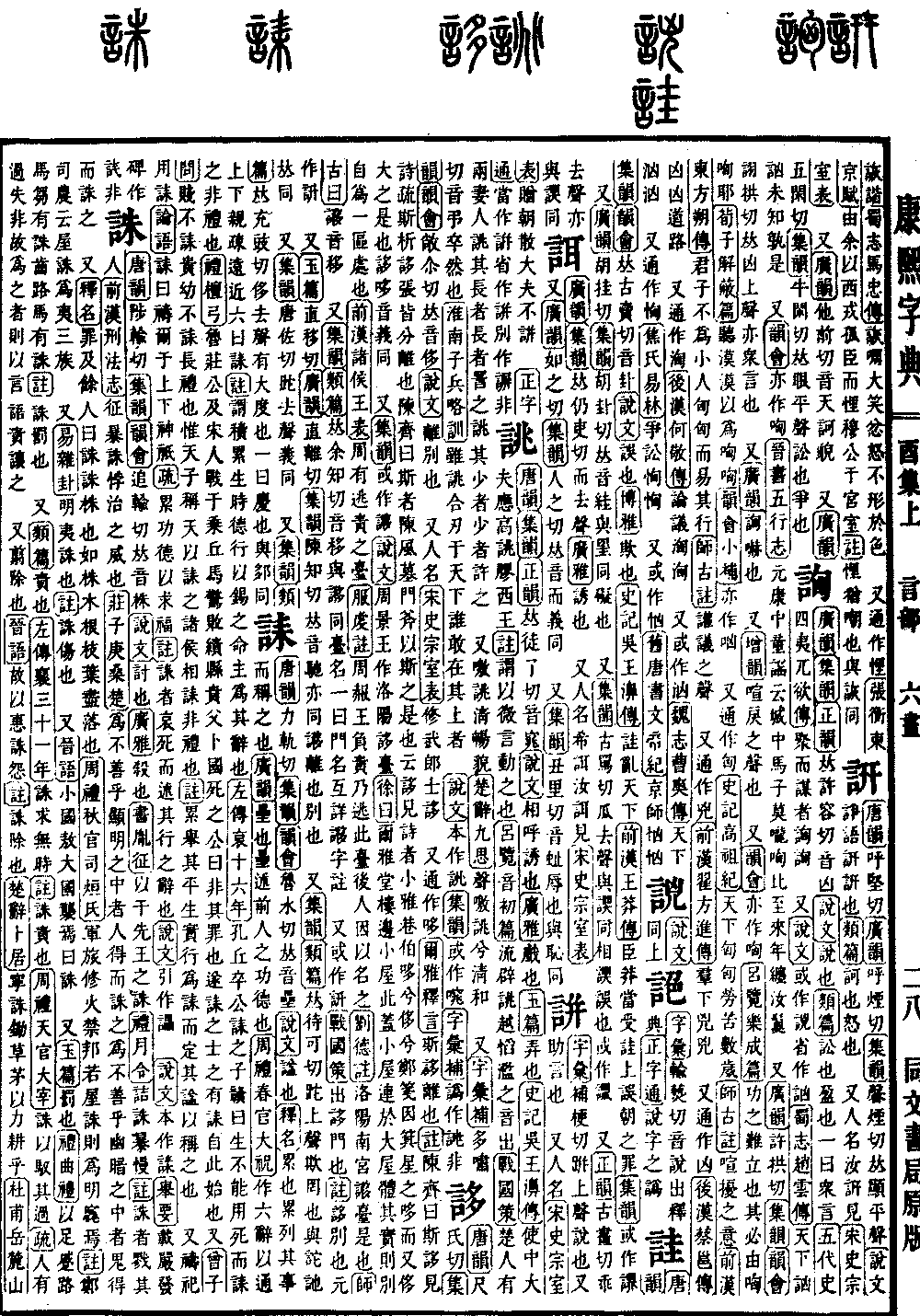
You Collection, Upper Volume
Radical: Speech (yán)
Kangxi Strokes: 13
Page 1160, Entry 02
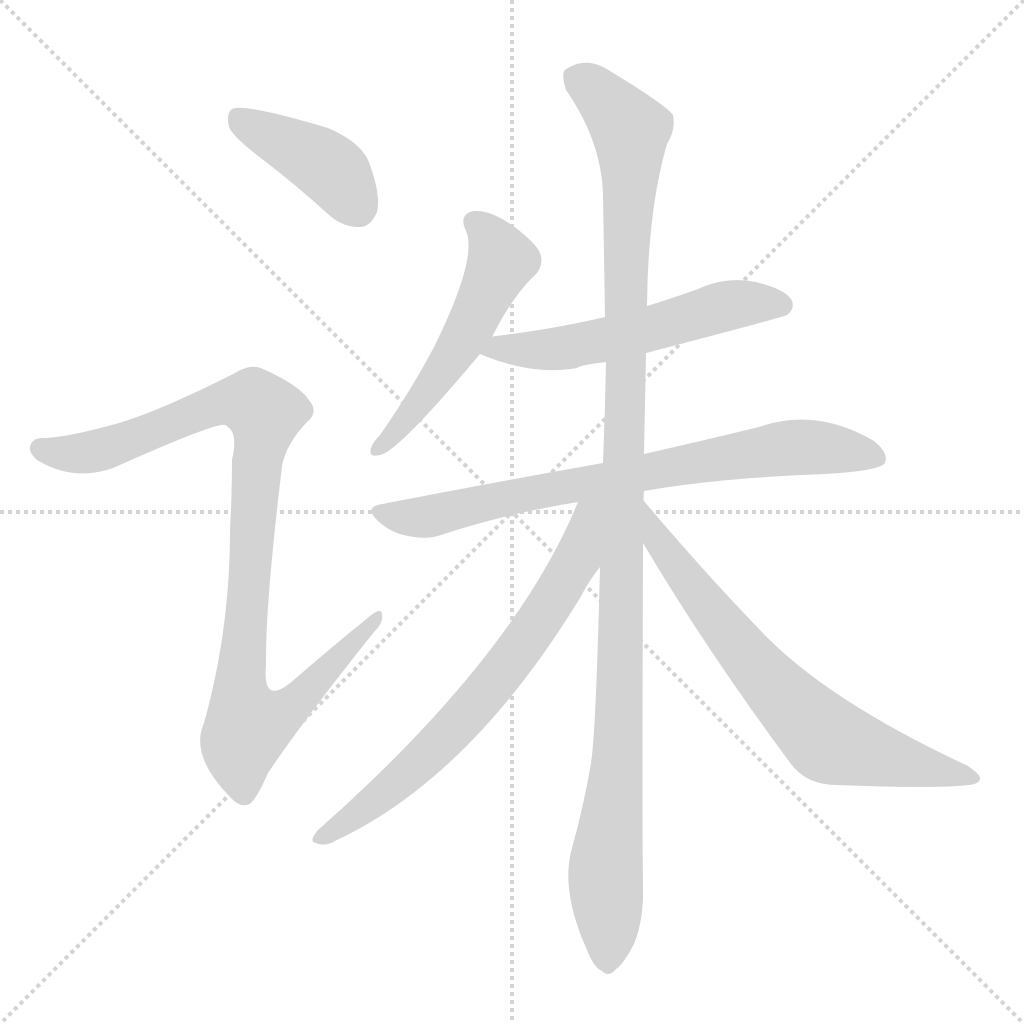
Pronounced zhu.
Shuowen Jiezi (Shuowen): To punish.
Guangya: To kill.
Book of Documents (Shangshu): To exercise the punishments of the former kings.
Book of Rites (Liji): Question and punish the violent and the negligent. Commentary: To punish means to execute that person.
History of the Former Han Dynasty (Qian Hanshu): Punishing the violent and suppressing the perverse is the power of governance.
Zhuangzi: If one does evil in the open, men will catch and punish them; if one does evil in the darkness, spirits will catch and punish them.
Also, Shiming: When a crime affects others, it is called zhu. Zhu is like a tree stump (zhu), as when the trunk of a tree is cut, the branches and leaves all fall.
Rites of Zhou (Zhouli): During military campaigns, manage fire prohibitions; if there is a collective punishment (wu zhu), then prepare an illuminated pit. Commentary: Zheng Sinong says: Collective punishment refers to the execution of the three clans.
Book of Changes (Yijing): Mingyi is punishment. Commentary: Punishment means injury.
Discourses of the States (Guoyu): When a small state is arrogant, a large state attacks it; this is called punishment.
Yupian: To penalize.
Book of Rites (Liji): Kicking the fodder of a royal carriage with one's foot incurs a penalty; damaging the teeth of a royal carriage horse incurs a penalty. Commentary: Punishment means a penalty.
Leipian: To demand or censure.
Zuo Commentary (Zuozhuan): Demanding without cease. Commentary: Punishment means to censure.
Rites of Zhou (Zhouli): Use punishments to manage their transgressions. Commentary: If a person has a fault and did not do it intentionally, then use language to censure and reprove them.
Also: To prune or remove.
Discourses of the States (Guoyu): Therefore, use kindness to eliminate resentment. Commentary: Punishment means to remove.
Songs of Chu (Chuci): Would it not be better to clear (zhu) the grass and weeds and farm with one's strength?
Du Fu: Beside these mists and clouds, the thatch can be cleared (zhu).
Zhengzitong: Clearing thatch for a house; here the character zhu is borrowed.
Also pronounced zhou.
Hua He: I dare not disobey the imperial edict, fearing to hasten the crime and punishment; I venture to accept the imperial command, my soul departs while my form remains.
Also pronounced zhu (departing tone).
Cai Yong: Below, one suffers the guilt of being burned or exiled; above, one receives the punishment of family extermination; the preceding carriage has already overturned, yet one follows the same track and rushes forward.
Textual Research: In the Rites of Zhou, Autumn Officials, Office of the Fire Manager, commentary, Zheng Sinong states: Collective punishment refers to the execution of the three clans. Following the original text, changed to read as refers to.