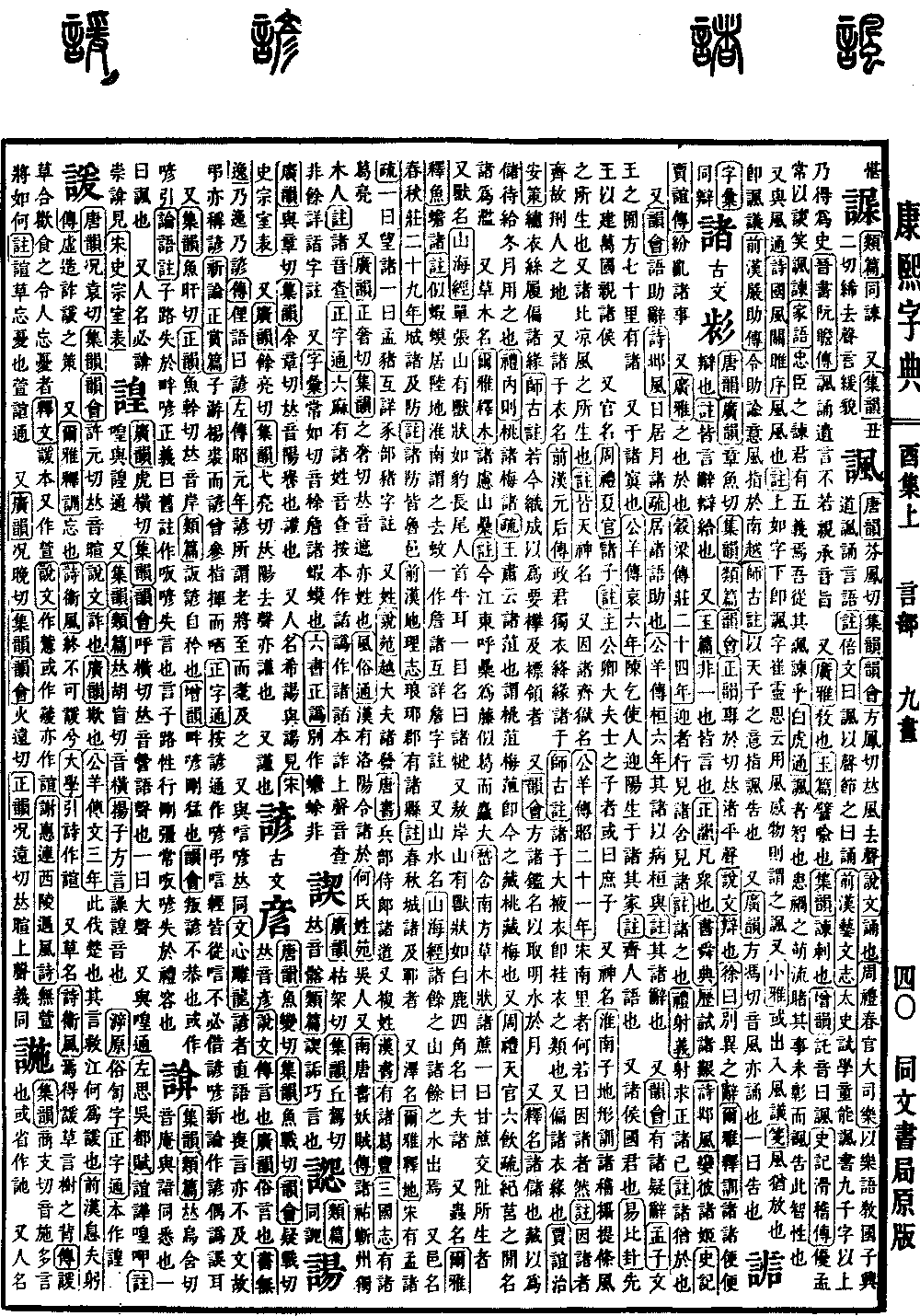
You Collection, Upper Volume
Radical: Words (yán)
Page 1172, Entry 04
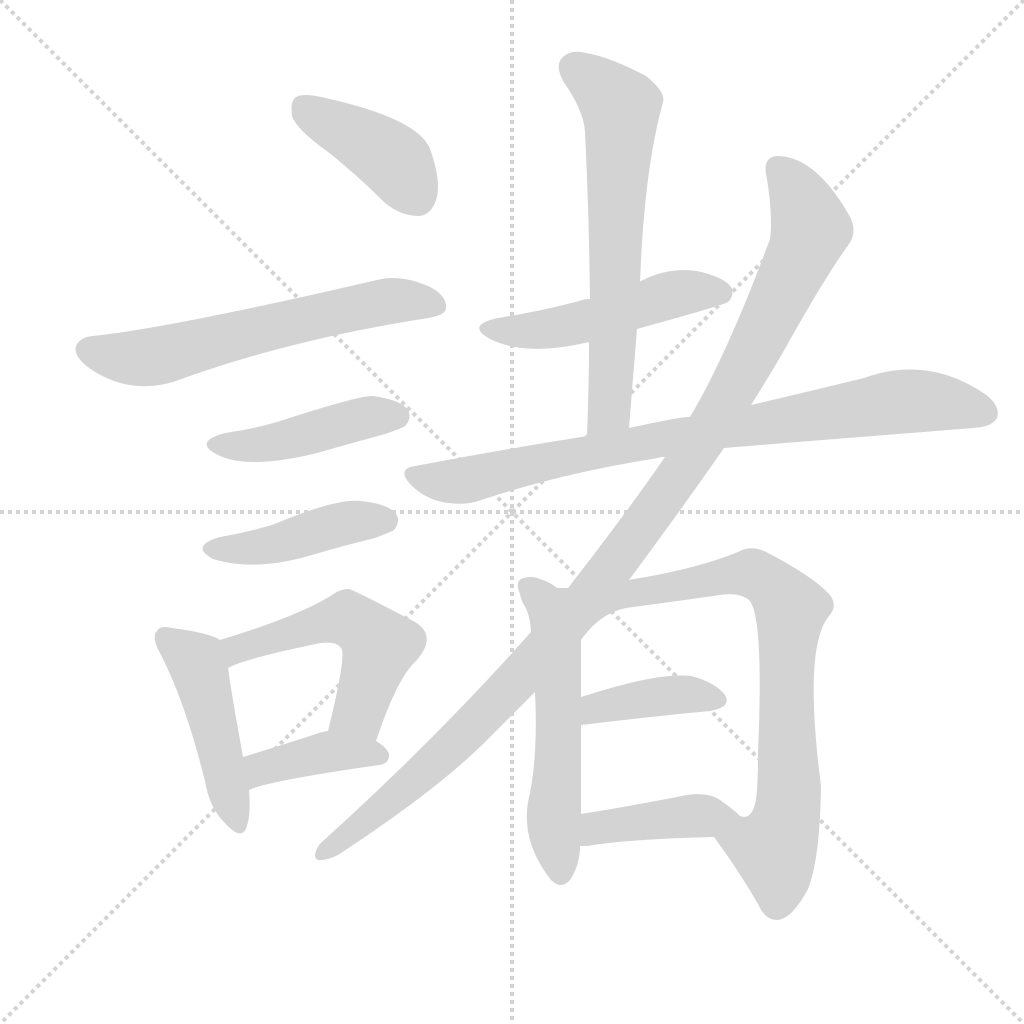
Ancient form. Pronounced zhu (level tone). In the Tang Dynasty Rhyme Dictionary (Tangyun) and the Guangyun, it is pronounced zhang + yu. In the Jiyun, the Leipian, the Yunhui, and the Zhengyun, it is pronounced zhuan + yu. According to the Shuowen Jiezi, it means to argue or debate. Xu Shen notes it is a word indicating distinction. In the Erya (Er Ya: Interpreting Teachings), it says "Zhu zhu, bian bian, means to argue." The commentary notes that both phrases refer to being eloquent in speech.
Additionally, according to the Yupian, it means not just one. It implies many things said. The Zhengyun states it refers to all or many.
In the Book of Documents (Shujing): "Endure all (zhu) difficulties."
In the Book of Odes (Shijing): "How beautiful those various (zhu) ladies (ji)."
In the Records of the Grand Historian (Shiji): "Disturbing all (zhu) affairs."
Also, per the Guangya, it means "at" or "in."
In the Guliang Zhuan (Guliang Commentary): "Those who welcome him will see him there (zhu), and will see him there (zhu) at the lodging." The commentary notes that here, zhu means "at" or "to."
In the Book of Rites (Liji): "In archery, one seeks to correct oneself (zhu)." The commentary notes that here, zhu is equivalent to "at."
Also, per the Yunhui, it is a modal particle.
In the Book of Odes (Shijing): "O sun, o moon (zhu)." The sub-commentary notes that "ju" and "zhu" are modal particles.
In the Gongyang Zhuan (Gongyang Commentary): "Is it perhaps (qi zhu) because of illness that Huan is involved?" The commentary notes that "qi zhu" is a phrase.
Also, per the Yunhui, "you zhu" is an expression of doubt.
In the Mencius: "King Wen's park was seventy square miles; is it true (you zhu)?"
Also, "yu zhu" means to place or deposit.
In the Gongyang Zhuan (Gongyang Commentary): "Qing sent a man to welcome Yang Sheng and place him (yu zhu) in his house." The commentary notes this is dialect from Qi.
Also, "Zhuhou" refers to feudal lords or sovereign rulers.
In the I Ching (Yijing): "The former kings established ten thousand states to draw close to the feudal lords (zhuhou)."
Also, a name of an official post. In the Rites of Zhou (Zhouli): "The Zhuzi (Masters of the Princes)." The commentary notes they are the masters of the sons of dukes, ministers, and grand masters. Some say they are the sons of the nobility.
Also, a name of a deity. In the Huainanzi (Huainan Zi): "The Zhuji, sheti, and tiaofeng are the birthplaces of winds."
Also, Zhubi, the birthplace of cooling winds. The commentary notes these are names of heavenly deities.
Also, Yinzhu is the name of a prison in Qi. In the Gongyang Zhuan (Gongyang Commentary): "What of the southern neighborhood of Song? It is said: It is as the Yinzhu place." The commentary notes that Yinzhu is a place name in Qi.
Also, Zhuyu is a name of a garment. In the History of the Former Han (Qian Han Shu): "Zhengjun alone wore a red-bordered Zhuyu." The Shigu commentary notes that Zhuyu is a large inner robe, similar to a gui garment.
Also, Pianzhu is a border of a garment. In the Jia Yi Biography: "Adorned with embroidered robes, silk shoes, and side-edged (pianzhu) borders." The Shigu commentary notes it is like modern weaving used for waist bands or collar trims.
Also, per the Yunhui, Fangzhu is the name of a mirror used to collect clear water from moonlight.
Also, per the Shiming: Zhu means to store (chu). It is stored as a supply to be used during the winter months.
In the Book of Rites (Liji): "Pickled peaches (tao zhu) and pickled plums (mei zhu)." The sub-commentary citing Wang Su says: Zhu means pickled vegetables, referring to pickled peaches and plums, similar to modern preserved peaches and plums.
Also, in the Rites of Zhou (Zhouli): "Between the Ji and Ju states, the name zhu refers to abuse."
Also, the name of a plant. In the Erya (Er Ya: Interpreting Trees): "Zhulu is a mountain vine." The commentary notes that in Jiangdong, it is called vine, resembling kudzu but coarser and larger.
In the Nanfang Caomu Zhuang: "Zhuzhe is also called sugarcane, growing in Jiaozhi."
Also, the name of a beast. In the Classic of Mountains and Seas (Shanhaijing): "In Shanzhang Mountain there is a beast shaped like a leopard with a long tail, a human face, cow's ears, and one eye, called Zhujian."
Also, in Aogan Mountain there is a beast shaped like a white deer with four horns, called Fuzhu.
Also, the name of an insect. In the Erya (Er Ya: Interpreting Fish): "Chanzhu." The commentary notes it resembles a toad and lives on land; in Huainan it is called qufu. Sometimes written as Zhanzhu.
Also, the name of a mountain and river. In the Classic of Mountains and Seas (Shanhaijing): "The Zhuyu mountain and the Zhuyu river originate there."
Also, the name of a city. In the Spring and Autumn Annals (Chunqiu): "Walled the city of Zhu and Fang." The commentary notes Zhu and Fang are both cities in the state of Lu. In the History of the Former Han (Qian Han Shu): "In Langya Commandery there is a Zhu county."
Also, the name of a marsh. In the Erya (Er Ya: Interpreting Land): "Song has Mengzhu." The sub-commentary says one name is Wangzhu, and another is Mengzhu.
Also, a surname. In the Shuoyuan: "The Yue official Zhu Fa." In the Old Book of Tang (Tangshu): "Vice Minister of the Ministry of War, Zhu Dao."
Also, a compound surname. In the History of the Han (Hanshu): "There was Zhuge Feng." In the Records of the Three Kingdoms (Sanguozhi): "There was Zhuge Liang."
Also, per the Guangyun, pronounced zhe. Also a surname. In the Fengsu Tong (Customs and Traditions): "In the Han Dynasty, there was a Luoyang Magistrate named Zhuyu." In the He Shi Xingyuan (He Family Surname Registry): "They are people of Wu."
Also, in the History of the Southern Tang (Nan Tang Shu): "The rebel Zhu You, a native of Dumu in Qizhou." The commentary notes that Zhu is pronounced cha. In the Zhengzitong: "In the list of surnames, there is the Zhu surname, pronounced cha." It is noted that the original character was written incorrectly as Zhu.
Also, per the Zihui, pronounced tu. Zhanzhu is a toad. In the Liushu Zheng'e: "It is written separately as toad (chanchu), which is incorrect."