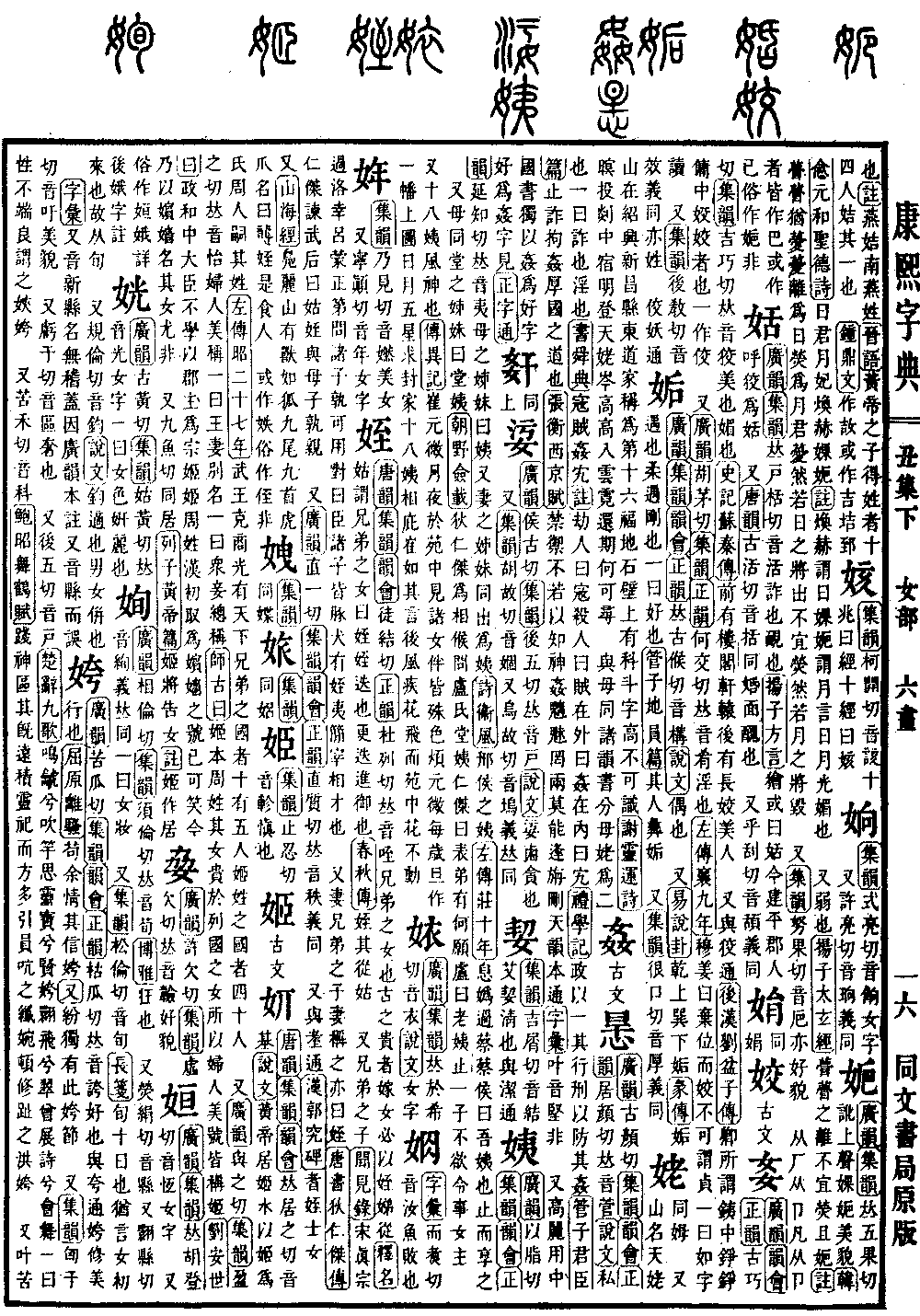
Chou Collection, Lower Volume
Radical: Woman (nǚ)
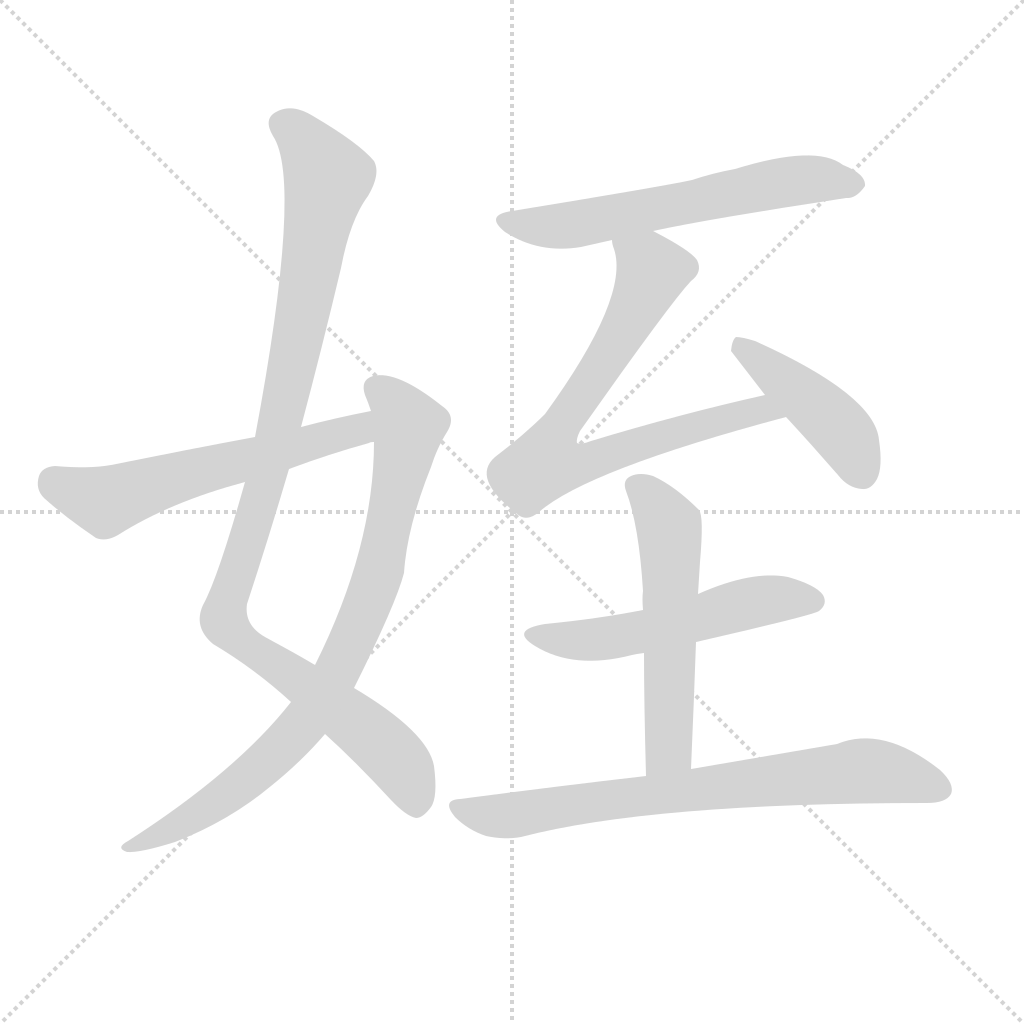
Zhi
Kangxi strokes: 9
Page 260, Entry 19
Pronounced tie. Refers to a brother's daughter. In ancient noble families, when a daughter was married off, she was required to be accompanied by a niece and a younger sister as attendants. Explanation of Names (Shiming) states: A paternal aunt refers to her brother's daughter as zhi. Zhi means to alternate, referring to the rotating service of attending to a ruler. The Spring and Autumn Annals Traditions (Chunqiu Zhuan) records: A niece follows her aunt in marriage. Also refers to a brother's son. Records of Things Heard and Seen (Wenjianlu) states: When Emperor Zhenzong of Song passed through Luoyang, he visited the residence of Lu Mengzheng and asked which of his sons was fit for appointment. Lu Mengzheng replied: My sons are all as useless as swine and dogs, but I have a nephew named Lu Yijian who possesses the talent of a prime minister. Also refers to the wife of one's wife's brother's son; this person is also addressed as zhi. The Biography of Di Renjie in the Book of Tang (Tangshu) records: Di Renjie remonstrated with Wu Zetian, saying: Between the relationship of an aunt and niece and that of a mother and son, which is closer?
Also pronounced zhi. The meaning is the same. It is also interchangeable with the character meaning elderly (die). The Stele of Guo Jiu from the Han Dynasty contains the phrase elderly zhi and refined men and women. Also, the Classic of Mountains and Seas (Shanhaijing) records: On Mount Fuli there is a wild beast that looks like a fox, with nine tails and nine heads, possessing the claws of a tiger; its name is longzhi, and this beast eats humans. Sometimes written in a variant form (yi). The popular form is written as zhi, which is incorrect.